Chore Chart for Roommates (Fair Split, Free Template)
A chore chart for roommates with a fair way to split jobs by effort, a 3-person rotation, a house meeting script and a free printable weekly template.
By Famiyo Editorial Team4 min read
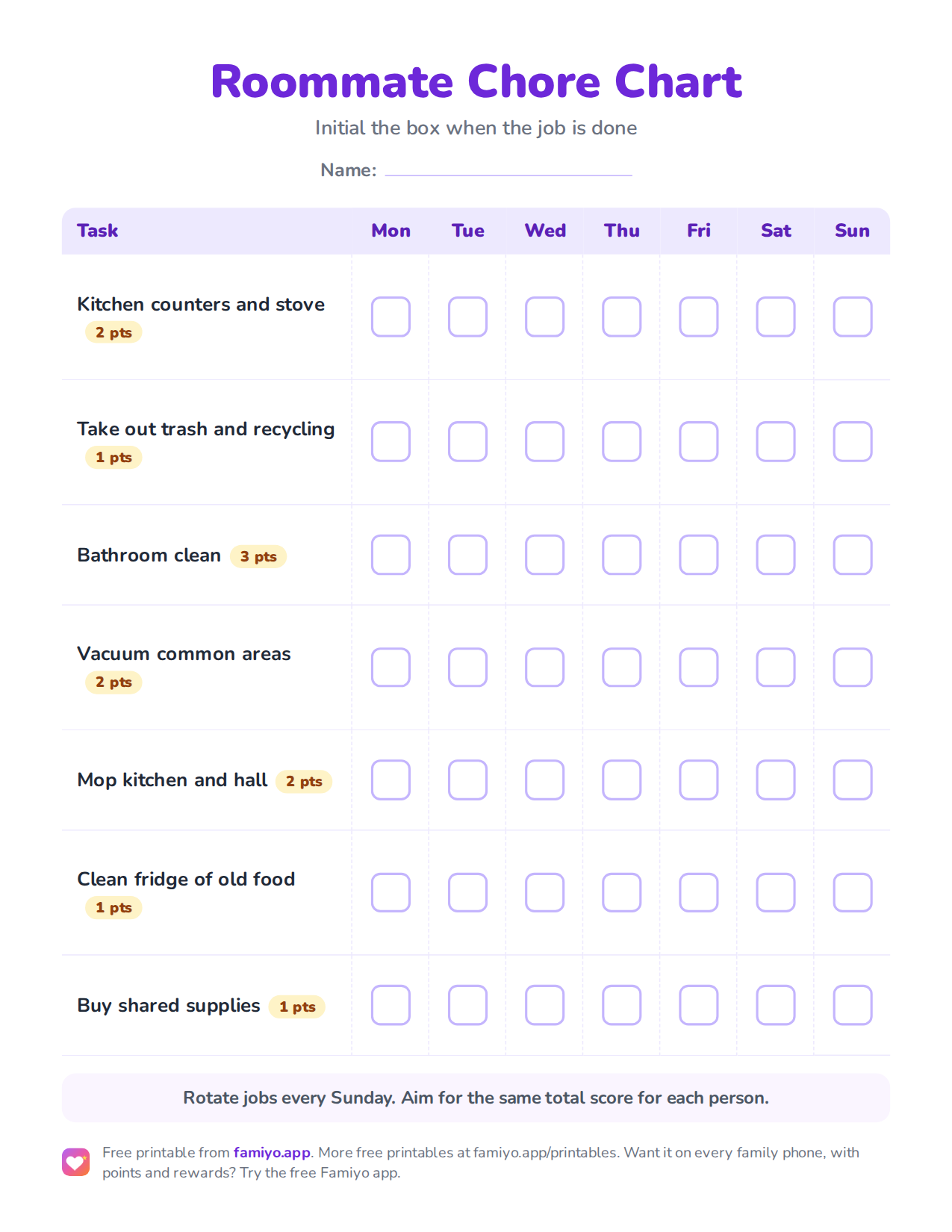
Free printable
Roommate Chore Chart
A weekly chart on one US Letter page. Download the PDF to print it, or save the image to use it on a tablet or in a document.
Free for home, classroom and nonprofit use, see the license. More free printables.
Roommates rarely fall out over one dirty dish. They fall out over the sense that someone is quietly doing more, and no one wants to be the person who counts. A chore chart fixes that by making the count visible before anyone feels the need to keep one. This page gives you a fair way to split the jobs, a rotation you can copy, the words to use at the first house meeting and a free printable.
Start with a list, not a schedule
Before you decide who does what, write down every job that has to happen in the home, however small. Do it together on a single sheet. Most shared homes have the same core list, and it is shorter than people expect.
| Job | How often | Effort (1 to 3) |
|---|---|---|
| Take out trash and recycling | Twice a week | 1 |
| Kitchen counters, stove and sink | Twice a week | 2 |
| Bathroom: toilet, sink, shower | Weekly | 3 |
| Vacuum or sweep common areas | Weekly | 2 |
| Mop kitchen and hall | Every two weeks | 2 |
| Clear old food from the fridge | Weekly | 1 |
| Buy shared supplies | Monthly | 1 |
Effort is a gut score. A 1 takes about five minutes and nobody dreads it, a 3 takes half an hour or is unpleasant. You do not need a precise measurement, because the purpose is a shared agreement that the bathroom counts for more than the trash. The same idea underlies the 5, 10 and 20 point sizes used in family charts.
How to split them fairly
- Add up all effort scores for one week. In the table above, with the trash and kitchen counted twice, and the mop counted as half a job each week, that is about 13 points.
- Divide by the number of roommates. With three people that is about 4 points each.
- Hand out jobs until each person has about 4 points. One person might take the bathroom, another the kitchen and trash, another the vacuuming and fridge.
- Rotate every week, so everyone has the bathroom about once in three weeks.
Rotation matters more than anything else on this list. A fixed assignment for the heavy job builds quiet resentment. A rotation spreads it, and it shows each person what the others actually do.
A three-week rotation
| Week | Roommate A | Roommate B | Roommate C |
|---|---|---|---|
| 1 | Bathroom | Kitchen and trash | Vacuum, fridge, mop |
| 2 | Kitchen and trash | Vacuum, fridge, mop | Bathroom |
| 3 | Vacuum, fridge, mop | Bathroom | Kitchen and trash |
Switch on Sunday so the new week starts clean. If your household has two people, swap the bathroom and the kitchen every week. With four, split the vacuuming and the mopping.
Agree what clean means
Most arguments are about definitions. One person's clean kitchen is a wiped counter, another's is a scrubbed stove. At the house meeting, take each job and write a single line saying what finished looks like: "Counters wiped, stove top wiped, sink empty." Keep it short enough to fit under the chart.
Here are words that help at the meeting:
- "I would like a system that makes it obvious nobody is doing more than their share."
- "What is the minimum you would count as done for the bathroom?"
- "Can we try this for four weeks and then change what is not working?"
When someone drops the ball
Raise it early, in private, and refer to the chart rather than the person. "The kitchen was yours this week and the stove is still dirty" is a statement about a job. "You never clean" is an accusation, and it starts a fight. Ask what got in the way. If a job is too heavy for someone's week, swap it, since the chart exists to keep things fair, not punish. For a similar idea at the other end of the age range, see how the chore chart for adult kids and college students at home handles missed jobs, and the reminder habits that keep a chart from sliding. Some households also add a larger monthly clean, borrowed from our monthly chores idea of bigger jobs on a fixed date.
Running the chart in Famiyo
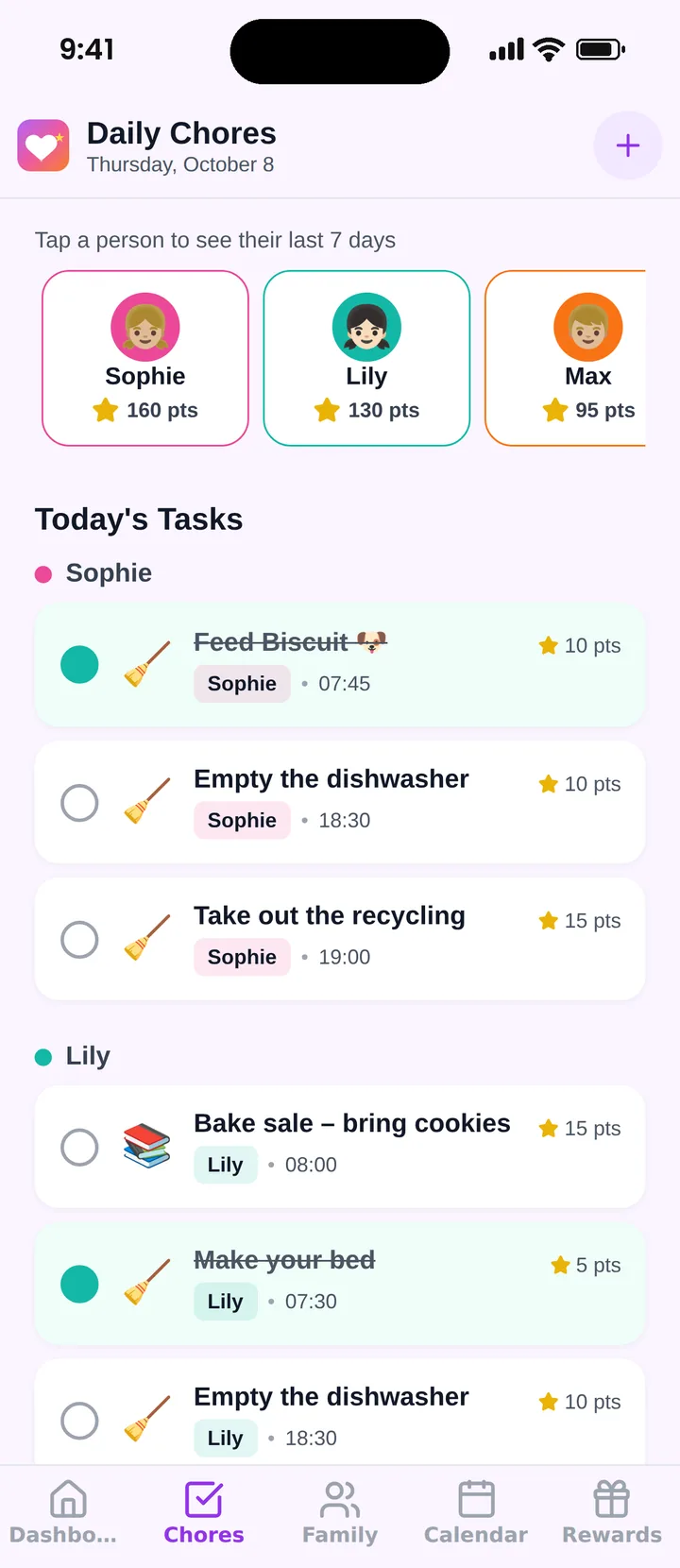
Famiyo is a free family app for iPhone and Android that combines a shared family calendar, chores with points and a rewards shop; kids join with a code, no email needed. It is built for families, but a shared household can use it the same way: everyone joins with a 6-character code, each person gets a color, and repeating chores with points make the effort scores visible. Everyone sees today's jobs on their own phone, and a notification tells you when one is done. The free plan covers 3 members and 1 repeating task; Premium removes the limits. See our ranking of the best chore chart apps if you are comparing.
Hold the house meeting this weekend, fill in the list together and start the rotation on Sunday.
Frequently asked questions
How do roommates split chores fairly?
List all jobs, score each by effort (1 for easy, 3 for heavy), and make sure every person's weekly total is about equal. Then rotate the jobs weekly so nobody is stuck with the bathroom. Fair means equal effort, not an equal count of tasks.
How often should roommates rotate chores?
Weekly works for most households, and it should be on the same day each week, such as Sunday. Rotate every job except any that someone strongly prefers and others don't mind, for example one person who likes cooking and takes extra dinners in exchange for fewer cleaning jobs.
What if one roommate never does their chores?
Talk to them privately and early, using the chart as the reference: 'The kitchen was yours this week and it is still open.' Ask what got in the way. If it keeps happening, agree a swap, such as they pay for a cleaner one month or take two jobs next week.
Should roommates split cleaning supplies?
Yes, and put the supplies on the chart too. One person buys the shared items each month on a rotation, and the others pay the same amount. A shared supplies list on the fridge or in a note prevents the 'we are out of sponges' standoff.
Try Famiyo With Your Family
Chores with points, a rewards shop for kids and one shared family calendar. Set it up in a couple of minutes.



Free to download • No credit card required • Available on iOS & Android