Chore Chart for Teens: Free Printable and Setup Guide
A chore chart for teens that works: a free printable, a sample week, point values and a setup that gives them ownership instead of daily reminders.
By Famiyo Editorial Team5 min read
Free printable
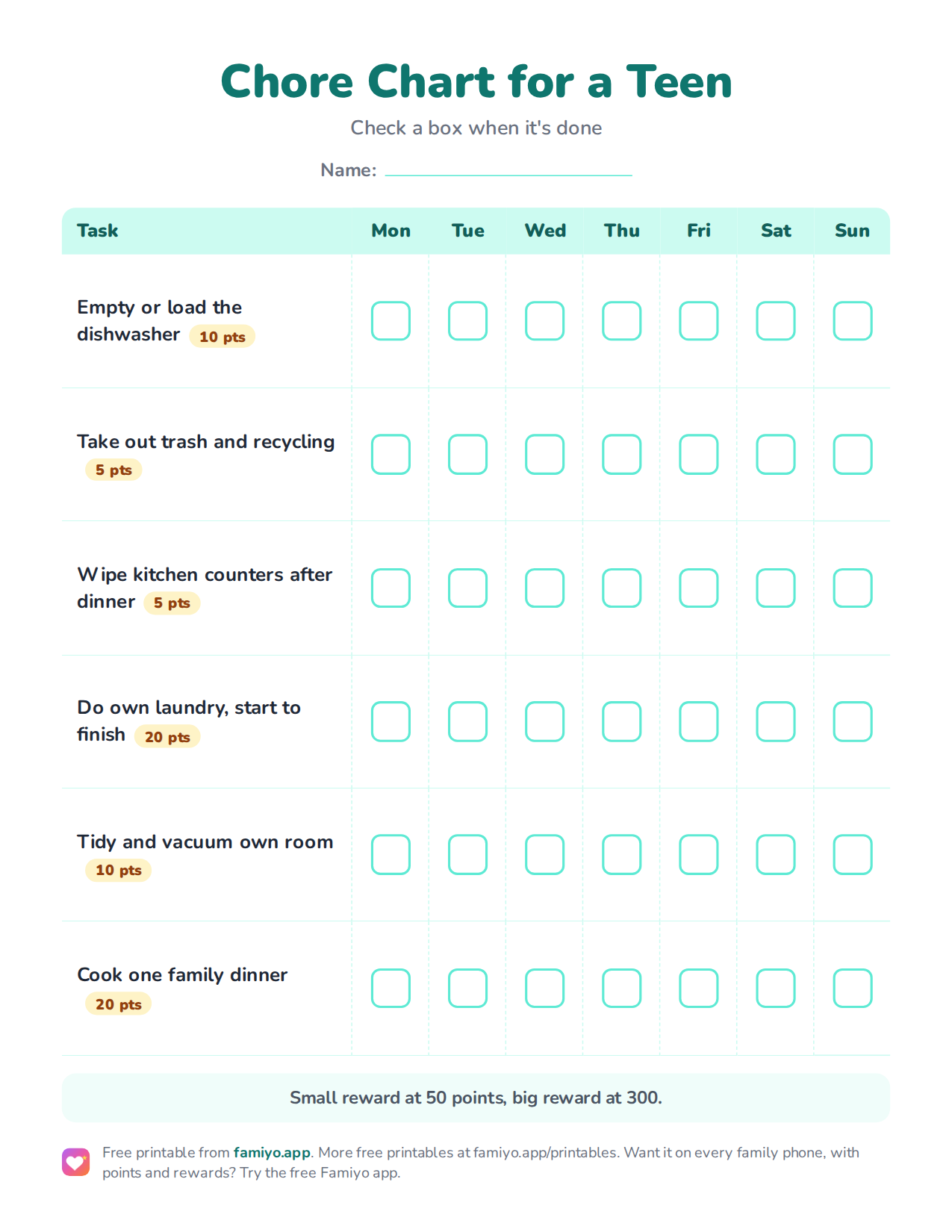
Chore Chart for a Teen
A weekly chart on one US Letter page. Download the PDF to print it, or save the image to use it on a tablet or in a document.
Free for home, classroom and nonprofit use, see the license. More free printables.
Teen chores fail for a boring reason: the chart was designed for a 7-year-old. Gold stars and daily check-ins feel babyish at 14, and a parent hovering over a checkbox turns every job into a standoff. This page gives you a chart built for older kids, with realistic jobs, a sample week, point values and the exact words to use when you set it up.
How a teen chore chart differs from a kid chart
Younger children need a visual prompt for every step. Teenagers need three other things: a say in the plan, a clear deadline, and some privacy about how they get the work done. A chart that gives them those will outperform a prettier one that doesn't.
Build the chart around ownership. Instead of "help with dinner cleanup," a teen owns "kitchen after dinner on Mon, Wed and Fri." Instead of "keep your room tidy," they own "room is vacuumed and the floor is clear by Saturday at noon." The job has an edge, so there is no arguing about whether it counts.
Keep the total honest. For ages 13 and up, 30 to 45 minutes a day is a reasonable ceiling for chores. If your teen also has a part-time job, a sport or heavy homework, aim for the low end. For a fuller list of options by age, see our guide to age-appropriate chores for kids.
What to put on a chore chart for teens
Mix daily upkeep, weekly resets and one skill-building job. The table shows a workable menu with sizes that match the Famiyo default point scale, so you can use it on paper or in an app.
| Job | How often | Time | Points |
|---|---|---|---|
| Take out trash and recycling | 2 to 3 times a week | 5 minutes | 5 |
| Wipe counters and table after dinner | Daily | 5 minutes | 5 |
| Load or empty the dishwasher | Daily | 10 to 15 minutes | 10 |
| Vacuum and tidy own room | Weekly | 15 minutes | 10 |
| Do own laundry start to finish | Weekly | 30 minutes | 20 |
| Cook a family dinner | Weekly | 30 to 60 minutes | 20 |
| Clean the bathroom | Weekly | 30 minutes | 20 |
| Mow the lawn or wash the car | Weekly or monthly | 30 minutes or more | 20 |
| Done without a reminder | Any job | None | +2 |
Not all of these belong on one chart. Pick four to six recurring jobs, then rotate the bigger ones. If a younger sibling is on the chart too, a teen can also earn points for helping them with their own tasks.
A sample week for a 15-year-old
This is a full chart for a teen with school and one after-school activity. Notice how the weekend carries the big jobs and the weekdays stay light.
| Day | Jobs | Points |
|---|---|---|
| Mon | Dishwasher, counters | 15 |
| Tue | Trash and recycling, counters | 10 |
| Wed | Dishwasher, counters | 15 |
| Thu | Laundry start to finish | 20 |
| Fri | Trash and recycling, counters | 10 |
| Sat | Room vacuumed, cook a family dinner | 30 |
| Sun | Free day, bonus +2 per job done without a reminder | 0 to 6 |
That comes to about 100 points a week. With rewards priced as small (30 to 50 points), medium (100 points) and big (300 to 500 points), your teen can afford something small every few days and a larger reward every 3 to 4 weeks. If you convert points to money, 100 points equals $1, which makes the weekly total a symbolic amount. Most families use points for privileges instead.
How to set up the chart with your teen
The setup conversation matters more than the chart design. Do it once, calmly, away from a messy kitchen.
- Pick a neutral time, such as a weekend afternoon. Say: "I want to make chores less of a hassle for both of us. Can we spend 15 minutes on a plan?"
- Show the list of possible jobs and let your teen choose two or three. Teens who pick their own tasks complain less.
- Agree on deadlines, not reminders. "By 8 p.m." is something a teen can manage. "Whenever I ask" is not.
- Decide what counts as done, in one sentence per job. "Dishwasher is empty and the dishes are in the right cupboards."
- Decide the consequence of a missed job before it happens. A common one: the job is done before the phone or the car keys come back.
- Pick a review date, about four weeks out, to change anything that isn't working.
If the conversation stalls, our article on how to get teens to do chores goes deeper on the arguments you may meet.
What to do when a teen stops using the chart
Most teen charts slide around week three. Don't scrap everything. Look at which of three things changed: the list is too long, the deadlines drifted, or the rewards stopped mattering. Fix the one that changed.
Resist the urge to nag about the chart itself. A single calm check-in a week, "How did the week go, anything to swap?", works better than daily prompts. If one job is always missed, trade it for something your teen is willing to do. Ten chores done grudgingly are worth less than five done on time.
Families with several children can use the same structure. Our guide to a chore chart for multiple kids shows how to keep jobs fair across ages.
Running the chart in Famiyo
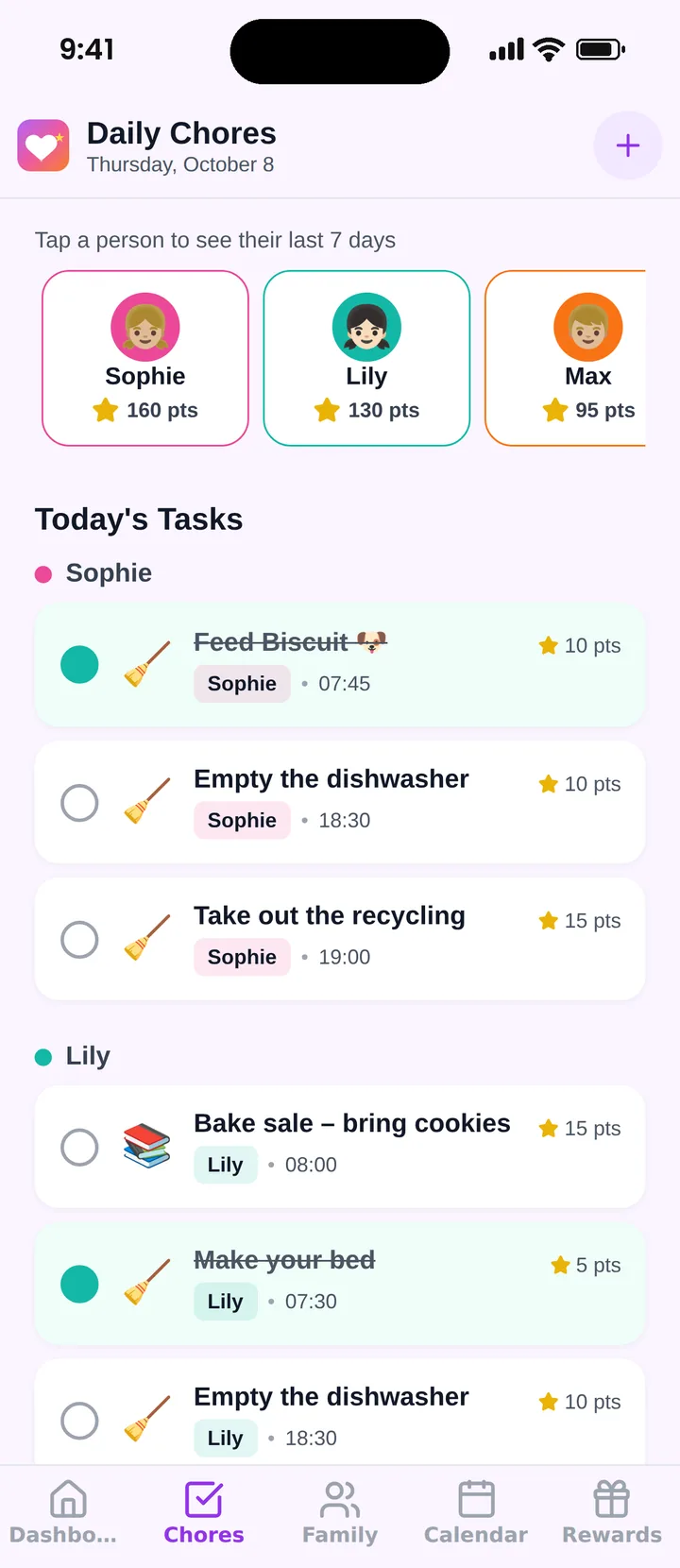
Famiyo is a free family app for iPhone and Android that combines a shared family calendar, chores with points and a rewards shop; kids join with a code, no email needed. For teens it can replace the paper chart: you add each job once, set it to repeat daily, weekly or every few days, and give it points. Your teen gets a notification about new tasks, checks jobs off on their own phone, and you hear when one is done, so there is no need to ask. You decide whether jobs count right away or need your approval. Changes sync live across every phone. See our list of the best chore apps for a wider comparison.
The free printable that comes with this page works the same way if you prefer paper. Print it, hang it where your teen walks past it, and check it together on Sunday evening.
Frequently asked questions
How many chores should a teenager have on a chore chart?
Four to six recurring tasks is plenty, plus one bigger weekly job. Together they should take about 30 to 45 minutes a day. Teens also have homework, sports and sleep to protect, so a longer chart usually backfires.
Should teens get paid for the chores on their chart?
Most families keep the basics unpaid, because they are part of living in the house, and pay only for extra jobs such as washing the car or mowing the lawn. A points system can cover the middle ground.
What if my teen ignores the chore chart?
Check the chart first. Too many tasks, vague deadlines or rules the teen never agreed to are the usual causes. Sit down together, trim the list, agree on what happens when a job is missed, and then follow through calmly.
Is a printable chore chart or an app better for teens?
Teens live on their phones, so an app often gets more attention than paper on the fridge. A printable still works well as a visible weekly plan. Pick whichever your teen will actually look at.
Try Famiyo With Your Family
Chores with points, a rewards shop for kids and one shared family calendar. Set it up in a couple of minutes.



Free to download • No credit card required • Available on iOS & Android