Chore List for Kids to Earn Money: Jobs and What to Pay
A pay-ready chore list for kids to earn money: 30 paid jobs sorted by size, with dollar amounts, point values and rules for keeping basic chores unpaid.
By Famiyo Editorial Team5 min read
A kid who asks "can I earn some money?" is handing you a great teaching moment, and most parents have no ready list of jobs to point at. Below are 30 paid jobs sorted by size, with a fair price and a point value for each, plus the rules that keep the system from turning every chore into a negotiation.
Which chores to pay for, and which to keep free
Start by splitting the house work into two buckets. Unpaid chores are the baseline of living in a family: making your bed, putting dirty clothes in the hamper, clearing your own plate, tidying your own room. Nobody gets paid to be part of the household.
Paid jobs are the extras. If the task is something a family would otherwise hire out or put off, or if it takes real effort beyond the daily routine, it belongs on the paid list. Washing the car is paid. Picking up your own socks is not.
This split also protects you from a common trap. If you pay for everything, a child may reasonably say "how much will you pay me?" before taking out the trash. If you pay for nothing, there is no way for them to earn extra when they want a specific thing. Two buckets handle both. For more on the thinking behind this, see our piece on extra chores kids can do for money.
Pay rates at a glance
These amounts follow the common range of $0.25 to $1 for a small extra job and $2 to $5 for a big one. If you prefer points, a rate of 100 points to $1 keeps things simple.
| Job size | Time | Pay | Points |
|---|---|---|---|
| Quick | 5 minutes | $0.25 | 25 |
| Small | 10 to 15 minutes | $0.50 to $1 | 50 to 100 |
| Medium | 20 to 30 minutes | $1 to $2 | 100 to 200 |
| Big | 45 minutes or more | $2 to $5 | 200 to 500 |
Quick jobs: $0.25 each
Good for younger kids or for a child who wants to earn a little every day.
- Wipe the kitchen table after dinner
- Sort the recycling bin
- Bring in the mail or packages
- Wipe the bathroom mirror
- Match and pair the clean socks
- Water the indoor plants
- Collect the trash from the small bins
- Shake out the doormats
Small jobs: $0.50 to $1
- Sweep the kitchen floor
- Dust the living room shelves
- Clean the inside of the microwave
- Wipe down the fridge shelves
- Wash the dog's bowls and refill them
- Organize the shoe pile by the door
- Wipe the baseboards in one room
- Take the trash and recycling to the curb
Medium jobs: $1 to $2
- Vacuum the stairs
- Clean the bathroom sink and mirror
- Wash and dry a load of towels, then fold them
- Pull weeds from one garden bed
- Clean out the car (trash, crumbs, mats)
- Mop the kitchen floor
- Walk the neighbor's dog, with a parent's okay
Big jobs: $2 to $5
- Wash the car, inside and out
- Rake the yard or shovel the driveway
- Clean the bathroom start to finish
- Organize the garage or basement shelves
- Deep-clean a bedroom closet
- Wash all the windows on one floor
- Mow the lawn, for kids who are old enough and trained
Age matters. A 6-year-old can wipe a table, while a 12-year-old can handle a bathroom. If you want a list organized by age, check our allowance ideas for a 10-year-old and the paid chores pages for each age.
Rules that keep paid chores from going sideways
A list is easy. Keeping the system calm for months takes a few ground rules.
- Set the price before the work starts. "Washing the car is $3" is a deal. "Wash the car and I'll give you something" invites a fight over what something means.
- Define "done." A clear finish line ("the car is clean inside and out and the mats are back") avoids the half-finished job that someone wants full pay for.
- Do the basics first. Paid jobs only count after the unpaid daily tasks are finished.
- Cap the total. Many families limit paid jobs to a few a week or to a set amount, so the extra work stays extra.
- Pay on a fixed day. Friday works for many families. Pay what was earned, in full, on time.
- Allow a redo. If a job is not up to the agreed standard, the child fixes it before payment, with no lecture.
- Let them choose. A menu of jobs gives your child control and often makes them more willing to work.
Money is also a perfect moment to teach saving. A simple split of 50% spend, 40% save and 10% give works for younger kids, and our guide on how to make money as a kid covers ideas beyond the house.
Tracking jobs and payments without a paper chart
A paper chart works until it disappears behind the couch. Some families keep a note on the phone, others use a spreadsheet, and many now use an app that keeps everything in one place. Whatever you choose, it needs to show three things: which jobs are available, who did what, and what has been earned and spent.
If you use points as the middle step, kids earn points for jobs and then choose between spending them on rewards or cashing some in. That also lets you reward non-money things such as a movie night or a later bedtime. For how many points a job should be worth, see our chore point system guide.
Doing it in Famiyo
Famiyo is a free family app for iPhone and Android that combines a shared family calendar, chores with points and a rewards shop; kids join with a code, no email needed. Put each paid job in as a chore worth points, using the table above as your price list. Kids check off the job on their own phone or you approve it, and you get a notification when it is done.
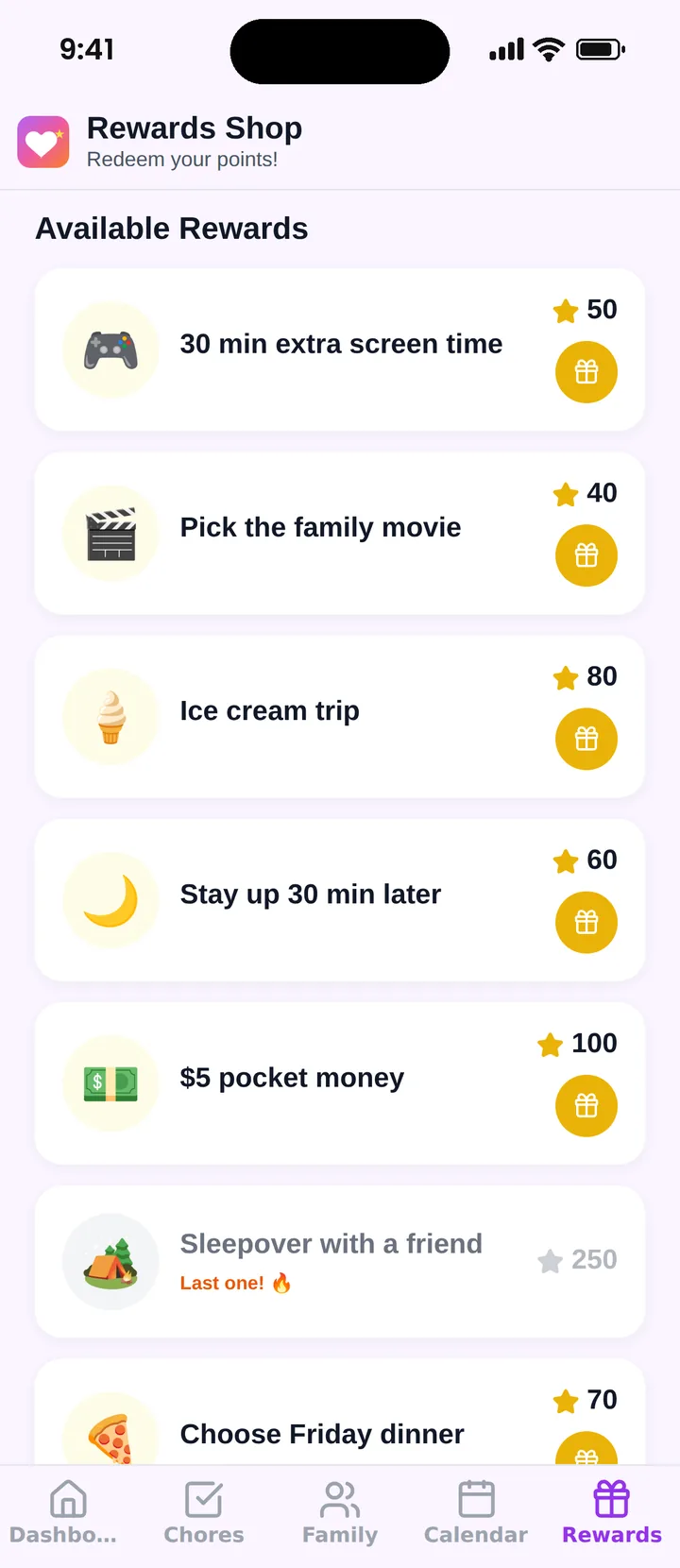
Add "Pocket money, $5" to the rewards shop at 500 points and set how many are available each week. The money itself changes hands outside the app. See our list of the best allowance apps for kids for the options.
Start with five jobs
Do not launch all 30. Choose five that suit your child, write the prices on the fridge or in your app, and run it for two weeks before you add more.
Frequently asked questions
Which chores should kids be paid for?
Pay for extra jobs that go beyond what a family member does anyway: washing the car, raking leaves, cleaning the garage. Keep everyday basics like making the bed, setting the table and tidying a room unpaid, since everyone who lives in the house helps run it.
How much should a kid earn per chore?
A good range is $0.25 to $1 for a small extra job and $2 to $5 for a big one. Price by effort and time, not by age, and settle the amount before the job starts so there is nothing to argue about afterward.
What if my child wants to do paid jobs all day?
Set a cap. Limit paid jobs to a few per week, or a maximum amount per week, and make sure the unpaid basics are done first. Money is a reward for extra effort, not a reason to skip the normal routine.
Can I use points instead of cash?
Yes. Give each job a point value, let kids save points toward rewards, and convert some of them to money if you like. A simple rate is 100 points to $1, which keeps the math easy for both of you.
Try Famiyo With Your Family
Chores with points, a rewards shop for kids and one shared family calendar. Set it up in a couple of minutes.



Free to download • No credit card required • Available on iOS & Android