Paid Chores for 11-Year-Olds: Jobs to Earn Money and What to Pay
Which chores an 11-year-old can do to earn money, what each job is worth, and how to run it with cash or points so it teaches something about money.
By Famiyo Editorial Team6 min read
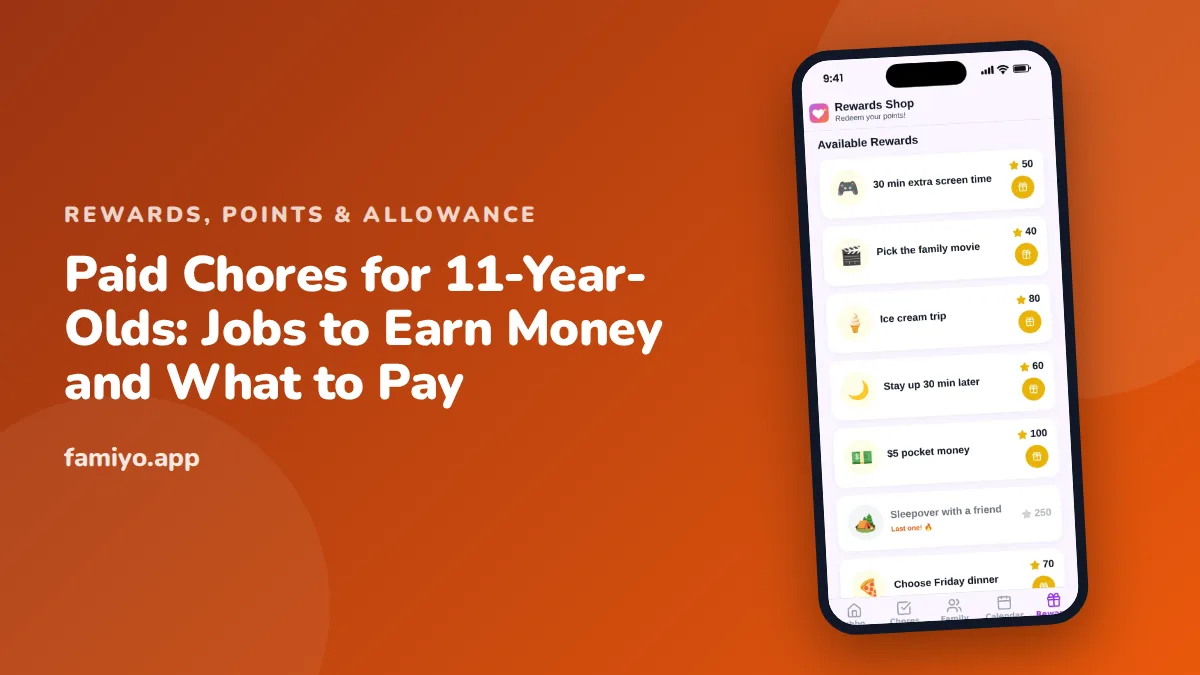
Eleven is a good age to start paying for work. Your child can follow a multi-step job, wants money for things you would not buy, and is old enough to notice that effort and payoff are connected. The trick is deciding which jobs count as extra and which are just part of living in a family.
This guide lists real jobs for an 11-year-old, what each is worth, a sample week of earnings, and how to handle the awkward moments, like a job done badly or a kid who says "no thanks, I have enough money."
What an 11-year-old can actually handle
By 10 to 12, kids can usually spend about 30 minutes a day on household work. They can clean a bathroom sink and toilet, cook a simple meal with an adult nearby, change their sheets and wash the car. That matters for paid work, because the jobs worth paying for are the ones that take real effort and some skill.
Physical ability is rarely the limit at this age. Attention is. An 11-year-old can mow a small lawn but may drift off halfway through, so the best paid jobs have a clear finish line you can check: "the whole car is washed, windows included."
Free jobs and paid jobs: where to draw the line
Start by listing what every family member does because they live there. Those jobs stay unpaid. Then list the extras, the jobs that take 15 minutes or more, don't happen daily, and that you might otherwise pay someone to do or simply do yourself.
| Unpaid (part of being in the family) | Paid (extra jobs) |
|---|---|
| Make the bed | Wash the car, inside and out |
| Tidy their own room | Mow the lawn |
| Clear their own dishes | Rake leaves or shovel snow |
| Put dirty clothes in the hamper | Deep-clean the bathroom |
| Help set and clear the table | Wash windows |
| Feed the family pet | Organize the garage or a closet |
Some families pay a flat weekly allowance for the unpaid list and treat paid jobs as bonuses. Others pay nothing for baseline chores and let kids earn everything through extras. Both are fine. What fails is paying for everything: the child starts asking "how much?" before taking out the trash, and you have no jobs left that you can ask for as a favor.
Jobs and what to pay
Use $0.25 to $1 for a small extra job and $2 to $5 for a big one. The numbers below sit inside that range, and you should adjust for your area and your budget.
| Job | Time | Pay |
|---|---|---|
| Wipe down kitchen cabinets and appliances | 15 minutes | $1 |
| Vacuum the whole downstairs | 20 minutes | $1 |
| Sweep and rinse the porch or patio | 15 minutes | $1 |
| Clean the bathroom (sink, toilet, mirror, floor) | 30 minutes | $3 |
| Wash and vacuum the car | 45 minutes | $4 |
| Rake the front yard | 45 minutes | $4 |
| Mow a small lawn | 45 to 60 minutes | $5 |
| Organize a closet or the garage shelf | 60 minutes | $5 |
| Pull weeds from a garden bed | 30 minutes | $2 |
| Walk a neighbor's dog (adult knows the plan) | 20 minutes | Set by the neighbor |
If the pay feels low per hour, that's normal. You are paying for the lesson and the habit, not trying to match a market wage. You can charge a bit more for jobs your child dislikes, which also teaches that unpleasant work usually pays better.
A sample week of earning
Say your 11-year-old gets no allowance and earns everything. A realistic week might look like this.
- Saturday morning: wash the car, $4.
- Saturday afternoon: rake the front yard, $4.
- Wednesday after school: wipe down kitchen cabinets, $1.
- Thursday: pull weeds in the garden bed, $2.
- Sunday: clean the bathroom, $3.
That adds up to $14, which fits inside the typical $10 to $15 weekly range for ages 11 to 13. A child who skips the big jobs earns less, and that is the point. It is useful for them to see that the number follows the effort.
How to keep it from turning into haggling
A few rules prevent most arguments.
- Agree on the job and the price before the work starts, never after.
- Define done. "The car is clean" is vague. "Outside washed, windows wiped, floor mats shaken, inside vacuumed" is not.
- Pay on the day, or on a fixed day each week. Waiting until "when I get to the ATM" teaches that promises are optional.
- If the work isn't up to standard, ask for a fix before paying. Say, "The wheels still have mud. Finish those and the $4 is yours."
- Let them say no. A kid who turns down a job is learning that money is a trade, and that trade goes both ways.
If your child tries to negotiate, treat it as a good sign. Counter once, calmly, and move on. Something like, "I can do $3 for the bathroom. Is that a yes?"
What to do with the money they earn
Earning is half the lesson. The other half is what happens next. At 11, a split between spend, save and give works well: for example 50% to spend, 40% to save and 10% to give. Put the three amounts in separate jars or envelopes so the split is visible.
Saving goals do a lot of the work. If they want a $60 game, show how many weeks of Saturday jobs that takes. Our guide to kids saving money covers goals and matching deposits, and how to teach kids about money goes further into spending decisions. For a broader pay scale that works for all ages, see how much to pay kids for chores.
Using points instead of cash
Some 11-year-olds don't care much about cash but care a great deal about screen time, a friend sleepover or a pick of the dinner menu. Points handle that. The default suggestion is 5 points for a small task, 10 for a medium one and 20 for a big one, with 2 bonus points if it's done without a reminder. If you want to convert to money, 100 points equals $1, so a 20-point job would be worth $0.20 and a $4 car wash would be 400 points.
Many families do a mix: points for everyday jobs that can buy small rewards, and cash for the big seasonal ones like raking leaves or washing the car.
Running paid chores in Famiyo
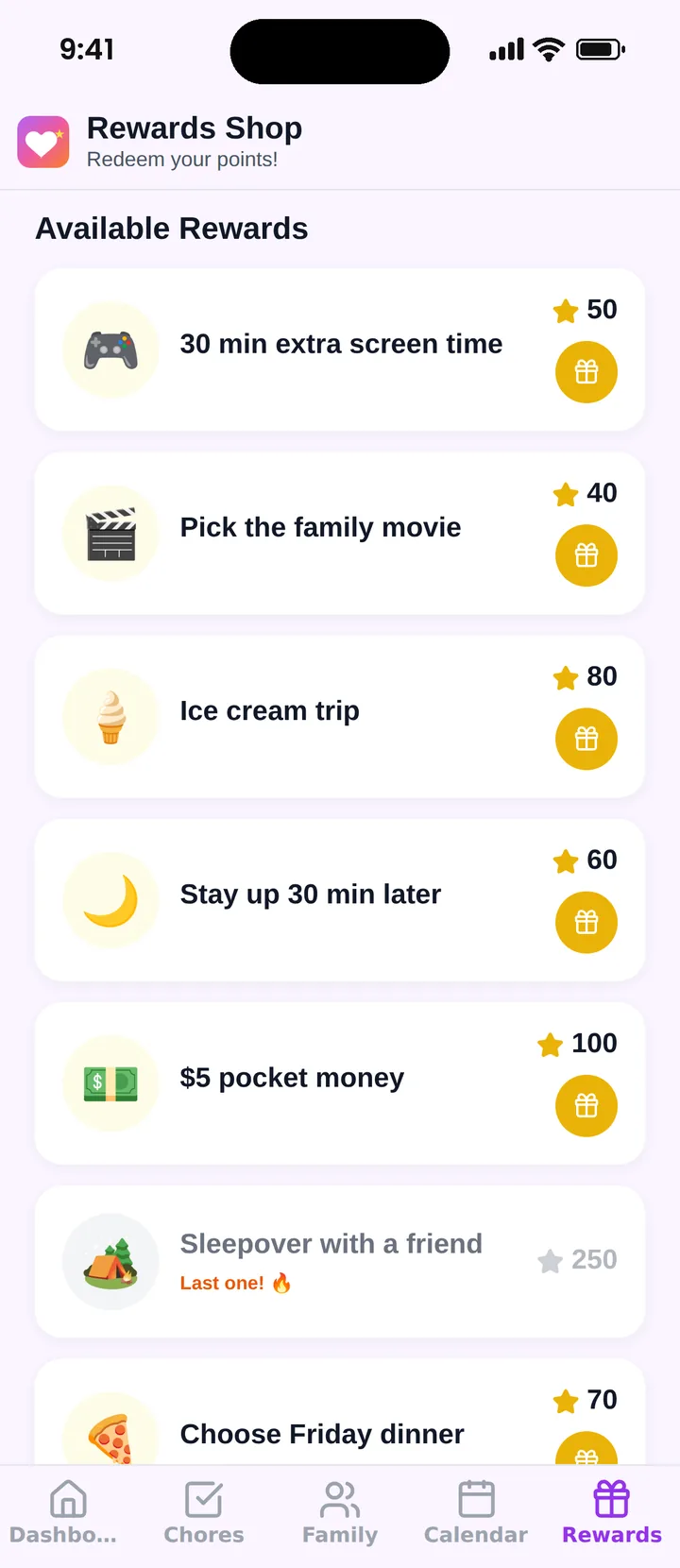
Famiyo is a free family app for iPhone and Android that combines a shared family calendar, chores with points and a rewards shop; kids join with a code, no email needed. You can set a chore's points per child, so your 11-year-old and your 7-year-old can earn different amounts for the same task. In the rewards shop, you create rewards with a price in points, such as a screen-time slot or a cash payout of $5 for 500 points. Kids redeem from their own phone and see how many points they will have left. Famiyo doesn't hold or move money, so you hand over the cash yourself when a reward is redeemed. See how it compares in our list of the best allowance apps for kids.
When your child turns 12
Twelve brings bigger jobs, more independence and often a first real interest in earning from neighbors. When your 11-year-old gets there, see our guide to paid chores for 12-year-olds. Until then, pick two paid jobs this weekend, agree on prices out loud, and let them keep the first payment in their hand.
Frequently asked questions
How much should an 11-year-old earn from chores?
Most families land between $10 and $15 a week in total for this age, counting any allowance. If you pay only for extra jobs, small ones run $0.25 to $1 and big ones $2 to $5, so a couple of big jobs a week gets close to that range.
Which chores should an 11-year-old do for free?
Anything that comes with living in the house: making the bed, tidying their room, clearing their own dishes, putting laundry in the hamper and helping with dinner cleanup. Pay is for extra work that you would otherwise do yourself or hire out.
What are good ways for an 11-year-old to earn money outside the home?
At 11, think small and close to home: walking a neighbor's dog, watering plants while someone travels, helping with a yard sale, or raking leaves for a relative. An adult should always know where they are and who they are working for.
Should I pay in cash or points?
Either works. Cash is concrete and good for learning to save. Points let the child choose between money, screen time and treats, which suits kids who care about more than cash. You can also convert at 100 points to $1.
Try Famiyo With Your Family
Chores with points, a rewards shop for kids and one shared family calendar. Set it up in a couple of minutes.



Free to download • No credit card required • Available on iOS & Android