Chore List for Multiple Kids: One Plan for Every Age
A chore list for multiple kids of different ages: shared jobs, age-matched solo jobs, a sample week for a 5-, 9- and 14-year-old, and how to keep it fair.
By Famiyo Editorial Team5 min read

Two kids is manageable. Three or four, with ages from 4 to 15, and the chore chart turns into a spreadsheet nobody wants to read. This page is a working plan you can copy: three layers of jobs, a master list sorted by age, a sample week for three kids and the fairness rules that stop most of the arguing.
Three layers that keep it fair
The list stays simple when you sort jobs into three groups.
- Personal jobs. Each child owns these every day: make the bed, dirty clothes in the hamper, clear their own plate, pack their bag. They never rotate.
- Shared jobs. The household chores that belong to everybody: dishes, setting the table, trash, wiping counters, sweeping. These rotate weekly so nobody is permanently on dishes.
- One bigger weekly job. A 20 to 30 minute task matched to age, like vacuuming a room or cleaning a bathroom sink. Add one from age 8.
Personal jobs teach independence. Shared jobs teach that a house is run by everyone. The weekly job gives older kids something to own. If you only use one layer, kids compare constantly. With three, the comparison tends to get quieter, because each kid can see that everyone has a bit of each.
For a broader menu of jobs, see our master chore list for kids.
The master list by age
Use this as a menu. Pick from the age row for each child. The time column is the total for the day, taken from the usual ranges for each age.
| Age | Personal daily jobs | Shared jobs they can take | Weekly job | Time per day |
|---|---|---|---|---|
| 2 to 3 | Toys in the bin, clothes in the hamper | Wipe up spills, help feed the pet | None | 5 to 10 minutes |
| 4 to 5 | Make the bed (roughly), clear their own place | Set the table, water plants, feed the pet | Match socks | 10 to 15 minutes |
| 6 to 7 | Pack the school bag, tidy their room | Sweep, empty unbreakable dishes from the dishwasher | Sort laundry by color | 15 to 20 minutes |
| 8 to 9 | Make the bed, tidy room, homework station | Load the dishwasher, take out the trash, make a simple snack | Vacuum one room, fold laundry | 20 to 30 minutes |
| 10 to 12 | Room reset, own towels | Dishes, wipe counters, help cook | Clean bathroom sink and toilet, change bed sheets | About 30 minutes |
| 13 and up | Own laundry start to finish | Cook a family meal, take out trash, shop from a list | Mow the lawn, deep clean the kitchen | 30 to 45 minutes |
The rule of thumb is 2 to 3 daily tasks for preschoolers and 3 to 4 for school-age kids, with a weekly "big" job from age 8. Don't load all of it at once. Start with the personal layer, add shared jobs after two weeks.
A sample week for a 5-, 9- and 14-year-old
Here's one household with three kids, so you can see the layers working together. The shared jobs rotate each week; this is week one.
| Child | Every day | Shared job this week | Weekly job |
|---|---|---|---|
| Maya, 5 | Make the bed, clear her plate, toys in the bin | Set the table | Water the plants on Saturday |
| Noah, 9 | Make the bed, tidy room, pack bag | Load the dishwasher | Vacuum the living room on Saturday |
| Ella, 14 | Own laundry on her day, room reset | Cook dinner on Tue and Thu | Clean the bathroom on Sunday |
Next week, the shared jobs shift: Maya clears the table and wipes it, Noah takes out the trash, and Ella handles the dishwasher. The mealtime job always matches ability. Whoever is 5 does the easy end of the shared job, so there's always a role for each child, even if it's not the same role.
Fairness rules that stop the arguments
These are the points that come up in almost every household with more than one kid.
- Count minutes, not tasks. One bathroom clean is not the same as one sock match. Aim for each child's list to take about the time that fits their age.
- Younger kids do the small version, not nothing. A 4-year-old can bring the napkins while the 10-year-old sets the plates.
- Fix the rotation day and write it down. Sunday evening works for most families.
- Allow one swap. If two siblings agree to trade a job, let them, as long as it gets done.
- Don't let the fast child become the default. If the 12-year-old always ends up doing everyone's leftovers, resentment builds quickly.
- Keep one place for the list, so no child can say they didn't know.
If disputes continue, it's worth reading our rules for chore charts that actually work, which cover why charts fail and how to fix them. If you prefer a visual format for the fridge, our chore chart ideas show 25 layouts to pick from.
Points, so each child competes with their own list
With several kids, a ranking between them backfires. Better to let each child earn against their own list. A common default is 5 points for a small job (2 to 5 minutes), 10 for a medium one (10 to 15 minutes) and 20 for a big one (30 minutes or more), with a bonus of 2 for doing it without a reminder. Each child can have a different point value for the same task, so a younger child doesn't feel behind. Rewards sit on a shared menu, such as 15 extra minutes of screen time at 30 to 50 points or a family movie pick at 100.
Replacing the paper chart with Famiyo
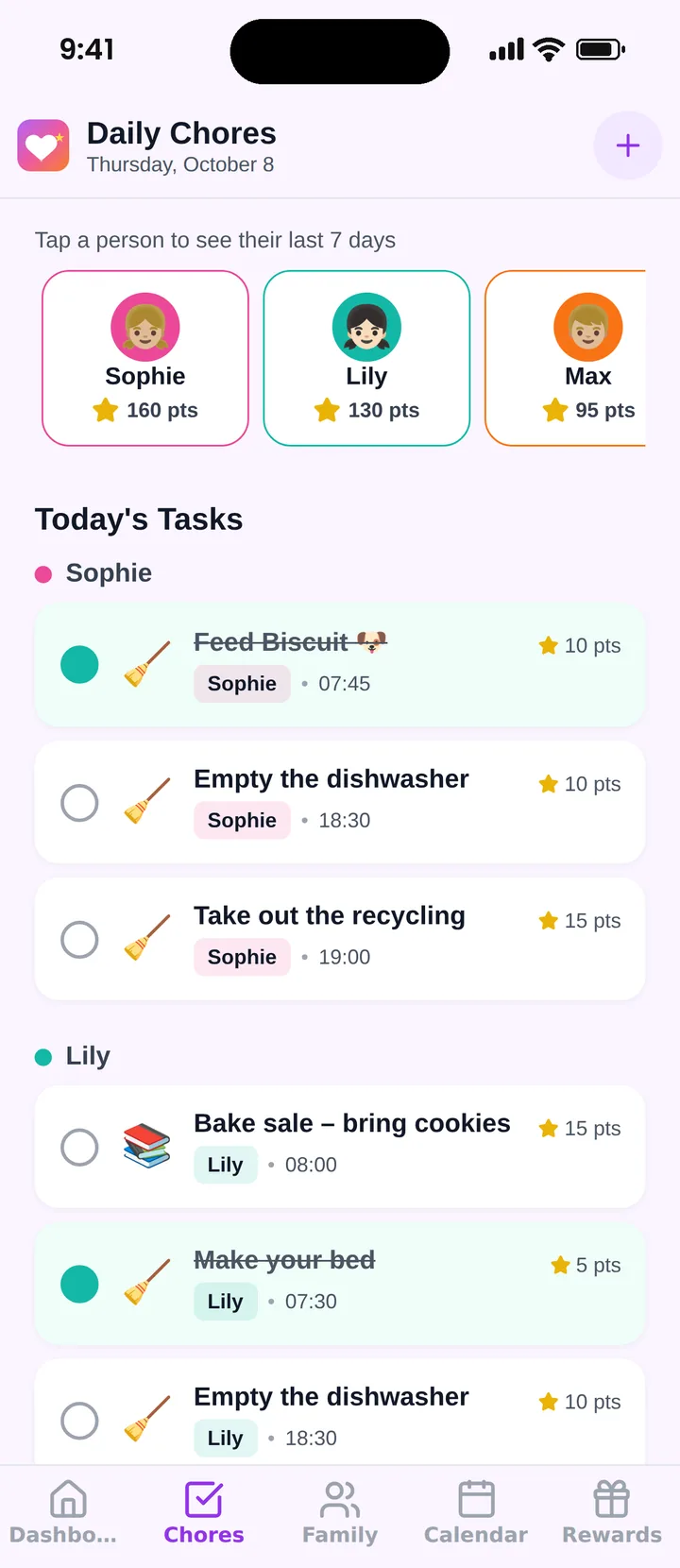
Famiyo is a free family app for iPhone and Android that combines a shared family calendar, chores with points and a rewards shop; kids join with a code, no email needed. It does the job of the chart for several kids at once. You add each chore, set it to repeat, pick who does it and how many points it's worth. Every child sees their own list on their own phone and hears about new tasks with a notification. You see everyone's day on one screen, with points earned so far, and all phones stay in sync live. The free plan covers up to 3 family members and 1 repeating task, and Premium removes the limits for bigger families. See our list of the best chore chart apps to compare options.
This weekend, pick the personal jobs for each child and write the first rotation on one sheet of paper. Ten minutes is plenty.
Frequently asked questions
How many chores should each child have?
A good starting point is 2 to 3 daily tasks for preschoolers and 3 to 4 for school-age kids, with one bigger weekly job from age 8. Total time runs from about 10 minutes a day at age 4 or 5 to 30 to 45 minutes for teens.
Should siblings of different ages have the same chores?
Not the same jobs, but the same fairness. Give each child tasks that fit their age, and let younger kids do the easy version of a shared job. A 5-year-old sets the table while a 14-year-old loads the dishwasher. Everyone has a job at every meal.
How do I rotate chores between siblings?
Pick a day, such as Sunday evening, and move each shared job one step down the line. Keep personal jobs fixed and rotate only the shared ones. Write the rotation down so it isn't up for debate, and skip a rotation when a child can't do the job yet.
What if one child finishes quickly and others take forever?
Judge each child by their own list, not by speed. When a child finishes early, they're free. If it feels lopsided, check the time estimates rather than the child. A faster worker doesn't get extra jobs as a penalty.
Try Famiyo With Your Family
Chores with points, a rewards shop for kids and one shared family calendar. Set it up in a couple of minutes.



Free to download • No credit card required • Available on iOS & Android