Chore List for Kids: The Master List by Room and Age
A master chore list for kids, sorted by room with the youngest age that can do each job, plus how to pick a few, split them fairly and turn them into a chart.
By Famiyo Editorial Team5 min read
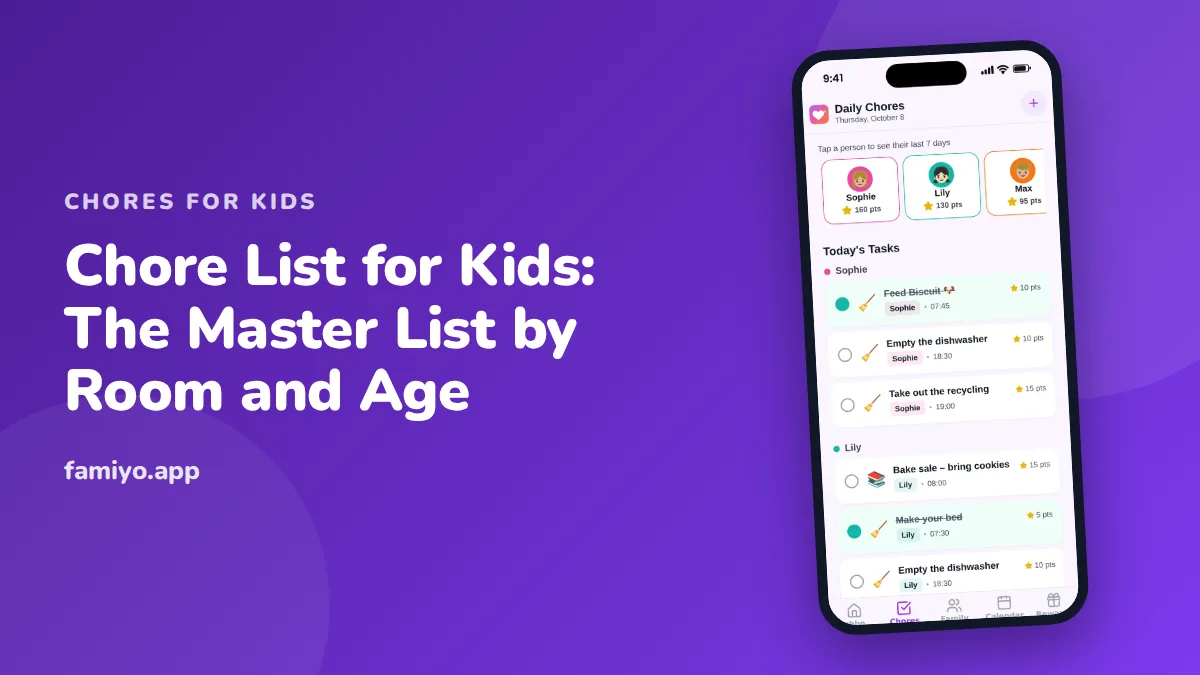
Most chore lists fail for one of two reasons. They are too long, so everyone quits by Thursday, or they are too vague, so "clean your room" means something different to a parent and a child. A good list is short, specific and matched to the age of the person holding it.
Below is a master list you can pull from, organized by room, with the youngest age that can usually do each job. Use it to build a list for one child or several, and then turn it into something that lives on a fridge or a phone.
How to use this list
Read through, circle a few, and stop. That is the whole method. A few reminders before the lists:
- Two or three daily jobs for preschoolers, three or four for school-age kids. Add one weekly bigger job from age 8.
- Write each job as one action a child can see: "Put dirty clothes in the hamper," not "Be tidy."
- The ages are the earliest typical start with some help. Your child may be ahead or behind, and either is fine.
- Younger jobs stay on the list as kids grow. A 10-year-old still puts clothes in the hamper.
Bedroom and personal jobs
These belong to the child and affect their own space. They are the best first jobs.
| Job | From age |
|---|---|
| Put toys in a bin | 2 |
| Put dirty clothes in the hamper | 2 |
| Make the bed (roughly) | 4 |
| Match socks | 4 |
| Pick up clothes from the floor | 4 |
| Pack the school bag | 6 |
| Tidy the room, including desk and shelves | 6 |
| Put away clean laundry | 7 |
| Change bed sheets | 10 |
| Do their own laundry start to finish | 13 |
Kitchen and meals
| Job | From age |
|---|---|
| Help feed a pet (scoop dry food) | 2 |
| Wipe up spills | 3 |
| Set their own place at the table | 4 |
| Clear their own plate | 4 |
| Empty unbreakable dishes from the dishwasher | 6 |
| Wipe the table after meals | 6 |
| Load the dishwasher | 8 |
| Make a simple snack | 8 |
| Pack a lunch | 9 |
| Cook a simple meal with an adult nearby | 10 |
| Cook a family meal | 13 |
Living areas and the rest of the house
| Job | From age |
|---|---|
| Put shoes and backpack where they belong | 3 |
| Water plants | 4 |
| Sweep a floor | 6 |
| Dust low surfaces | 6 |
| Take out the trash | 8 |
| Vacuum one room | 8 |
| Fold laundry | 8 |
| Clean the bathroom sink and toilet | 10 |
| Wipe windows and mirrors | 10 |
| Wash the car | 10 |
| Mow the lawn | 13 |
| Shop from a list | 13 |
| Help with younger siblings | 13 |
For a deeper look at how rooms and ages combine, our companion piece on kids' responsibility lists takes a different approach, organized by life skill.
Seasonal and weekly extras
Daily jobs keep the house running. A few bigger ones can sit on the list once a week or once a month, from about age 8, so a child has something to look forward to finishing.
| Job | From age | How often |
|---|---|---|
| Vacuum one room | 8 | Weekly |
| Clean out the car | 8 | Monthly |
| Wipe the bathroom sink and mirror | 8 | Weekly |
| Rake leaves | 8 | Seasonal |
| Clean the bathroom, toilet included | 10 | Weekly |
| Change the bed sheets | 10 | Weekly |
| Wash the car | 10 | Monthly |
| Sweep and tidy the garage | 12 | Monthly |
Weekly jobs work best when they have a fixed day. "Saturday morning" beats "this weekend" every time.
Building a list for one child
Here are three sample lists, each short enough to survive.
A 5-year-old: make the bed, put dirty clothes in the hamper, set the table. About 10 to 15 minutes.
A 9-year-old: make the bed, clear their own plate, tidy their room, take out the trash, plus one weekly job such as vacuuming one room. About 20 to 30 minutes a day.
A 13-year-old: make the bed, do their own laundry once a week, load or empty the dishwasher, cook one family dinner a week. About 30 to 45 minutes.
When you draft one, add a column for when each job happens. "Before breakfast," "after school," "Saturday morning." A time anchors the job to something that already happens, which is the main reason a list turns into a habit.
Making the list fair with more than one child
If you have several kids, the common worry is that someone is doing more. A few fixes:
- Match effort, not task type. A 6-year-old's 10 minutes and a 12-year-old's 30 minutes can both be fair.
- Rotate the disliked jobs weekly.
- Let each child pick one job they like.
- Put everything in one place so everyone sees the same board.
We go further on this in chore lists for multiple kids.
When a list stops working
Lists wear out. Around week three, the novelty goes and a few jobs start slipping. That is normal, not a sign that your child is difficult. Before adding rules, check three things.
First, is the list too long? Cut one job. Second, is the timing wrong? A job set for the busiest part of the evening will lose to homework every time, so move it. Third, is the job clear? If your child is unsure what done looks like, describe it in a sentence they can check themselves. "Dishes in the dishwasher, counter wiped" beats "clean up the kitchen."
Then give it two more weeks before changing anything else. Habits need that long.
From list to chart
A list is a plan. A chart is how you see whether the plan is happening. Once you have chosen the jobs, you need a place where each child can see theirs and mark progress. Paper and magnets work. Whiteboards work. There are plenty of formats to try, and our collection of chore chart ideas for kids shows 25 of them.
One thing that makes any chart last: a link between finished jobs and something the child cares about. That can be points toward a reward, a weekend privilege, or just a visible streak. A chart nobody responds to fades within a couple of weeks.
Putting the list in Famiyo
Famiyo is a free family app for iPhone and Android that combines a shared family calendar, chores with points and a rewards shop; kids join with a code, no email needed. It can replace the paper chart. You add each job, choose who does it and how many points it is worth, and set it to repeat daily, weekly or every few days. Kids get a notification when a new task lands, check off their own jobs on their own phone, or wait for a parent to approve, as you choose.
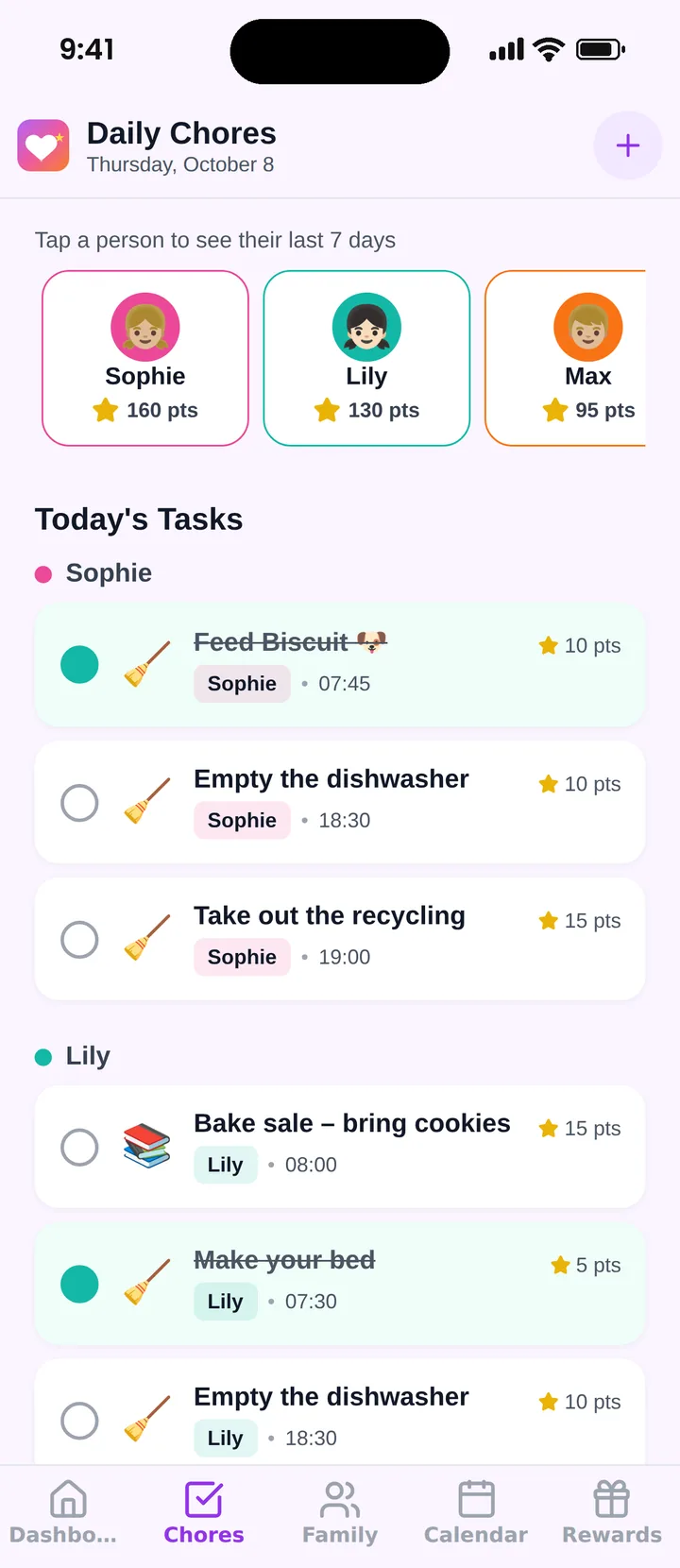
Everything stays in sync between phones, so a job done at 4 p.m. shows up for you straight away. The free plan includes 1 repeating task and up to 3 family members. For other options, see our list of the best chore chart apps.
Choose three jobs from the tables, write them down tonight, and keep the list that short for two weeks.
Frequently asked questions
How many chores should be on a kids' chore list?
Two or three daily jobs for preschoolers, three or four for school-age kids, plus one bigger weekly job from age 8. A list longer than that tends to collapse within a week or two, so start small and add one job at a time.
What is the best way to turn a chore list into a chart?
Choose the jobs, write each as a single action, give each one a day or time, and put the result where the child sees it daily. Paper on the fridge works, and so does a shared app. What matters is that it is visible and that checking off is easy.
Should every child get the same chores?
Not exactly. Match jobs to ability, so a 5-year-old and a 12-year-old do different things. Rotate the unpopular ones, like bathroom or trash, so no child is stuck with them for good. Fair means fair effort for each age, not identical tasks.
How do I choose which chores to start with?
Start with jobs your child can already do with little help and that affect their own space: bed, clothes, dishes from their meal. Add shared household jobs after those become routine, usually in 2 to 3 weeks.
Try Famiyo With Your Family
Chores with points, a rewards shop for kids and one shared family calendar. Set it up in a couple of minutes.



Free to download • No credit card required • Available on iOS & Android