Chores and Allowance by Age: One Chart
One chart of chores and allowance by age, from 2 to 14+: what each age can do, time per day, typical weekly amounts and a free printable to hang up.
By Famiyo Editorial Team4 min read
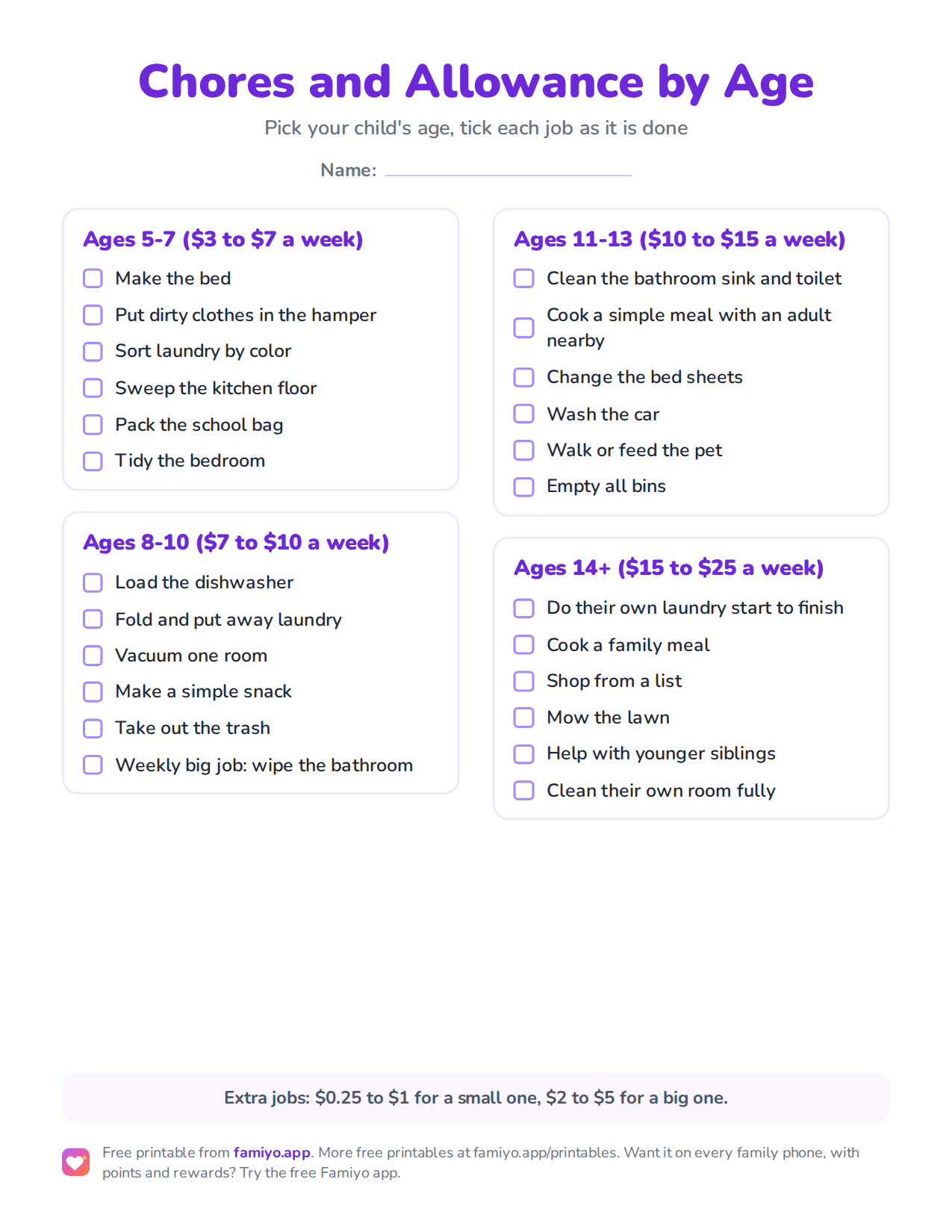
Free printable
Chores and Allowance by Age
A checklist on one US Letter page. Download the PDF to print it, or save the image to use it on a tablet or in a document.
Free for home, classroom and nonprofit use, see the license. More free printables.
Parents who search for a chores and allowance chart usually want two things on one page: what a child of a given age can do, and what a fair weekly amount looks like. Here is one chart that covers both, from toddlers to teens, with a printable version that fits on the fridge. Use it as a starting point and then adjust, because no two children in the same age band are the same.
The chart: chores, time and allowance by age
Time per day is the total for all daily jobs, not for each one. Amounts are weekly, in dollars, and follow the rule of thumb of $1 per year of age as a floor.
| Age | Typical chores | Time per day | Weekly allowance |
|---|---|---|---|
| 2-3 | Put toys in a bin, put clothes in the hamper, wipe up spills, help feed a pet | 5 to 10 minutes | None yet |
| 4-5 | Make the bed (roughly), set and clear their own place, match socks, water plants, feed a pet | 10 to 15 minutes | None at 4, from $3 at 5 |
| 6-7 | Sort laundry by color, empty unbreakable dishes from the dishwasher, sweep, pack the school bag, tidy their room | 15 to 20 minutes | $3 to $7 |
| 8-9 | Load the dishwasher, fold and put away laundry, vacuum one room, make a simple snack, take out the trash | 20 to 30 minutes | $7 to $10 |
| 10-12 | Clean the bathroom sink and toilet, cook a simple meal with an adult nearby, change bed sheets, wash the car | 30 minutes | $7 to $10 at 10, $10 to $15 at 11-12 |
| 13+ | Do their own laundry start to finish, cook a family meal, shop from a list, mow the lawn, help with younger siblings | 30 to 45 minutes | $10 to $15 at 13, $15 to $25 at 14+ |
The chore bands and the allowance bands do not line up exactly, so the last column splits where it has to. If your child is 10, use the lower figure. At 11 or 12, move up.
How many chores per child
The age bands tell you what to ask for, but not how many things at once. The safe rule is 2 to 3 daily tasks for preschoolers, 3 to 4 for school-age kids, and one weekly "big" job from age 8. A 9-year-old with six daily chores will give up on all six.
Keep old jobs when you add new ones, since they get faster as they become habits. A 9-year-old still makes the bed, but it now takes a minute.
What the allowance is for
Allowance and chores are related, but you can set them up in two ways.
- Allowance separate from chores. A flat weekly amount for learning to handle money. Chores are unpaid family work.
- Allowance plus paid extras. The same flat amount, with basic chores unpaid and extra pay for jobs beyond the usual: $0.25 to $1 for a small extra job, $2 to $5 for a big one.
The second setup is the one most families end up using. Everyone does the basics, and a child who wants more money can earn it by washing the car or raking leaves. For a deeper look at the younger end, see chores for 2-year-olds, and for ages 9 to 12 our guide to chores for tweens.
Using the printable
The printable below has four sections, one per age band, each with the chores that fit and the weekly amount in the heading. It suits a family with children of different ages: cut it into strips and give each child theirs, or hang the whole sheet and circle the section that applies. Tick each job as it is done and add up the week on payday.
Two tips for the sheet. Pick only the 3 or 4 jobs from your child's section that you really want done daily, and cross out the rest. And write the payday on top, because a chart without a pay date quickly loses its point.
When chores and allowance go wrong
Three problems come up most.
- Chores are too hard. If a child cannot do the job without help, drop to the age below for a few weeks.
- Pay depends on perfection. Pay for done, not for done well. Show the missed spot once and let them fix it.
- The amount keeps changing. Pick a figure, hold it for a month, and only then adjust. Kids trust a system that does not move.
When a child's basics become automatic, it is time to add a job. For laundry in particular, how to get kids to do their own laundry breaks it into steps.
Letting an app replace the paper chart
Famiyo is a free family app for iPhone and Android that combines a shared family calendar, chores with points and a rewards shop; kids join with a code, no email needed. It replaces the paper chart: you add each chore once, repeat it daily or weekly, choose who does it and give it points, and each child can get their own number of points for the same task. Kids hear about new tasks by notification and check them off on their own phone, and you see the update live on yours.
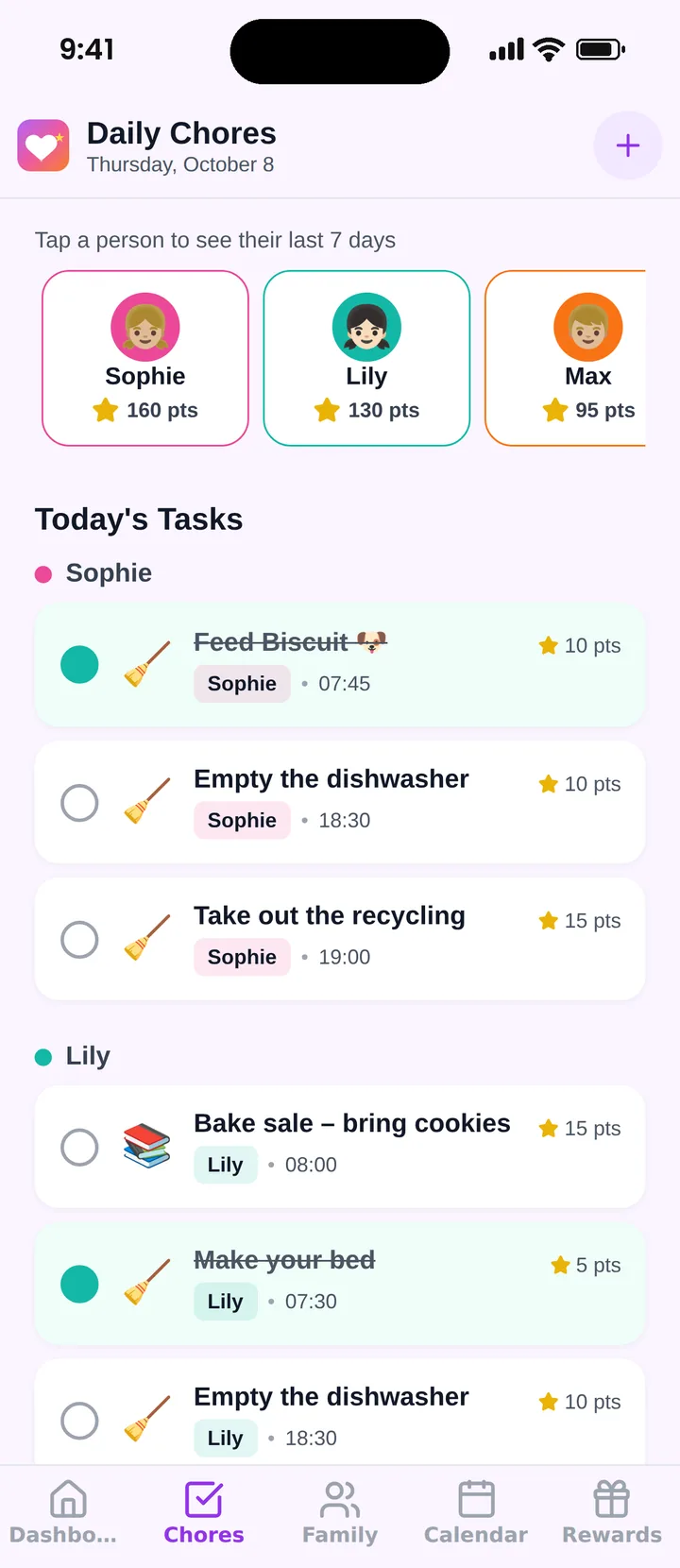
Compare the options in our list of the best chore chart apps. If points will turn into money, 100 points equal $1.
Frequently asked questions
How much allowance should a child get for their chores?
A common rule is $1 a week for each year of age. Typical ranges are $3 to $7 at ages 5-7, $7 to $10 at 8-10, $10 to $15 at 11-13 and $15 to $25 at 14 and up. Treat the rule as a starting point, not a standard.
Should allowance be tied to chores?
Keep basic family chores unpaid, since everyone in a household helps. Many families pay a base allowance separately and add $0.25 to $1 for a small extra job or $2 to $5 for a big one. Choose one system and keep it consistent.
How many chores should a child have each day?
Start with 2 to 3 daily tasks for preschoolers and 3 to 4 for school-age kids. From about age 8, add one bigger weekly job. If daily jobs turn into arguments, the list is usually too long.
At what age should a child start getting allowance?
Around age 5, once a child can count small amounts and understands that money buys things. Before that, chores can be rewarded with stickers or points, which teach the same link between effort and reward.
What do you do when a child skips chores?
Stay calm and predictable. Name the job and the time, let the missed one go unpaid or unchecked, and try again the next day. Check that the task suits the age and that the steps are clear before you add penalties.
Try Famiyo With Your Family
Chores with points, a rewards shop for kids and one shared family calendar. Set it up in a couple of minutes.



Free to download • No credit card required • Available on iOS & Android