Chores for 14 Year Olds to Earn Money (With Pay Rates)
Paid chores for 14 year olds with pay rates: which jobs stay unpaid, which earn $0.25 to $5, a sample week, and how to pay by phone or in points.
By Famiyo Editorial Team6 min read
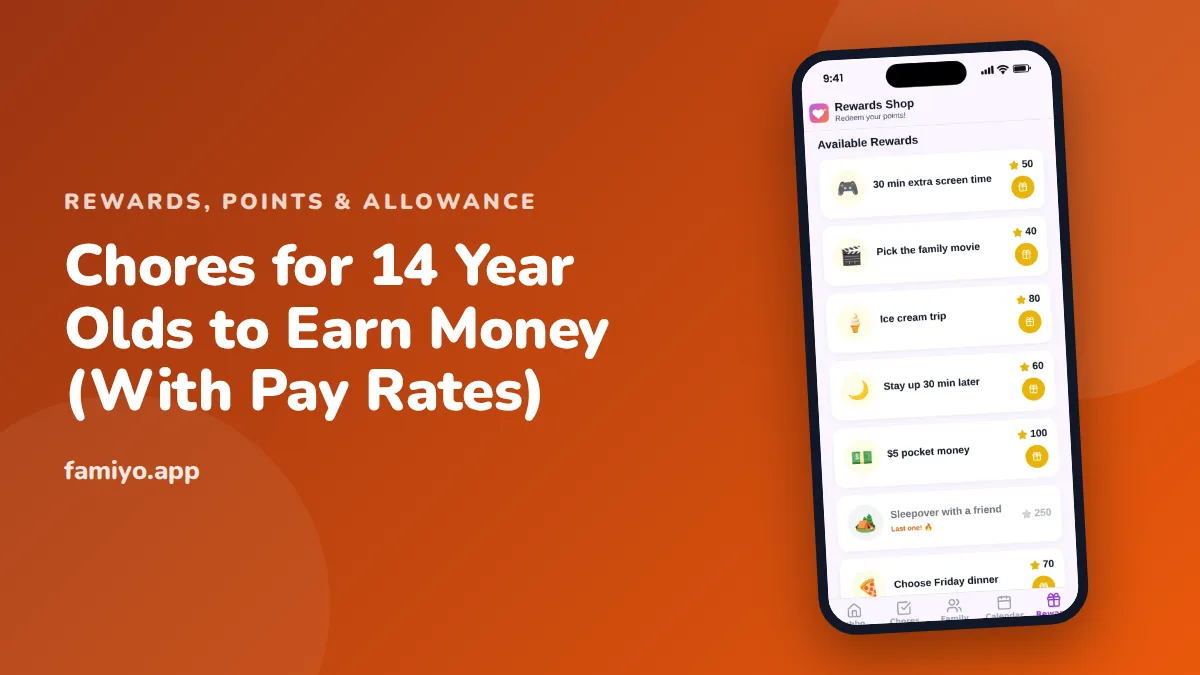
A 14-year-old has outgrown pocket-money chores like feeding the cat, and is not yet old enough for most real jobs. That gap is exactly where paid work at home fits. This guide covers what a 14-year-old can do well, which jobs should stay unpaid, what to pay for the rest, and a few ways to get the money to them that suit a kid who lives on their phone.
Which chores should a 14 year old do without pay?
Start here, because it decides everything else. A 14-year-old is a full member of the household. Their room, their laundry, their dishes, their share of the trash and a regular family meal are part of living in the house. These are unpaid, and they stay unpaid.
Typical guidance for ages 13 and up puts the range at 30 to 45 minutes a day of regular work, including running their own laundry start to finish and helping with younger siblings. That is the baseline. Pay only starts once you go past it.
The test is simple: would you otherwise do this job yourself, or pay someone to do it? Cleaning their own bathroom is baseline. Cleaning the whole house on a Saturday while you are out is a job.
What jobs can a 14 year old do to earn money at home?
Fourteen is old enough for tasks that take real strength, real time or real responsibility. The table groups them by size, using the pay ranges we use across the blog: $0.25 to $1 for a small extra job and $2 to $5 for a big one.
| Job | Size | Rough time | Suggested pay |
|---|---|---|---|
| Wash the inside windows of one room | Small | 15 minutes | $1 |
| Rinse and sort the recycling for the month | Small | 10 minutes | $0.50 |
| Scrub the grout or clean the shower | Medium | 30 minutes | $2 |
| Wash and vacuum the family car | Big | 45 minutes | $4 |
| Mow the front and back lawn | Big | 45 to 60 minutes | $5 |
| Rake leaves into bags | Big | 60 minutes | $5 |
| Deep-clean the fridge and wipe the shelves | Medium | 30 minutes | $3 |
| Cook a full dinner for the family, start to finish | Big | 60 minutes | $4 |
| Watch a younger sibling for a few hours so you can go out | Big | 2 to 3 hours | $5 |
| Help a neighbor with yard work or a pet while they travel | Big | Varies | Their rate, agreed up front |
Two notes on that table. First, the lawn and the car are the classic big jobs for a reason: they have a clear start, a clear finish and a result you can see from the driveway. Second, babysitting a sibling is a judgment call. Some families treat it as part of the 13+ baseline and some pay it. Decide in advance and say so, because a teen who is surprised either way will be annoyed.
How do you set a fair rate?
A fair rate has three parts: the size of the job, the quality you expect and how much you would otherwise pay. Fourteen-year-olds are quick to compare a job to what a neighbor would charge, so lean on that. If a yard service charges $40 for the lawn and you pay your teen $5, they will notice. You do not have to match the market, but you should be able to explain the gap: they live here, they use your mower and the work is practice.
Here is a four-step way to set one up.
- List the jobs you would happily hand off. Pick three to five.
- Put each into small, medium or big, using the minutes in the table above.
- Agree on what done looks like, in plain words. "Mowed" means every strip, edges trimmed and clippings swept off the path.
- Write the rate next to the job and stick to it for a month before changing anything.
If your teen wants to negotiate, let them. A 14-year-old who builds a case for $6 instead of $5, with reasons, is practicing something useful. Just do not renegotiate on the spot while they are standing there with the mower running.
What does a sample week look like?
Say your 14-year-old does a normal 35 minutes a day of unpaid chores: their room, their laundry, clearing the table and taking out the trash. On top of that they pick two paid jobs.
| Day | Unpaid baseline | Paid job |
|---|---|---|
| Monday | Room, trash | None |
| Tuesday | Laundry, clear the table | None |
| Wednesday | Room, trash | None |
| Thursday | Laundry, clear the table | Clean the shower ($2) |
| Friday | Room, trash | None |
| Saturday | Clear the table | Mow the lawn ($5) |
| Sunday | Room | None |
That works out to $7 for a week, well below what a typical weekly allowance for this age would cost ($15 to $25). That is on purpose. Paid chores are extra money on top of an allowance, or in place of one if you prefer to tie income to effort. If you worry that paying for everything will spoil them, read how to reward your child without spoiling them.
How should you pay a teen: cash, app or points?
The format matters less than the habit. Pay on a fixed day, pay in full and never "forget" for a week.
Cash is concrete. Teens see it leave your wallet and arrive in theirs. The downside is that it disappears into a pocket and rarely makes it to savings.
A payment app or a bank transfer works well if your 14-year-old has an account of their own. The money arrives with a timestamp, which is handy when you disagree about whether it was paid. It also makes it easier to nudge a share into savings, say a third.
Points sit in between. The teen earns points for each job, and the points convert to whatever you decide: screen time, a night out, or money at a set rate. In the Famiyo default suggestion, 100 points equal $1, so a $5 lawn job is 500 points. The advantage is choice. A teen who is saving for headphones can cash points out as money, and a teen who just wants a late night can spend them on that instead. Our reward system for kids guide covers how to build one that lasts past the first month.
Setting it up in Famiyo
Famiyo is a free family app for iPhone and Android that combines a shared family calendar, chores with points and a rewards shop; kids join with a code, no email needed. For paid chores, you can give your teen the baseline jobs as ordinary chores, add the bigger jobs with a higher point value and then put pocket money in the rewards shop as an item with a price in points. Your teen redeems from their own phone and sees how many points they have left. The money itself changes hands outside the app, so you pay the cash or transfer when they redeem. See our list of the best allowance apps for kids if you are comparing options.
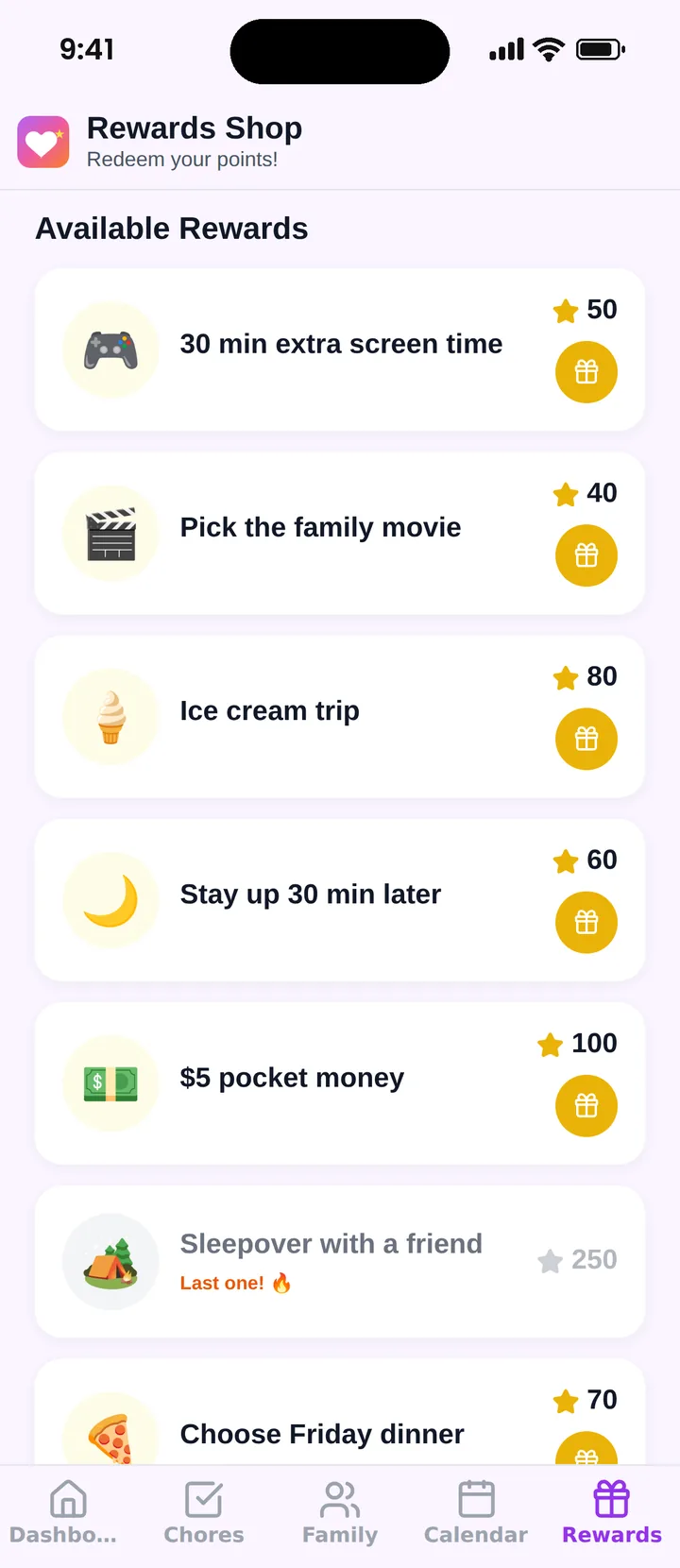
You can also let your teen check off their own tasks, or require a parent to approve them first. For paid jobs, approval is usually the better choice.
What goes wrong, and how to fix it
Teens are good at finding the edge of any system. A few predictable problems come up.
The first is "I'll do it later." Give each paid job a deadline, and say that after it passes, the job goes back on the open list or to a sibling.
The second is the teen who decides money is not worth the effort. That is allowed. If your teen turns down a paid job, they do not get the money. They still do the baseline.
The third is blurring paid and unpaid. If you pay for loading the dishwasher on Tuesday, you will have trouble getting it done free on Wednesday. Keep the line clear and write the unpaid list down.
Finally, if your teen is also looking at outside work, keep the conversation going. Babysitting and yard work for neighbors are normal at this age, and the home rates give them a sense of what their time is worth. When your teen turns 15, the jobs and the rates grow with them, and our guide to chores for 15 year olds to earn money picks up from here.
Pick three jobs from the table this week, write the pay next to each one and put it on the fridge or in the app before anyone starts.
Frequently asked questions
How much should I pay a 14 year old for chores?
Pay $0.25 to $1 for a small extra job and $2 to $5 for a big one, such as mowing or washing the car. Everyday jobs like their own laundry and clearing the table stay unpaid. A weekly allowance for this age is usually $15 to $25.
Which chores should a 14 year old do for free?
Anything that comes with living in the house: keeping their room clean, doing their own laundry, clearing their dishes, taking out the trash and helping with a family meal. Paid work is for jobs that go beyond that, which you would otherwise do yourself or hire out.
Should I pay my teen in cash, by app or in points?
Any of the three works if it is predictable. Cash feels real, a payment app is convenient for a teen who has a bank account, and points let a teen choose between money and other rewards. Pick one and pay on the same day each week.
What if my 14 year old does a paid chore badly?
Agree on what done looks like before the job starts, then check it against that description. If it falls short, they fix it before being paid. That is how it works with any employer, and it teaches more than a lecture does.
Can a 14 year old work outside the home for pay?
Yes, informally. Many 14-year-olds babysit, mow lawns and do yard work for neighbors. Formal jobs at this age are limited by state and federal rules on hours and types of work, so check your state's labor department before you agree to anything with an employer.
Try Famiyo With Your Family
Chores with points, a rewards shop for kids and one shared family calendar. Set it up in a couple of minutes.



Free to download • No credit card required • Available on iOS & Android