Positive Reinforcement for Kids With Autism: What Works
Positive reinforcement for kids with autism works when the reward is one your child truly likes, comes right away and follows a clear goal. Examples inside.
By Famiyo Editorial Team6 min read
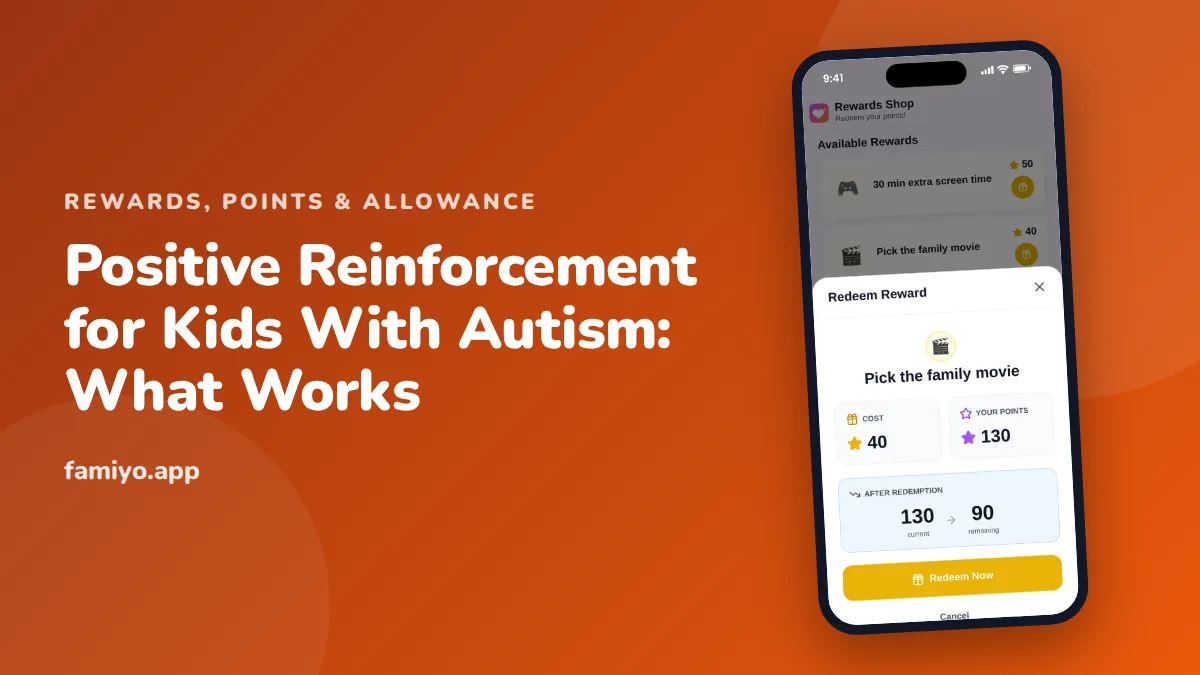
Your child lights up when the tablet comes out and barely notices when you say "great job." Or the sticker chart that worked for a cousin sits untouched on your fridge. Reinforcement for an autistic child often needs more fitting than for other kids, and this guide covers how to find rewards that matter to your child, how to time them, what to put on a chart, and where this approach can go wrong.
None of this replaces the plan your child's therapist or pediatrician has set up. Think of it as everyday practice that fits alongside it.
What positive reinforcement means (and what it doesn't)
Positive reinforcement is simple in definition: something pleasant follows a behavior, and the behavior becomes more likely next time. The key word is "pleasant to the child." A reinforcer is defined by its effect, not by your intention. If you give a gold star and the behavior doesn't increase, the star wasn't a reinforcer for that child, however nice the gesture.
That's why general advice for typical kids can miss with an autistic child. Many autistic children are less motivated by social rewards such as smiles or cheering, and more by objects, activities, sensory experiences or time with a special interest. Others love praise but find a loud "Yay!" overwhelming. The American Academy of Pediatrics notes that early behavioral support for autism leans on rewarding desired skills, and the CDC lists positive reinforcement among the strategies commonly used in treatment. What counts as rewarding is still individual, so you have to find it by watching.
It also isn't a bribe. A bribe is offered in the middle of a meltdown to make it stop. Reinforcement is planned ahead, tied to a clear goal, and given after the behavior happens.
Find out what your child actually likes
Spend a few days just observing. What does your child choose when nothing is required? What do they ask for, reach for or stay with longest? Write it down. You're building a menu, and the menu needs several items because any single reward wears out.
| Type | Examples | Worth knowing |
|---|---|---|
| Activity | Trampoline time, a favorite video for 5 minutes, train tracks, a walk | Easy to give in small doses, so you can repeat it |
| Sensory | Squishy toy, a spin in a chair, weighted blanket time, bubbles | Safe and quick; check that the sensation is a pleasant one for your child |
| Special interest | Looking at a map book, sorting cards, a few minutes on the subject they love | Often the strongest reinforcer; keep it for earned moments |
| Food | A favorite snack, one piece of a preferred treat | Fast and clear, but keep portions small and don't let food become the only tool |
| Social | A high five, a quiet "I saw that," a hug if your child likes them | Some children prefer calm words over big reactions |
| Choice | Picking the song in the car, which cup to use, the order of tasks | Choice itself is rewarding for many kids |
Offer two or three items before a task and let your child pick. The choice tells you what's working today, and it gives your child some control, which matters a great deal.
Pick one small goal
It's tempting to fix everything at once. With reinforcement, a single clear target works better. Choose a behavior that's observable, so that you and anyone else helping can tell whether it happened. "Be good at dinner" is not observable. "Stay at the table for 3 minutes" is.
Then shrink it to something your child can already almost do. If getting dressed is hard, start by reinforcing putting on socks. Build from a win. The table shows how a larger skill can be broken into steps, each with a fast reward.
| Big goal | First small step | Reward right after |
|---|---|---|
| Brushing teeth | Put toothpaste on the brush | Choose the song for the 2-minute timer |
| Staying at the table | Sit for 3 minutes with the plate in front of them | A 2-minute movement break |
| Putting shoes on | Pick up shoes and bring them to the door | A high five and a preferred sticker |
| Asking for a break | Hand over a "break" card instead of leaving | An immediate break, every time |
| Picking up toys | Put 3 toys in the bin | Preferred toy for 5 minutes |
Reward effort at first, then ask for slightly more. If your child masters putting toothpaste on the brush for several days, the next step is a few strokes of brushing.
Time it, and make it visible
Timing matters more than size. For a new skill the reward should land within seconds. A delay of an hour leaves a child with no way of connecting it to what they did.
Visual supports help here because they make the rule predictable. A first-then card is the simplest: two pictures or words, "First shoes, then bubbles." Many autistic children find predictable structure calming, and it removes the guessing about what's expected.
- Choose the task and the reward, and put both on a card where your child can see them.
- Say it once, calmly, and point: "First shoes, then bubbles."
- Wait. Give a short, steady prompt only if needed, with no extra talk.
- The moment the task is done, give the reward and name the behavior in a few words: "Shoes on. Bubbles."
- Keep the reward small and brief so you can do it again many times a day.
For a child who is ready, a token board or chart extends this idea: tokens or points are earned for each target behavior, and a set number buys a reward. Our guide to the point system for kids shows how to set those numbers, and you can scale them down to a handful of tokens for a younger or newer learner.
Praise that fits your child
If praise does motivate your child, make it specific and low-key. "You waited for your turn" tells them exactly what to repeat. "Good job!" doesn't. Keep your tone and volume where your child is comfortable, and skip the public fuss if they dislike attention in front of others. A quiet comment or a thumbs up may be all it takes.
Be careful about what you praise. Reward skills and effort that help your child: asking for help, using a break card, trying a new food one bite. Be wary of rewarding behaviors that only make things look typical, such as forcing eye contact or hiding stimming. Many autistic adults have described the cost of that kind of masking, and a child who learns to hide discomfort for rewards may carry the strain without anyone noticing. If a goal would require your child to suppress something that's helping them cope, it probably isn't the right goal.
When reinforcement stops working
Rewards wear out, and that's normal.
If your child loses interest, the reward has likely become too familiar. Rotate in other items from the menu, or let your child choose from two. If the child seems to be refusing the task rather than the reward, the step may be too big. Go back to a smaller one.
If the behavior appears only when you hold the reward, add variety. Start offering the reward on some successes rather than every one, and use praise more often. Keep an eye on the pattern over weeks, not days.
If meltdowns increase, look at what changed. Sensory overload, a break in routine or unclear expectations are common triggers, and no chart fixes them. Step back, reduce the demands and talk to your child's care team. For a broader view of what drives children, see our piece on kids motivation. If your child also has attention differences, positive reinforcement for kids with ADHD covers a different set of tweaks.
Using the rewards shop in Famiyo
Famiyo is a free family app for iPhone and Android that combines a shared family calendar, chores with points and a rewards shop; kids join with a code, no email needed. For an older child who can work with points, you can set up the menu as rewards: each one gets a price in points, a limit on how many are available and the days it can be used. The child redeems from their own phone and sees how many points are left, which makes the rule visible and predictable.
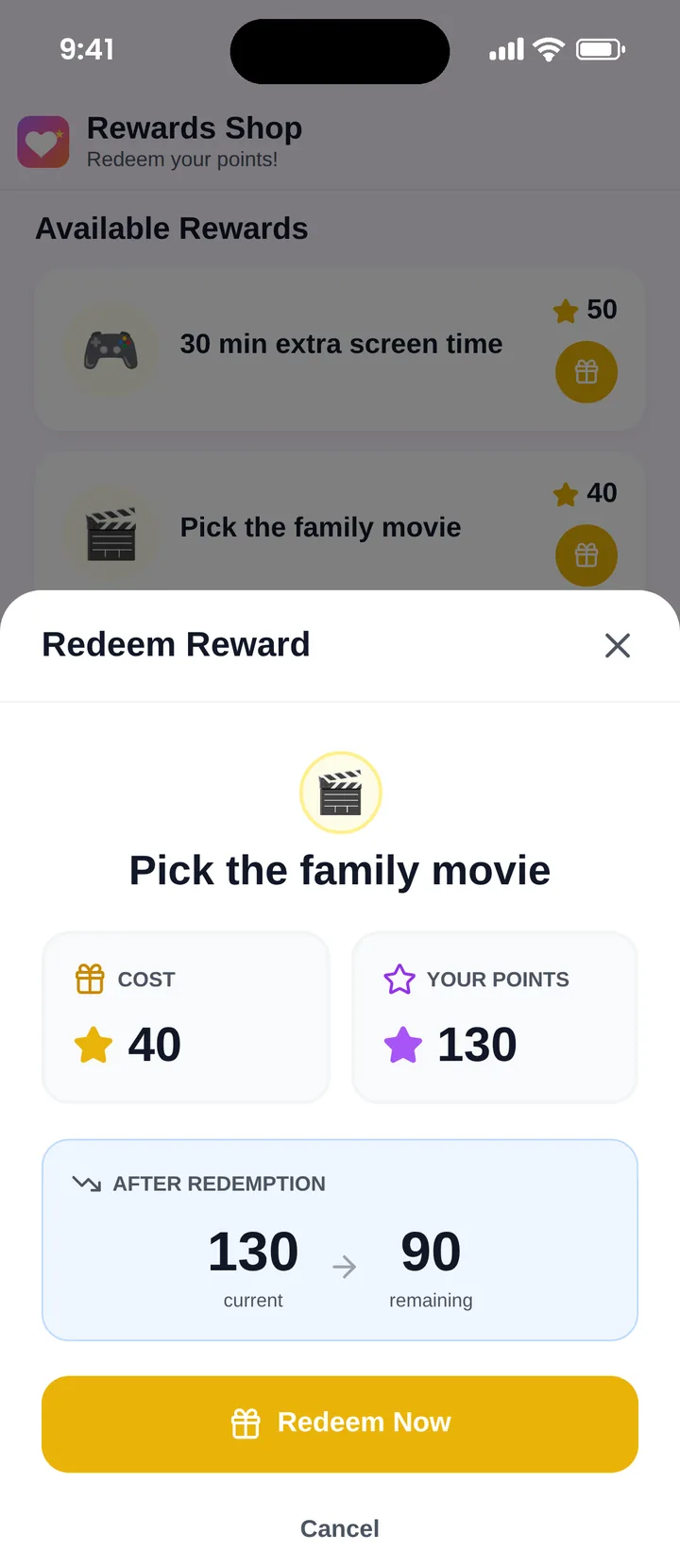
You pick whether a parent approves each task, so the reward follows only what you've confirmed. Browse our list of the best reward chart apps for kids if you're comparing options.
A first step for this week
Write down five things your child chooses freely, pick one tiny goal, and run a first-then card for three days. Note what happens and adjust. If something about your child's behavior worries you, bring your notes to the next appointment with their therapist or pediatrician.
Frequently asked questions
What are good reinforcers for autistic children?
The best reinforcers are whatever your child chooses again and again: a favorite object, a few minutes of a special interest, a snack, a movement break, or quiet time alone. Preferences are personal and change, so watch what your child picks when given free choice and refresh the list often.
Is praise enough as positive reinforcement for autism?
Sometimes, but not always. Some autistic children find bright, loud or public praise uncomfortable, and for others spoken praise simply isn't motivating. Try quiet, specific comments, a thumbs up, or a tangible reward alongside words, and let your child's reaction tell you what lands.
How quickly should the reward come?
As close to the behavior as you can manage, ideally within a few seconds when a skill is new. A reward that arrives an hour later is hard to link back to the action. As the skill becomes steady, you can slowly stretch the wait and move to a chart.
Can rewards backfire for a child with autism?
Yes. A reward can lose its pull if it's overused, or it can teach the wrong lesson if it pays a child for hiding discomfort, such as sitting still through something painful. Reward effort and skills that help the child, and check in with their therapist or pediatrician if you're unsure.
Try Famiyo With Your Family
Chores with points, a rewards shop for kids and one shared family calendar. Set it up in a couple of minutes.



Free to download • No credit card required • Available on iOS & Android