Chores for 13 Year Olds to Earn Money (With Pay Rates)
Chores for 13 year olds to earn money at home, with fair pay rates per job, what should stay unpaid, how to track it and when to use points.
By Famiyo Editorial Team6 min read
At 13, most kids want money before they can legally have a regular job. A 13-year-old with something to buy and a long summer will do real work for fair pay, and that is a good thing. This guide lists jobs worth paying for, what to pay, what to keep unpaid and how to run it so it teaches something about money instead of turning every task into a negotiation.
Which chores can a 13-year-old do to earn money?
The line that works for most families: unpaid chores are what everyone does to live in the house. Paid jobs are extras that save you time or money, or that you would otherwise do yourself or hire out. A 13-year-old can take on bigger tasks than a younger child, which is why this age has the best selection.
| Paid job | What it involves | Time | Suggested pay |
|---|---|---|---|
| Wash the car | Inside and out, vacuum, wipe windows | 40 to 60 min | $4 to $5 |
| Mow the lawn | Front and back, edges raked | 45 to 60 min | $4 to $5 |
| Deep-clean a bathroom | Tub, shower, floor, mirror, behind the toilet | 30 to 40 min | $3 to $4 |
| Cook a family dinner | Plan, cook and clean the kitchen after | 60 min | $3 to $5 |
| Wash windows | Inside of the downstairs windows | 30 min | $2 to $3 |
| Organize a closet or garage shelf | Sort, label, bag donations | 45 to 60 min | $3 to $5 |
| Rake leaves or weed a bed | One bed or one section of lawn | 30 to 45 min | $2 to $4 |
| Pet extras | Wash the dog, clean the cage or tank | 20 to 30 min | $1 to $3 |
| Small extras | Wipe skirting, sort shoes, clean the fridge shelf | 5 to 15 min | $0.25 to $1 |
These rates follow a simple pattern: $0.25 to $1 for a small extra job and $2 to $5 for a big one. They are starting points. Adjust for your area and for how long the job takes your child, which is slower at 13 than it would be for you.
What should a 13-year-old do without being paid?
The daily and weekly basics. Their own laundry, room, dishes, a share of the kitchen reset and their pet's feeding are part of being a family member. A good rule: if you would be annoyed to be asked for payment to do it, the job is unpaid.
This is not about being tight. If every chore carries a price, a child learns to ask "how much?" before "can I help?" and refuses anything that is not paid. Keeping the basics unpaid protects the habit. If you want a closer look at the pros and cons, we cover that in our wider paid chores guides, and our page on kids motivation explains what drives children beyond money.
How much allowance does a 13-year-old get in total?
Typical weekly allowance at ages 11 to 13 runs $10 to $15. There is also a common rule of thumb of $1 a week for each year of age, which gives $13. Treat it as a starting point and not a standard.
If you pay for chores separately from allowance, think about the total. A 13-year-old who gets $10 in allowance and earns $8 from two jobs has $18 in a week, which may be more than you intended. Decide the monthly ceiling first, then work back to the job rates.
How to set up paid jobs without a daily negotiation
A few simple rules save you a lot of argument.
- Keep a short written menu of paid jobs and prices. Do not set prices on the spot.
- A job must be done to the agreed standard before it is paid. Write what done looks like.
- Pay on a set day, such as Sunday, not immediately after each job.
- Let your child claim jobs rather than assigning them. You choose which ones are on the menu this week.
- Limit the paid total per week so a keen child does not take every job.
- Do not pay for a job you asked for as a basic chore. If it was not on the menu, it is unpaid.
If a job is done badly, ask for it to be redone before payment. It is the same as it would be with a neighbor.
What about jobs for neighbors?
Many 13-year-olds earn most by working for others: walking a dog, watering plants during a vacation, helping with yard work. This is usually fine, but a few rules help. Rules about working outside the home vary by state and by the type of job, so check yours. Keep the work close to home, in daylight and with a parent knowing where and when. Agree the rate with the neighbor in advance and have your child do the talking, which is half the education.
Points as pay: one way to do it
For some kids, points are a cleaner system than cash. The default scale is small jobs at 5 points, medium at 10 and big at 20, with 2 extra for doing it without a reminder. If you want to convert to money, 100 points is $1, so washing the car for 500 points equals $5.
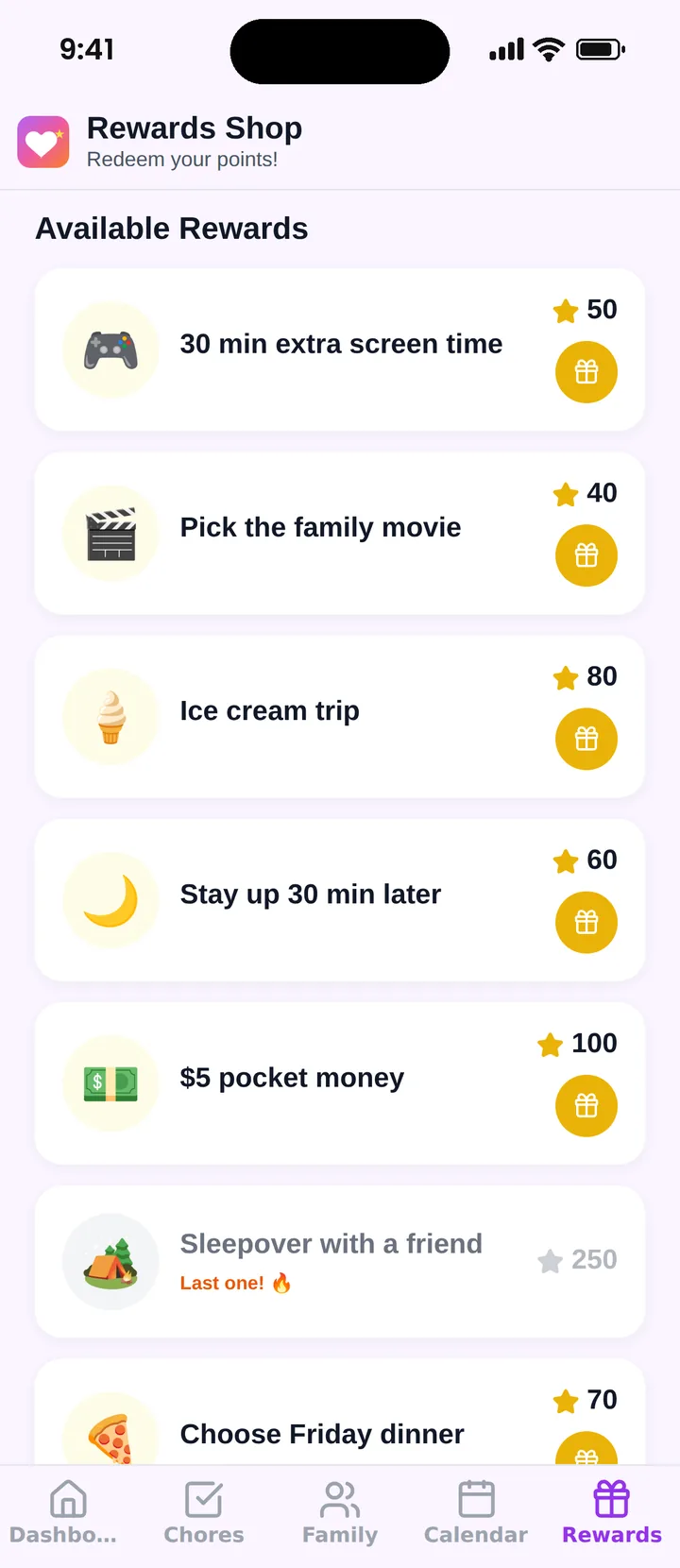
Points have one clear advantage: the child chooses what to spend them on. They could trade 30 to 50 points for 15 extra minutes of screen time, 100 for the family movie pick or 300 to 500 for a day out. The same pot can also pay pocket money, with you handing over the cash. Our pages on rewards for kids and how to reward kids without money cover the non-cash side in more detail, and how to reward your child without spoiling them deals with when it goes too far.
Mistakes that make paid chores backfire
Three patterns show up again and again. The first is paying for everything, which was covered above. The second is paying before the job is checked, so the standard slips and the next job is rushed. Pay after you have looked at the result, and say so up front.
The third is moving the price. If you agreed $4 for the lawn, do not drop it to $3 because it looked a bit patchy, and do not raise it because your teen asked nicely on the way out. Change prices on a set day, once a month, with a short talk. Kids accept a fair rule far better than a mood.
It also helps to ask your 13-year-old what they are saving for. A goal of $60 for a game or $120 for a bike turns the menu into a plan, with a number of jobs to get there. Writing the goal at the top of the page makes the effort visible and gives you a natural moment to talk about saving, spending and waiting. Many kids find that the wait is the part that teaches them the most.
Paying out in Famiyo
Famiyo is a free family app for iPhone and Android that combines a shared family calendar, chores with points and a rewards shop; kids join with a code, no email needed. For paid chores, give each extra job a point value, for example 500 points for the car wash, and set up a reward in the rewards shop such as "$5 pocket money" priced at 500 points. The 13-year-old sees what they have earned on their own phone, redeems the reward and sees how many points are left. You hand over the cash yourself, since the app does not hold or move real money.
The statistics screen shows points this week and in total, so you can see at a glance what was earned. For an overview of options, see our list of the best allowance apps for kids.
This week, write a menu of five paid jobs with prices and keep it on the fridge or in the app.
Frequently asked questions
How much should I pay a 13-year-old for chores?
For extra jobs, $0.25 to $1 for a small one and $2 to $5 for a big one is a sensible range. A typical weekly allowance at 11 to 13 is $10 to $15. Keep basic household chores unpaid so there is a clear difference.
What chores can a 13-year-old do to earn money?
Mow the lawn, wash the car, deep-clean a bathroom, wash windows, clear gutters with supervision, cook a family dinner, babysit a sibling for a short time or organize a garage shelf. Pick jobs that are bigger than the daily routine.
Should a 13-year-old be paid for all chores?
Usually not. Everyday jobs like their room, dishes and laundry belong to living in the house. Pay for the extras that go beyond that. Mixing the two makes a child decline anything unpaid.
Can a 13-year-old earn money from neighbors?
Often yes, for things like dog walking, yard work and watering plants. Rules about working outside the home vary by state and by type of job, so check yours and keep the work close to home and daylight hours.
Should I use points or cash with a 13-year-old?
Both can work. Points let a teen choose between screen time, a day out or cash from you. A common conversion is 100 points for $1. The money itself is handed over outside any app.
Try Famiyo With Your Family
Chores with points, a rewards shop for kids and one shared family calendar. Set it up in a couple of minutes.



Free to download • No credit card required • Available on iOS & Android