Chores for 16 Year Olds to Earn Money at Home
Paid chores for 16 year olds: household jobs worth paying for, pay of $2 to $5 per big job, a written agreement and how to link money to real costs.
By Famiyo Editorial Team5 min read
By 16 most teens can do almost anything an adult in the house can. They drive, cook, run errands and hold opinions about how much they should be paid. That is good news if you handle it the right way: you can offer real work for real pay, and the conversation becomes closer to a first job than a chore chart. Here is how to decide what to pay for, what stays free, how to write it down and how to tie money to the costs a 16-year-old actually has.
What should a 16 year old do for free?
The baseline list at this age is longer than it was at 13. A 16-year-old keeps their room and bathroom clean, runs their own laundry, cooks dinner for the family a couple of times a week, loads and empties the dishwasher and keeps their car or gear in order. These belong to living in the house.
Put one extra thing on that list that surprises some parents: a share of the household's driving. If your teen uses the car, the family can reasonably expect some trips to the grocery store, a pickup of a younger sibling or a drop-off at practice without cash changing hands. That is part of the deal for having wheels.
Everything beyond that baseline is a candidate for pay.
What jobs are worth paying a 16 year old for?
The best paid jobs share three features. They save you time or money, they have a clear finish and they are not something your teen already does for free. Here is a table of options with pay in the usual ranges.
| Job | Why it counts as paid work | Rough time | Suggested pay |
|---|---|---|---|
| Full grocery run from a list, with a budget | You save a trip | 60 minutes | $3 |
| Mow, edge and bag clippings | You save a weekend chore | 60 minutes | $5 |
| Deep-clean the kitchen: oven, fridge, cabinet fronts | Rarely gets done | 90 minutes | $5 |
| Wash, vacuum and check tires and fluids on the family car | Saves you a visit to the shop | 60 minutes | $4 |
| Drive a sibling to a weekly activity for a month | Saves you a regular trip | Per run | $0.50 to $1 per trip |
| Tutor a younger sibling in a subject you know they can handle | Saves you a tutor | 45 minutes | $2 |
| Batch-cook meals for the freezer | Saves a weeknight | 90 minutes | $5 |
| Set up a phone, laptop or printer for a grandparent | Real skill, real help | 45 minutes | $2 |
Pay is capped at the big-job range on purpose. If your teen wants more than $5 an hour, the better route is outside work: babysitting, yard work for neighbors or a part-time job. Our guide to how to motivate a teenager is worth a look if your teen shows interest in earning but not in effort.
How do you write the deal down?
At 16, a handshake is not enough. A short written agreement keeps both sides honest and gives your teen a first taste of how work agreements run. It takes five minutes and fits on one page.
- Name the jobs the teen is expected to do for free, in a short list.
- Name the paid jobs, the pay for each and what done looks like.
- Say when pay arrives: for example, every Sunday evening.
- Say what happens if a job is done badly or late: the job goes unpaid until it is fixed, or it goes to someone else.
- Say how long the agreement lasts, usually a month or a season, and when you will review it together.
Keep the tone friendly. This is not a contract to hold over a teen. It is a way to avoid the "you never said that" argument, which at 16 is a reliable one.
How do you connect money to real costs?
The most useful thing a 16-year-old can learn about money is how much life actually costs. Rather than handing over a flat allowance and watching it vanish, tie some of it to expenses.
A few ways to do this:
- Your teen pays part of their phone plan, gas or car insurance from their earnings. A third or a half is common, depending on income.
- Clothes beyond basics come out of their own budget, with a set amount from you for essentials.
- A savings goal, such as a deposit for a used car or a trip, gets a visible target and a date.
For a longer look at how a regular allowance works alongside paid jobs, see our comparison of points vs money for kids. Some families find that a teen who gets paid in points, with a set exchange rate to dollars, makes more deliberate choices than one who simply receives cash.
Does a reward matter beyond the cash?
Yes, though less than parents expect. At 16, a teen who is motivated by cash will work for cash. A teen who is not will respond to autonomy: the car on Saturday night, a later curfew, an extra hour of online time or a friend sleeping over. Our list of rewards for high school students has ideas that work at this age.
You can offer both. A job board with a cash price and an optional trade, such as "or earn the car Saturday night", lets your teen choose what matters to them.
Running paid jobs in Famiyo
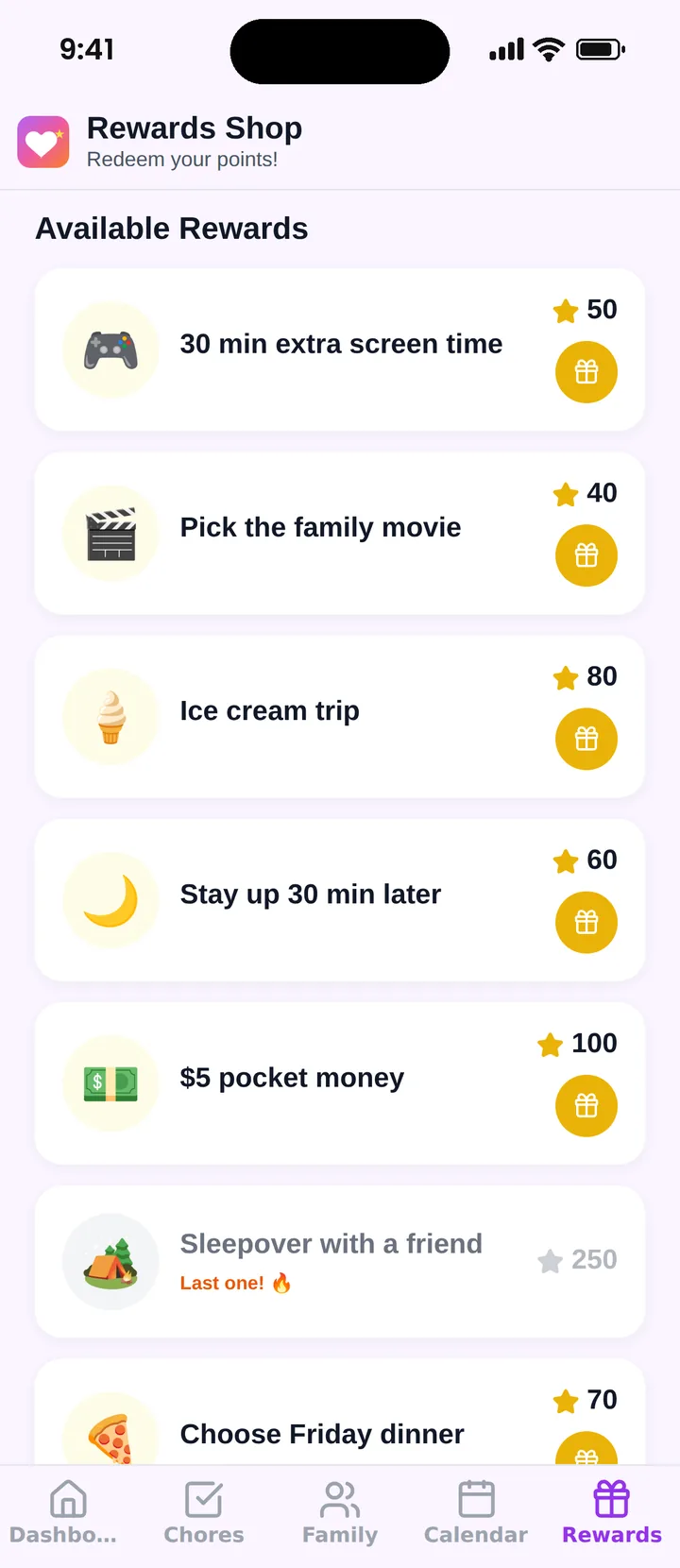
Famiyo is a free family app for iPhone and Android that combines a shared family calendar, chores with points and a rewards shop; kids join with a code, no email needed. For a 16-year-old, you add each paid job as a chore with its own points, then build a rewards shop that mixes pocket money, gas money, a later curfew night and screen time, each with a price in points. Your teen redeems from their own phone and sees how many points they have left. In the default suggestion, 100 points equal $1, and the money changes hands outside the app. Parents can approve each job before the points arrive, and you can see a teen's last 7 days of chores at a glance. Our list of the best allowance apps for kids covers other options.
When your teen has an outside job
Many 16-year-olds start part-time work outside the home. When that happens, the paid chores at home usually shrink, and that is fine. Keep the baseline expectations the same, since a job does not excuse them from the household. You may also want to review what you pay for: if they now earn $12 an hour elsewhere, a $5 lawn job may no longer interest them, and that is a good problem to have. If your teen has just started working, move the conversation to saving and spending, and step back from pay for chores.
Sit down with your teen this weekend, write the free list and the paid list on one page and sign it together. Before you finalize the paid list, check it against the 15-year-old version in our guide to chores for 15 year olds to earn money and decide what has grown up.
Frequently asked questions
How much should a 16 year old earn from chores at home?
Pay $2 to $5 for a big job and $0.25 to $1 for a small extra one. Most 16-year-olds earn around $5 to $15 a week from paid jobs on top of a typical allowance of $15 to $25. The amount matters less than it being fair and consistent.
Should a 16 year old get an allowance or a paycheck at home?
Either works if it matches how you want them to think. An allowance covers a set list of expenses and teaches budgeting. Pay per job teaches that effort turns into income. Many families use a smaller allowance for expenses and a job board for extra money.
What household jobs can a 16 year old do that save me money?
Yard work, car washing and basic maintenance checks, deep cleaning, grocery runs, cooking dinner, tutoring a younger sibling and driving them to practice. Each of these is something you would otherwise do yourself, skip or pay for, which is the best test of a job worth paying for.
Should I pay my 16 year old for driving a sibling?
It depends on the family. Some treat it as a baseline expectation, since the teen benefits from using the car. Others pay a small fee for regular runs. Whichever you choose, decide before the first trip and write it down, so it does not become a surprise.
How do I make sure a 16 year old saves what they earn?
Tie the money to a real goal, such as car insurance, gas, a phone upgrade or college savings, and let them choose. A simple split of a third to the goal, a third to spend and a third to save works, and pay by transfer if they have an account.
Try Famiyo With Your Family
Chores with points, a rewards shop for kids and one shared family calendar. Set it up in a couple of minutes.



Free to download • No credit card required • Available on iOS & Android