Kids Reward Chart App: Does It Work and How to Use One
Do reward chart apps work for kids? What behavior research suggests about immediate rewards, how a digital chart differs from paper, and rules that keep it working.
By Famiyo Editorial TeamUpdated 6 min read
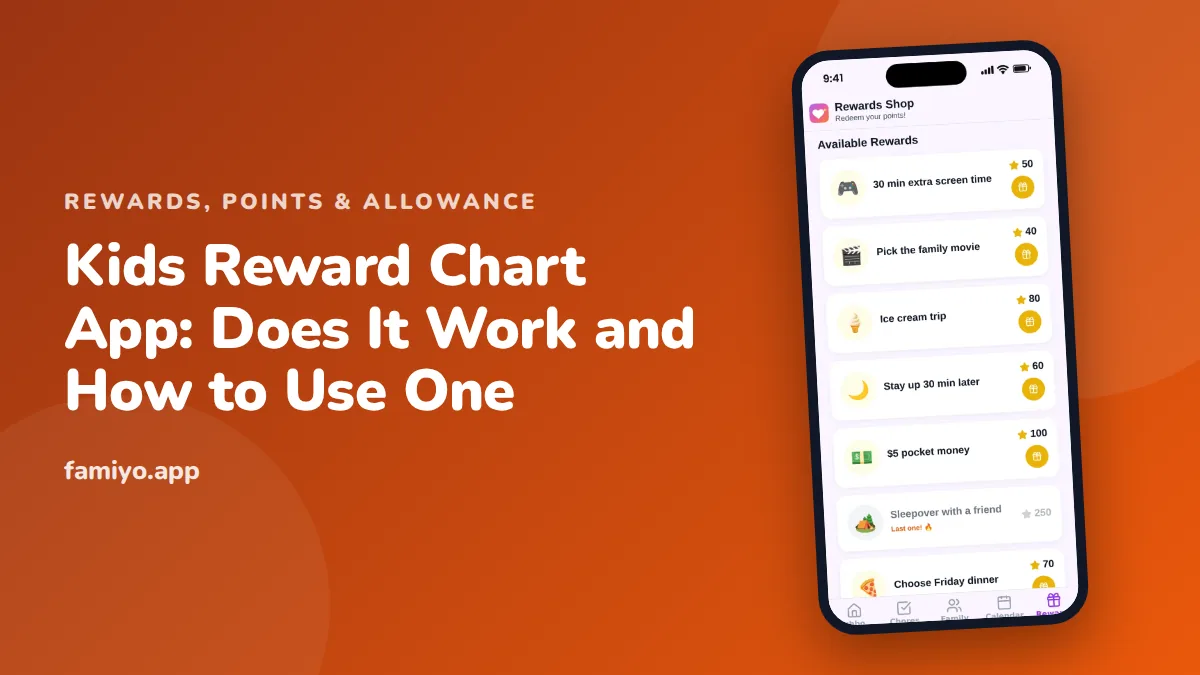
A reward chart looks simple: do the thing, get a sticker, trade stickers for a prize. Yet parents report both miracles and total failure from the same tool. The difference is rarely the chart. It is the timing, the size of the reward and the child's age. This guide looks at what behavior research and child development guidance say about rewards, how a reward chart app differs from a paper one, and the design rules that keep it working. Where we are not sure, we say so, because the evidence depends on the child.
Do reward charts work?
For starting a specific habit, often yes. The idea behind them is positive reinforcement: a behavior followed by something the child values becomes more likely to happen again. It is among the most widely used ideas in child behavior guidance, and pediatric organizations such as the American Academy of Pediatrics recommend praise and positive attention as the base of discipline.
The caveats matter. Effects vary by child, they are strongest for new or boring tasks, and they fade if the reward does. A chart is a tool for building a habit, not a permanent engine. If you want the argument both ways, our article asking whether a reward system is good or bad for kids goes through the objections, and the one on intrinsic motivation in kids explains what you are aiming for in the end.
One concern deserves a direct answer. Psychologists have long discussed the overjustification effect: when a child who already enjoys something is rewarded for it, they sometimes enjoy it less afterward. The practical response is to reward routine tasks, like chores and packing the bag, and not activities a child loves, such as drawing or reading for fun.
What makes a reward chart work?
Behavior guidance keeps returning to the same few design features.
| Feature | Why it matters | What it looks like |
|---|---|---|
| Immediate | Young children link a reward to the action only if they are close in time | Points appear the moment the task is ticked |
| Specific | "Be good" can't be earned, "put shoes on the rack" can | One clear action per row |
| Small | Big rewards invite gaming and disappointment | 5 to 20 points per task |
| Predictable | Moving goalposts breaks trust | Prices fixed for the week |
| Achievable | Early wins build the habit | Start with tasks the child already mostly does |
| Positive | Taking away earned points feels like punishment | Points only go up |
A reward that fails more than one of these will probably fail in practice, regardless of the app.
Paper chart or app: how they differ
Both work. The differences are practical.
Paper is physical, and a preschooler can touch it, peel a sticker and show Grandma. For ages 3 to 6 that matters, and our guide to how to make a kids reward chart has printable ideas. The weakness is upkeep: someone has to remember it, draw the lines and keep it on the fridge. It also doesn't follow the child to Dad's house.
An app syncs between both parents, sends a reminder, keeps the history of the last week without you doing anything, and lets older kids see a number grow. Children from about 7 often prefer it because it feels grown-up. The weakness is screens: a child who is already over-scheduled with devices may do better with paper.
Some families do both, with paper for the youngest and the app for the older ones. That is fine, as long as the rules are the same.
Setting prices that keep kids interested
The usual starting scale is 5 points for a small task of 2 to 5 minutes, 10 for a medium one of 10 to 15 minutes, and 20 for a big one of 30 minutes or more, with a bonus of 2 points for finishing without a reminder. Rewards sit on a similar scale: 30 to 50 points for a small one such as 15 extra minutes of screen time, about 100 for a medium one like picking the family movie, and 300 to 500 for a day out.
Aim for a child to afford a small reward every 2 to 3 days and a big one every 3 to 4 weeks. If the small ones take two weeks, the child loses interest. If they come every day, the points mean nothing. Adjust prices, not tasks, if the balance feels off.
For chore-specific pricing, see our guide to a reward system for chores.
A worked example helps. Say your 8-year-old earns 10 points for emptying the dishwasher and 5 for feeding the dog, and does both on five days of the week. That is 75 points. With a small reward at 40 points and a medium one at 100, the child can have a small treat early in the week and a family movie pick roughly every ten days. The numbers feel fair, they are easy to explain, and the child can do the math without you.
Do the same check for a younger child with fewer tasks. A 5-year-old with three 5-point tasks a day earns 15 points daily. A 30-point reward is two days away, which is about the longest a child that age can wait without losing the thread.
Mistakes that make charts fail
Changing the rules after the fact is the most common. A child who earned 100 points and finds the movie now costs 150 learns that effort is not trusted. Another is using the chart for everything, which stretches attention across ten behaviors. Pick one or two. A third is withholding the reward because of an unrelated bad moment. Earned means earned.
Watch also for gaming, where a child ticks a task not done. If it happens, move to parent approval for a while and talk about what done means. Do not treat it as lying; it is usually a child testing the rules.
What if the child isn't interested in the rewards?
Then the reward is wrong, not the child. Ask what they would like to work toward, and offer a menu of three or four options at different prices. Time with a parent, such as a bike ride or baking together, is often more wanted than a toy. Interests also change quickly, so refresh the menu every month or so. If a child shrugs at everything, watch for a week to see what they ask for unprompted, and start there.
For children with ADHD or autism, charts often work better when rewards come sooner and steps are smaller, and it is worth asking the child's pediatrician or therapist for advice that fits them. We cover both in our guides to a reward system for kids with ADHD and a reward system for kids with autism.
Fading the rewards
A chart is meant to end. Once a behavior happens without prompting for several weeks, widen the gap: reward only the hardest task, or only the weekly total. Replace some prizes with time together. Keep praising the specific effort, because that part never needs to stop.
A reward shop in Famiyo
Famiyo is a free family app for iPhone and Android that combines a shared family calendar, chores with points and a rewards shop; kids join with a code, no email needed. Parents create rewards with a price in points, how many are available and when. Kids redeem from their own phone and see how many points they will have left, so the trade-off is clear. Parents get a push notification when a reward is redeemed. Chores and events can carry different points for different children, and you can set whether a child checks off or a parent approves.
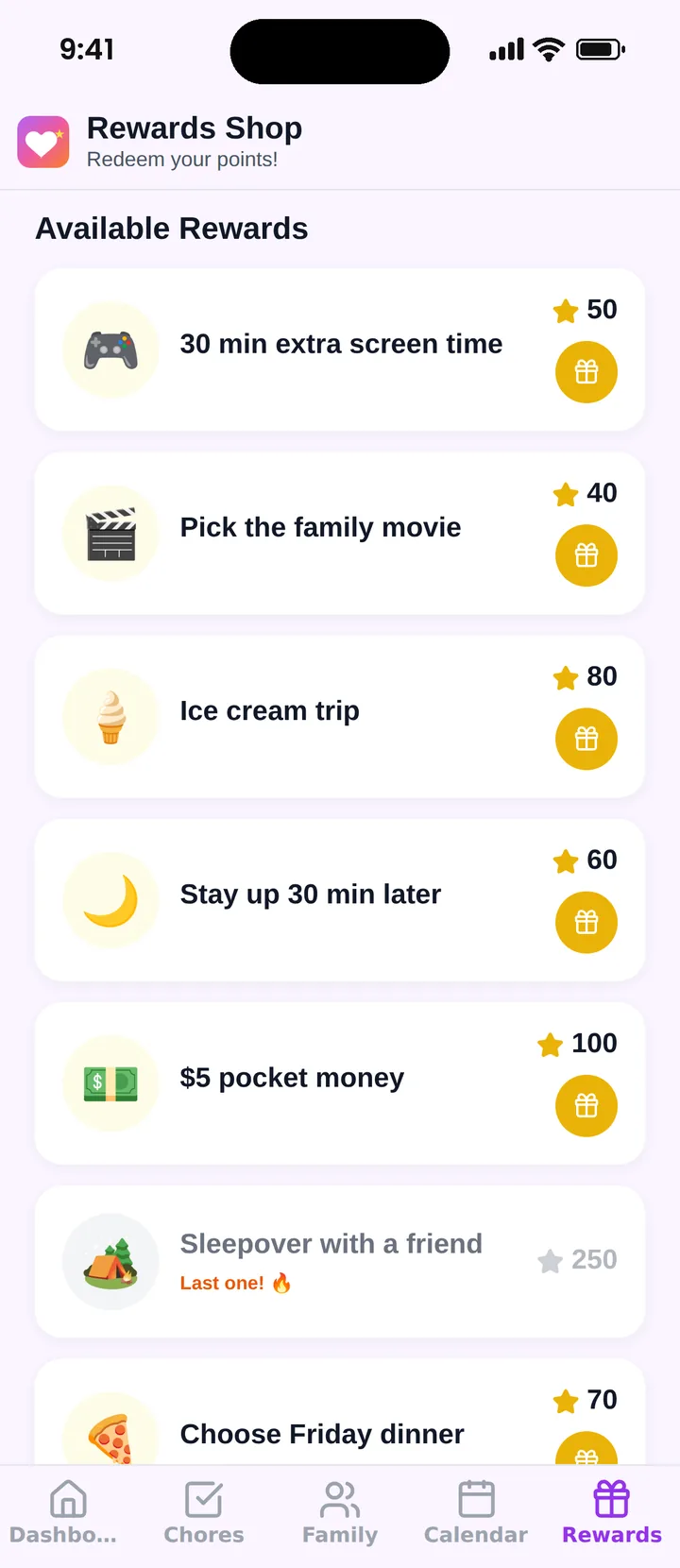
Pocket money can be a reward, but the money itself changes hands outside the app. Compare options in our list of the best reward chart apps for kids.
Choose one habit, set a small reward you can give today, and keep the rules the same for three weeks.
Frequently asked questions
Do reward charts actually work?
For many children, yes, for starting a specific habit. Positive reinforcement is a well-established idea in child development guidance, including from the AAP. Results depend on the child and the design: small, immediate, clear rewards work better than distant, vague ones.
Will rewards ruin my child's intrinsic motivation?
It can happen when a child already enjoys the activity and then gets paid for it. Use rewards for tasks a child finds dull, like chores, and not for reading or hobbies they love. Fade rewards over time and keep praising effort.
Is a digital reward chart better than paper?
Neither is better for everyone. Paper is tangible and good for ages 3 to 6. An app saves effort for you, syncs between parents and gives older kids a reward they can see building. Pick the one you will keep up for three weeks.
How many points should a reward cost?
A common setup is 5 points for a small task, 10 for a medium one, and 20 for a big one, with small rewards costing 30 to 50 points. A child should be able to afford a small reward every 2 to 3 days.
When should we stop using the reward chart?
When the behavior happens without it for several weeks. Stretch the gap first: fewer rewards, then rewards only for the hardest task. Many families keep a light version for big jobs and drop it for everything else.
Try Famiyo With Your Family
Chores with points, a rewards shop for kids and one shared family calendar. Set it up in a couple of minutes.



Free to download • No credit card required • Available on iOS & Android