Clothing Allowance for Teenagers: How to Set One Up
How to set a clothing allowance for a teenager: what to include, how much to start with, how to pay it, and rules that keep shopping from turning into a fight.
By Famiyo Editorial Team6 min read
Somewhere around age 12 or 13, clothes stop being something you buy and become something your kid has strong opinions about. A clothing allowance moves the decisions, and the consequences, to the person wearing the outfit. This guide covers what to include, how to pick an amount, how to pay it in a way that works on a phone, and what to do when it goes wrong in week two.
What a clothing allowance actually is
It is a fixed amount, paid on a schedule, that a teen uses to buy their own clothing. It is not a reward and it is not pocket money. It replaces the "can you buy me this?" conversation at the mall with a budget they manage.
The idea works because it turns a recurring argument into a system. You set the amount and the boundaries once. Your teen decides whether a $60 pair of sneakers is worth skipping three other purchases. That is real budgeting practice with stakes small enough to survive a mistake.
It also fits the broader picture of what teens should handle themselves. If you have not set the overall structure yet, our guide to allowance for teenagers covers how much, how often and what regular spending money should cover. The clothing budget sits next to it, as a second, separate amount.
What to include and what to leave out
The most common cause of failure is vagueness. "Clothes" turns into a debate about whether a gym membership hoodie counts. Write the list down.
| Usually covered by the teen's budget | Usually still yours |
|---|---|
| Everyday tops, jeans, hoodies, shoes | Winter coat when the old one is outgrown or worn out |
| Brand-name or trend items beyond the basics | School uniform or required dress code items |
| Accessories, hats, jewelry | Sports uniforms and team gear |
| Extra pairs of sneakers | Formal outfit for a wedding or a funeral |
| Seasonal wardrobe refreshes | Underwear and socks (many families keep these on the household list) |
Adjust the right-hand column to fit your family. The principle is to keep genuine needs with you and give the teen the choices that involve taste. A good test: if the item would cause a problem at school, in the weather or at an event, you buy it. If it is a style decision, the teen does.
Some families also keep a small "emergency" line. Outgrown shoes in the middle of the month are not a budgeting failure, and a teen who gets stuck with wet feet will not learn the lesson you were hoping for.
How much to give
There is no published standard, so work from your own numbers. Three steps:
- Add up what you spent on this child's clothes in the last 12 months. Check card statements if you do not remember.
- Remove the items you plan to keep buying yourself, like the coat and the uniform.
- Divide what is left by the number of payments you will make. Twelve for monthly, four for seasonal.
Say that leaves $480 a year. Monthly is $40. Seasonal is $120. Round to a number that is easy to remember and easy to move.
Two cautions. If your teen has been shopping on your card with no limit, the first budget will feel like a pay cut, because it is one. Explain that plainly. And if you can only afford a number that is clearly too low, say so and tell them you will revisit it in three months, once you both see how it goes. Teens handle "this is what we can do" far better than a number that seems to come from nowhere.
For the broader question of how much regular spending money a teen should get, the typical range in our allowance numbers for ages 14 and up is $15 to $25 a week. Clothing is a different pot, so do not subtract it from that.
Monthly or seasonal payments
Monthly is easier to run and easier to budget for. Seasonal gives bigger chunks and teaches saving, since a teen has to decide whether to blow it all in September or hold some back for a winter sweater.
| Monthly | Seasonal (4 times a year) | |
|---|---|---|
| Best for | Ages 12 to 14, first budget | Ages 15 and up, some experience |
| Teaches | Small, regular decisions | Planning and saving up for bigger items |
| Risk | Frequent small purchases of low-quality items | A teen spends everything in the first week |
| Admin | One payment on a fixed date each month | Four payments, tied to back to school, winter, spring, summer |
If you are unsure, start monthly and move to seasonal once your teen has run out of money early at least once and handled it calmly.
How to pay it
Pick a method that matches how your teen actually shops. If they buy mostly online, a transfer to a teen account or a prepaid card is easier than cash. If they shop in person with friends, cash or a card works fine. The important thing is that payment lands on the same day every period, without a reminder. If you forget, the system loses credibility fast.
Keep the money separate from their regular spending money, ideally in a different account or envelope. Mixing the two is how "I had nothing left for shoes" turns into "you owe me $50".
Set the ground rules before the first payment
A short conversation, before money changes hands, saves a lot of arguing later. These are the points to cover:
- The amount and the payment date
- What is covered and what is not (use the table above)
- Your veto: anything that breaks school rules, safety or your family's values stays off the table
- What happens when the money runs out (nothing, until the next payment, except genuine needs)
- Returns: items bought with clothing money can be returned, but the refund goes back to the clothing pot
Then say the key sentence out loud: "If you run out, we do not top it up for wants. We cover real needs." Teens test this once. How you respond decides whether the system works.
When the first overspend comes, resist the urge to rescue. Ask what they would do differently, listen, and leave it there. The reasons behind that approach are the same ones in our piece on how to teach kids about money: small failures at 14 are far cheaper than large ones at 24.
Keeping it separate from chores and jobs
Do not tie the clothing allowance to chores. Clothes are a need. If chore performance can shrink it, you end up in a negotiation about whether a missed bathroom clean is worth a pair of jeans, and neither lesson survives.
Extras are different. If your teen wants a $120 jacket on top of their budget, that is a good moment for the chores-for-money conversation. Our guide to chores for teenagers to earn money covers fair rates for bigger jobs, and first jobs for teens covers what to do once earning outside the house becomes realistic. Many families reduce the clothing allowance when a teen starts a regular job, then agree on what moves to the teen's own paycheck.
Tracking extras and pocket money in Famiyo
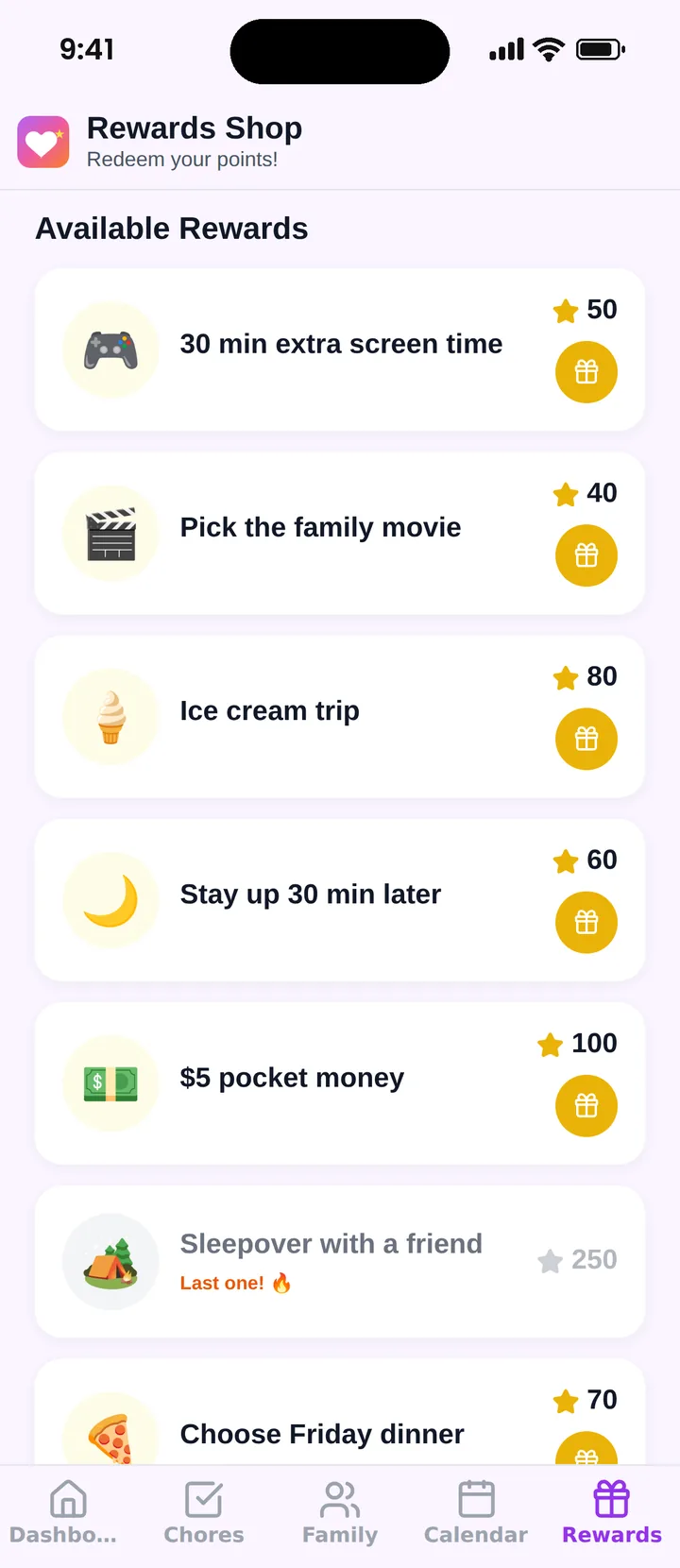
Famiyo is a free family app for iPhone and Android that combines a shared family calendar, chores with points and a rewards shop; kids join with a code, no email needed. It does not hold or move money, and the clothing allowance itself should stay outside the app. Where it helps is the optional extras layer: your teen earns points for chores, and you add rewards to the rewards shop, such as "$10 toward clothes" or a pocket money payout, at a price in points you choose. Using the default of 100 points to $1, that reward would cost 1,000 points. The money itself changes hands in real life. For other tools to compare, see our list of the best allowance apps for kids.
Review after one season
Mark a date in your calendar for three months out. At the review, ask three questions: Was the amount enough for the basics? Did anything happen that a rule should have covered? Is it time to move to seasonal or to raise the amount?
Adjust, write down the change and keep going. A clothing allowance that nobody reviews turns into a fixed cost that nobody understands, which is the opposite of what you were trying to build.
Frequently asked questions
How much clothing allowance should a teenager get?
Start from what you already spend on their clothes in a typical year, divide it by the number of payments, and adjust after a trial season. There is no standard figure. Fit it to your budget, your teen's needs and local prices.
Should a clothing allowance be separate from regular allowance?
Yes, in most families. Pocket money is for wants. Clothing money covers a need. Keeping two amounts, ideally on two dates, stops a teen from blending them and then saying the shoes were 'taken out of my allowance'.
Should teens earn a clothing allowance through chores?
No. Clothes are a basic need, so the budget should not depend on chore performance. Pay it regardless, and let chores or a job fund extras. That keeps the lesson about budgeting clean.
What happens if a teen spends it all early?
Let it stand. Running out before the next payment is the lesson. Cover genuine needs like a coat in winter or shoes that no longer fit, then ask the teen to cover wants from their own money until the next payment.
At what age should I start a clothing allowance?
Most families begin between 12 and 14, when a teen starts caring about brands and fit and can handle a monthly or seasonal budget. Younger kids can start with a small, supervised version for one category, like shoes.
Try Famiyo With Your Family
Chores with points, a rewards shop for kids and one shared family calendar. Set it up in a couple of minutes.



Free to download • No credit card required • Available on iOS & Android