Chores for 5-Year-Olds to Earn Money: Jobs and What to Pay
Paid chores for 5-year-olds: which jobs to pay for, what to pay (25 cents to a few dollars), and how to track it with points so money stays simple.
By Famiyo Editorial Team6 min read

At five, a child can carry a laundry basket halfway down the hall and then announce that they would like to be paid for it. That is a decent time to start talking about money, as long as you keep the lesson small. This guide covers which jobs are worth paying a kindergartener for, what the pay should be, and how to track it so you are not hunting for quarters.
Which chores should stay unpaid
Before the pay list, draw a line. Basic "family member" jobs stay unpaid. For a 5-year-old that means roughly 10 to 15 minutes a day of things like making the bed (roughly), setting and clearing their own place, matching socks, watering plants and feeding a pet with help.
Why unpaid? These are the jobs everyone in the house does because they live there. If you pay for each of them, the child learns that nothing happens without a fee. Keep a second category for extras, the jobs that go beyond the daily basics. That is what pay is for.
If you are not sure where the line falls for your family, our article on paid chores for 4-year-olds shows the same split for a younger child, and the one for 6-year-olds shows how it shifts a year later.
Paid jobs a 5-year-old can really do
These jobs are extras, take a few minutes to maybe half an hour with help, and have a clear "done" moment. The prices use the common ranges of $0.25 to $1 for a small extra job and $2 to $5 for a big one.
| Job | Time | What counts as done | Pay |
|---|---|---|---|
| Sort the sock basket into pairs | 10 min | All pairs matched, none left over | $0.25 |
| Wipe the table and chairs after dinner | 5 min | No crumbs on the surface | $0.25 |
| Water all the indoor plants | 5 min | Each pot has a small cup of water | $0.50 |
| Pull weeds in one garden patch (with you) | 15 min | A bucket full | $0.50 |
| Wash the lower half of the car with a sponge | 20 min | All the doors they can reach | $1 |
| Tidy the toy closet or a drawer | 20 min | Everything sorted into bins | $1 |
| Help bag leaves or pick up sticks | 30 min | The yard patch is clear | $2 |
| Help wash the car start to finish | 45 min | Washed and rinsed, with you doing the high parts | $3 |
| Big job: rake a small yard section | 45 min | A visible clean area | $5 |
You will notice nothing on this list involves sharp objects, chemicals or the stove. At five, the best paid jobs are physical, repeatable and easy to check at a glance.
How much is too much?
Keep chore pay modest. If you also give a weekly allowance, the typical range for ages 5 to 7 is $3 to $7, and chore pay is on top of that, not a replacement. A rule of thumb many parents use is about $1 a week for each year of age, which would put a 5-year-old near $5, though it is a starting point and not a standard.
Think in terms of what you want the child to learn. A few dollars a week is enough to buy a small toy in a month or two. That is real, understandable and still within the attention span of a 5-year-old.
For a closer look at pay scales for other ages, see our guide on paid chores for 7-year-olds.
Use points first, money second
Cash is abstract for a kindergartener. A coin goes into a pocket and is gone by dinner. Points are easier to see, count and plan around, and you can convert them when it is time.
A workable setup:
- Small job (2 to 5 minutes): 5 points
- Medium job (10 to 15 minutes): 10 points
- Big job (30 minutes or more): 20 points
- Bonus for doing it without a reminder: +2 points
If you want to convert to money, 100 points equals $1. So a child who earns 40 points in a week has earned 40 cents. Choose the conversion that makes the math clean for you and stick to it.
Let the child pick a goal first. "You need 300 points for the dinosaur puzzle." Count together on a few evenings. A 5-year-old learns the idea of saving much faster when the finish line is something they want and can picture.
A sample paid week
Here is what a realistic week might look like for a 5-year-old in a points-first setup. The unpaid basics happen every day and are not listed.
- Monday: Sort the sock basket, 5 points.
- Wednesday: Water the plants, 5 points, plus 2 for starting without a reminder.
- Friday: Tidy the toy closet, 10 points.
- Saturday: Help wash the car, 20 points.
- Sunday: Cash in or save. The child chooses how many points to spend.
That is 42 points, about 42 cents at the 100-to-$1 rate. It sounds small, because it is. A reward worth 300 points is about seven weeks of steady work at this pace, which is a good first lesson in patience.
What to say when they ask for money for everything
It will happen. A 5-year-old who has just learned that jobs earn money will test the edges. A few lines that help:
- "That one is part of living here, so it's not paid. The car wash is an extra job, and that one is."
- "You can earn points for that. Do you want to do it today or Saturday?"
- "Nice work on the bed. That's your job and I noticed."
Keep your tone friendly and flat. The point is not to win the argument but to keep the two lists clear.
Teaching the money part
Earning is only half the lesson. Once a child has a handful of points or a few coins, give them something to do with it. The simple spend, save, give split works for young kids, for example 50% to spend, 40% to save and 10% to give. With a 5-year-old, you can make it physical: three jars, three labels, a coin in each.
Talk about it in short bursts. "You have 60 points. The puzzle costs 300. How many more weeks?" Do not expect them to do the math. The goal is to connect effort, waiting and something they want. Let them make small mistakes, too. A child who spends everything on a sticker book and then wants the puzzle will learn more from that than from a lecture.
If a week goes badly and few jobs get done, just let the points be what they are. The next week starts clean, and the pay stays tied to the work.
Doing paid chores with Famiyo
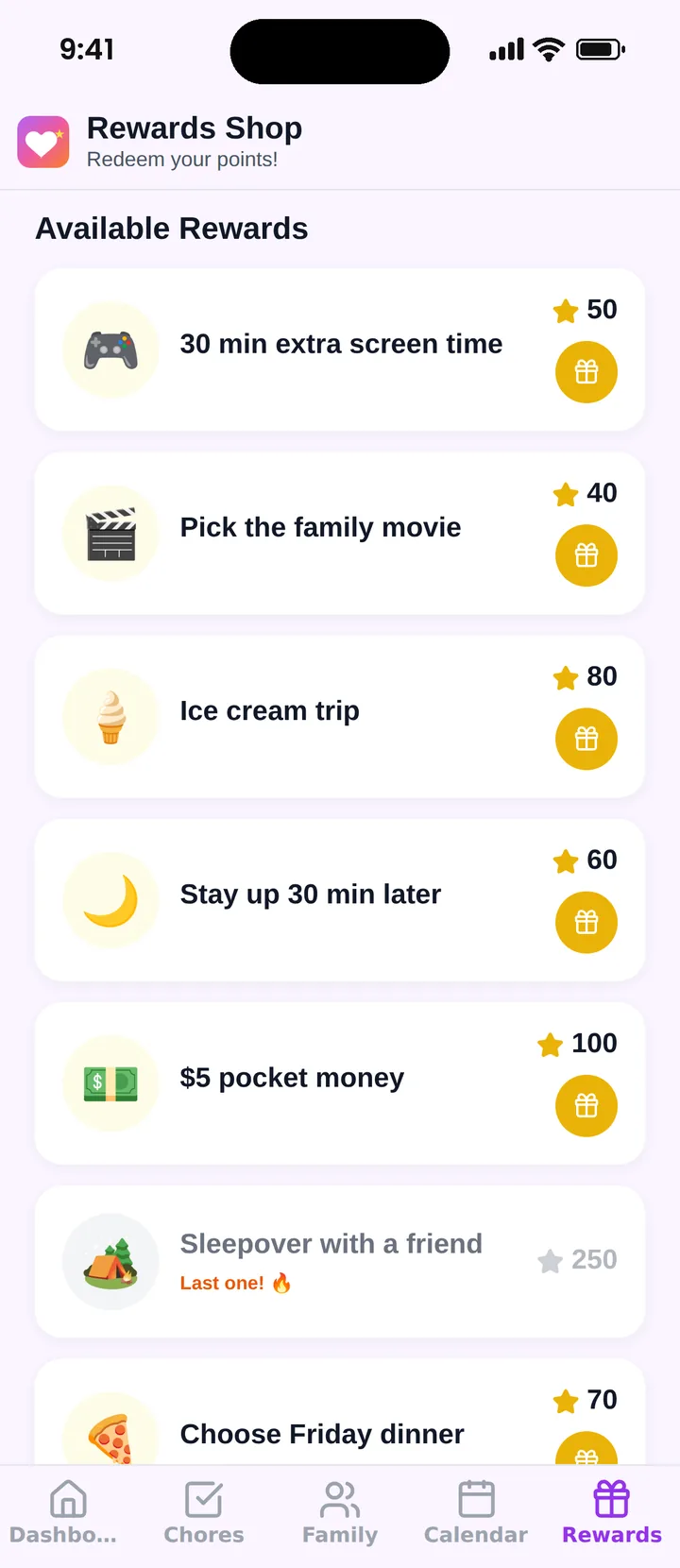
Famiyo is a free family app for iPhone and Android that combines a shared family calendar, chores with points and a rewards shop; kids join with a code, no email needed. For a 5-year-old, the rewards shop is the useful part: your child earns points for each chore, and you set the rewards that points can buy, including pocket money, with a price in points. They redeem from their own phone and see how many points they will have left. Famiyo does not move or hold real money, so when they redeem a pocket money reward, you hand over the cash yourself. See our list of the best allowance apps for kids if you are comparing options.
Before you start
Pick three paid jobs from the table and one reward your child wants. Explain the rule in two sentences, then run it for two weeks before changing anything. A system that is simple enough to explain at breakfast is simple enough to last.
Frequently asked questions
How much should a 5-year-old get paid for chores?
A small extra job is worth about $0.25 to $1, and a big one $2 to $5. If you also give a weekly allowance, the typical range for ages 5 to 7 is $3 to $7, so keep chore pay on top of that modest.
What chores should a 5-year-old do without pay?
The everyday jobs that come with being in the family: making the bed, putting toys away, clearing their own place, feeding a pet with help. Pay is for extras that go beyond those basics.
Should I pay a 5-year-old in cash or points?
Points work well at this age because a 5-year-old can count progress toward a goal without handling money. You can convert at 100 points to $1 when they want to cash in, and the money itself changes hands outside the app.
What if my 5-year-old only does chores when there is money?
Narrow the paid list to a few extra jobs and keep basic chores unpaid and expected. Praise the unpaid work out loud. If the pay is the only motivation for everything, it has crept into the basics.
Is 5 too young to learn about money?
No. Five is a good age to learn that money comes from effort, that coins have different values and that you can save for something. Keep it short and concrete, such as a jar and a goal.
Try Famiyo With Your Family
Chores with points, a rewards shop for kids and one shared family calendar. Set it up in a couple of minutes.



Free to download • No credit card required • Available on iOS & Android