Paid Chores for 4-Year-Olds: Jobs to Earn Money and What to Pay
Which extra jobs a 4-year-old can earn coins for, what to pay (usually $0.25 to $0.50), and how to start without turning every chore into a deal.
By Famiyo Editorial Team6 min read

A 4-year-old will happily sweep the porch for a quarter, then spend it on the first shiny thing in the checkout aisle. That is not a failure. It is the first lesson, and it is the one you can actually teach at this age. Below you will find jobs worth paying for, fair amounts, a sample week and the exact words to introduce the idea.
Should you pay a 4-year-old for chores at all?
Most families keep everyday jobs unpaid. Putting toys in the bin, clothes in the hamper and clearing their own plate are what you do because you live in the house. Money is for extras, the things you might otherwise pay a neighbor's teenager to do.
At 4, the amount hardly matters. What sticks is the pattern: I did a job, I got a coin, I chose what to do with it. If you would rather skip cash completely, a token system for kids' behavior gives the same pattern with stars or tokens, and you can convert later.
One rule keeps this from going sideways. Paid jobs are optional. If your child says no to a paid job, nothing happens, and that is part of the lesson. Unpaid jobs are not optional, and no coin changes that.
Paid jobs a 4-year-old can really do
The best paid jobs at this age are short, physical, and finish with something you can see. Think ten minutes or less. Show the job once, do it together the first time, and keep your standards at "done enough".
| Job | What done looks like | Time | Pay |
|---|---|---|---|
| Sort the recycling | Paper in one bin, bottles in the other | 5 min | $0.25 |
| Wipe the patio or porch table | Damp cloth, whole top, no puddles | 5 min | $0.25 |
| Dust the baseboards | One sock on a hand, one room | 5 min | $0.25 |
| Brush crumbs from under the kitchen table | Hand brush and dustpan, you help with the pan | 5 min | $0.25 |
| Water the garden beds | Small watering can, every bed you point to | 5 min | $0.25 |
| Wash plastic toys | Tub of soapy water, rinse, towel on the grass | 10 min | $0.50 |
| Collect sticks or pinecones | Bucket full | 10 min | $0.50 |
| Pull weeds from a marked patch | You point at the weeds and they pull | 10 min | $0.50 |
| Match the family's clean socks | All pairs found, pile on the couch | 10 min | $0.50 |
| Wash the lower car doors and wheels | Sponge and bucket, you do the top | 15 min | $1 |
Notice what is not on the list: anything with a stove, a blade or a chemical. A 4-year-old can scrub a plastic dinosaur. They cannot be left with spray cleaner.
What to pay a 4-year-old
The usual range for a small extra job is $0.25 to $1, and a 4-year-old belongs at the bottom of it. Two quarters for a ten-minute job feels like a fortune to them. The bigger $2 to $5 jobs that older kids get simply do not exist at this age.
You may have heard the rule of $1 a week per year of age, which would be $4 for a 4-year-old. It is a starting point for allowance, not a standard, and it does not map neatly onto per-job pay. For a child this young, a dollar or two in a normal week is plenty.
Some practical choices:
- Pay in coins, not bills or a number on a screen. A quarter is something a child can hold, count and drop in a jar.
- Use a clear jar, so the pile visibly grows.
- Pay right away. A 4-year-old will not carry a promise of Saturday money through a Tuesday.
- Pay the same for the same job, whichever child does it.
- Never take money back as a punishment. The jar is theirs once they have earned it.
If you like the spend, save, give habit, you can keep it very simple: one coin goes in the "give" box, the rest is spend or save. The 50, 40 and 10 percent split is a good target for older kids, but on a quarter it is just arithmetic nobody enjoys.
A sample week
Three or four paid jobs is a busy week for a preschooler. Here is one that stays under $3.
| Day | Paid job | Pay |
|---|---|---|
| Monday | Sort the recycling | $0.25 |
| Wednesday | Wash plastic toys in the tub | $0.50 |
| Friday | Wipe the patio table | $0.25 |
| Saturday | Pull the marked weeds, then wash the car wheels | $0.50 + $1 |
That comes to $2.50, and every other day is just regular family life with no money attached. When your child turns 5, the jobs get a little longer and the pay moves up; our guide to paid chores for 5-year-olds picks up from here.
How to introduce paid jobs: what to say
- Pick a calm moment and put the jar on the table. Let your child pick it, it makes it theirs.
- Explain the difference in plain words: "In our family everybody helps with toys and plates. That is just what we do. Extra jobs earn quarters."
- Do the first job together and say what finished looks like: "All the bottles are in this bin, all the paper is in that one."
- Pay in coins right away, and say what you saw: "You sorted the whole pile. That is a quarter."
- Within a week, let them spend a little of it on something they chose. A sticker, a small pack of crayons, a ride on the coin horse outside the grocery store.
The spending part matters as much as the earning. A coin that never turns into anything stays a coin.
Money in a world of taps and cards
Your 4-year-old rarely sees money change hands. You tap a phone, a bag appears. That makes money a little like magic, and it is a good reason to use physical coins at this age. Let them hand the cashier a coin once in a while, and point at the price tag before they choose.
Points can be a bridge. If you use the common conversion of 100 points to $1, a 25-point job pays a quarter and a 50-point job pays two. You are not asking a 4-year-old to do the math. You are keeping your own record straight so the pay stays fair from week to week. Our chore point system guide shows how to set point values for the everyday chores.
When it goes wrong
Your child asks "what do I get?" for putting toys away. Stay friendly and stay put: "Toys are for everyone in the family. Extra jobs are for quarters." If you pay once, you will be paying forever.
Your child loses interest after two weeks. Normal. Paid jobs are optional, so let a few weeks go by without them, then bring one back when the jar is empty.
Two siblings argue over who gets which job. Offer the same list to both, with the same pay, and let them take turns choosing first.
Your child wants to spend everything the day they earn it. Let them. A 4-year-old who buys a small thing and then wants a big thing will understand saving far better than one who got a lecture about it.
Tracking points and rewards in Famiyo
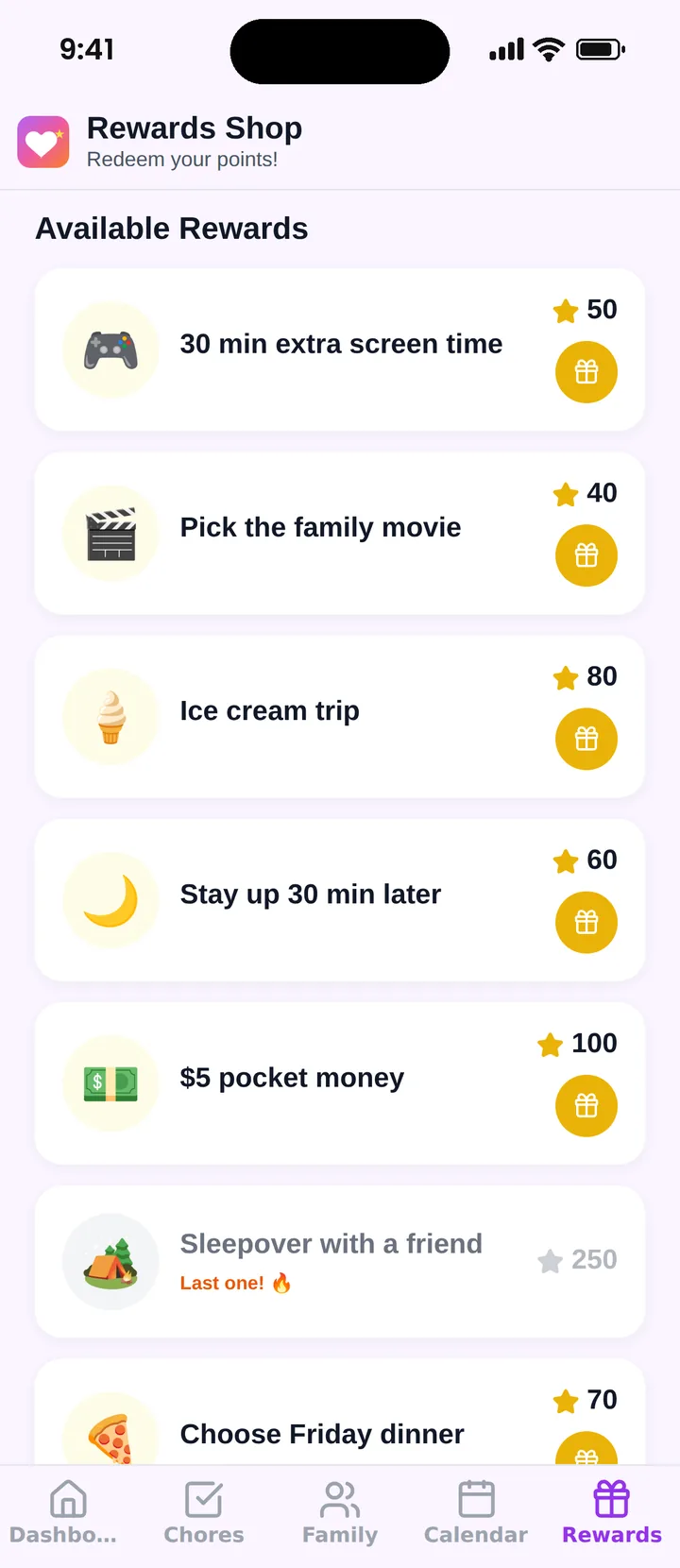
Famiyo is a free family app for iPhone and Android that combines a shared family calendar, chores with points and a rewards shop; kids join with a code, no email needed. For a 4-year-old, you will usually be the one holding the phone, so set chores to need your approval and tap them done together.
Give each paid job a point value, for example 25 points for sorting recycling, and add a reward such as "$1 in your jar" for 100 points. Pocket money can be a reward in the rewards shop, but the money itself changes hands outside the app, so you pay the coins as usual.
If you are comparing tools, our list of the best allowance apps for kids sets out what each one does.
Your next step
Pick one job from the table, keep it to ten minutes, and keep a jar and a few quarters nearby. Run it this weekend, pay right away, and see what your child does with the coin.
Frequently asked questions
How much should I pay a 4-year-old for chores?
Stay at the low end of the usual range for a small extra job, which is $0.25 to $1. Most 4-year-olds do well with $0.25 or $0.50 per job, paid in coins right after the work, and a dollar or two in a typical week.
Should a 4-year-old get an allowance?
It is optional. At this age a child cannot hold a weekly promise in their head, so many families skip a fixed allowance and pay small coin amounts for extra jobs. Everyday family chores should stay unpaid.
What chores can a 4-year-old do to earn money?
Think short, concrete extras with a clear finish: sorting recycling, washing plastic toys in a tub, collecting sticks in a bucket, pulling weeds you point to, wiping the patio table, or matching the family's clean socks.
Should I pay my 4-year-old in cash or points?
Either works. Coins are easier to understand because a 4-year-old can see and count them. Points work as a bridge: if 100 points equal $1, a 25-point job pays a quarter, and they can be swapped for coins.
Try Famiyo With Your Family
Chores with points, a rewards shop for kids and one shared family calendar. Set it up in a couple of minutes.



Free to download • No credit card required • Available on iOS & Android