Paid Chores for 7-Year-Olds: Jobs to Earn Money and What to Pay
Chores for 7-year-olds to earn money: 15 paid jobs with prices from $0.25 to $5, which chores stay free, and how to track pay with points or an app.
By Famiyo Editorial Team5 min read

Seven is when kids start asking where money comes from and what it can buy, and when they are strong and reliable enough to do jobs that are worth something. This page lists real paid jobs for a 7-year-old, what to pay, where the line sits between free chores and paid ones, and how to track it all without carrying around quarters.
Free chores first, paid jobs second
Before the price list, sort the jobs into two groups. Free jobs are the everyday basics a family member does because they live there. At 7, that usually means 15 to 20 minutes a day: sorting laundry by color, emptying unbreakable dishes from the dishwasher, sweeping, packing the school bag and tidying their room.
Paid jobs are extras, the occasional things that go beyond daily upkeep. This split keeps money from becoming the reason to do anything at all. If you want the reasoning, see our look at whether kids should get paid for chores, which weighs both sides.
A handy test: would you ask a houseguest to do it? Then it is an extra. Would every person in the house be expected to? Then it is free.
15 paid jobs for a 7-year-old
The prices follow the usual ranges: $0.25 to $1 for a small extra job and $2 to $5 for a big one. Times assume a child who has done the job before.
| Job | Time | What "done" looks like | Pay |
|---|---|---|---|
| Sort the recycling into bins | 5 min | Paper, plastic and glass in the right bins | $0.25 |
| Wipe baseboards in one room | 10 min | No dust lines along the wall | $0.25 |
| Water the garden or window boxes | 10 min | Every plant has been watered | $0.50 |
| Wash the dog's bowls and refill them | 5 min | Clean and full | $0.50 |
| Sweep the porch or garage floor | 15 min | All debris in the dustpan | $0.50 |
| Wipe down kitchen cabinet fronts | 15 min | No sticky spots | $0.75 |
| Clean the bathroom mirror and sink | 15 min | Streak-free, counter clear | $1 |
| Match and fold the whole family's socks | 15 min | Every pair matched | $1 |
| Organize a closet shelf or toy storage | 20 min | Everything sorted and labeled | $1 |
| Pull weeds in a garden bed | 25 min | A full bucket, roots included | $2 |
| Help bag leaves | 30 min | Yard patch clear | $2 |
| Wash the car's lower half and wheels | 30 min | No dirt visible up to the door handles | $3 |
| Dust and vacuum the living room | 30 min | Surfaces wiped, floor clear of crumbs | $3 |
| Help wash the whole car (with you) | 45 min | Washed, rinsed, dried | $4 |
| Clear a small yard of sticks and rake leaves | 45 min | A visible, clear area | $5 |
Nothing on the list uses the stove, a knife or a strong chemical. For a younger child, our guide on paid chores for 6-year-olds has a shorter, simpler list, and the one for 8-year-olds adds jobs that need more independence.
How much money is too much?
Keep chore pay small. A good guide is the weekly allowance range for ages 5 to 7, which is $3 to $7. A common rule of thumb of $1 a week per year of age would put a 7-year-old at $7, though it is only a starting point.
If you already give an allowance, treat chore pay as a bonus on top. If you do not, a child doing three or four extra jobs a week will land in a similar range. Do the math before launching, so you are not surprised by a $20 weekly bill when the child discovers car washing.
Points first, then cash
A 7-year-old can count, but holding cash tends to disappear it. Points make the tally visible and let you adjust prices without a conversation about change. The default scale:
- Small job (2 to 5 minutes): 5 points
- Medium job (10 to 15 minutes): 10 points
- Big job (30 minutes or more): 20 points
- Bonus for starting without a reminder: +2 points
At 100 points to $1, those point values are pocket change, so the dollar prices in the table above need bigger numbers. Convert them directly: the $3 car wash becomes 300 points, and a $0.50 watering job becomes 50 points. Use the small scale for everyday habits and the bigger one for paid extras, and tell your child which is which.
Our guide on the chore point system shows how to set values for different tasks if you want more detail.
Make money visible: spend, save, give
Seven is old enough for a three-jar rule. A split many families use for younger kids is spend, save and give, for example 50%, 40% and 10%. If the child earns $4, that is $2 to spend, $1.60 to save and 40 cents to give.
Let them pick the saving goal. A $20 toy takes a few weeks at this pace, which is long enough to feel real and short enough to reach. Check in weekly with a simple question: "How close are you?" You are teaching patience, so resist the urge to top it up. If you want to extend the lesson, a later step is teaching kids about investing, which can wait a few years.
What to say about paid jobs
Kids do better when the rules are said out loud once and then repeated calmly. A script:
- "These jobs are every day and everyone does them. They don't earn money."
- "These are extra jobs. You can pick one, and you get paid when I check it."
- "If you do the job, you get paid. If you skip it, you don't, and that's fine."
- "You can save, spend or give your pay. Let's decide your split."
Pay promptly and exactly. If you promised $2 and do $1.50 "because it wasn't perfect," trust takes a hit. If the job is not done well, ask them to fix it first, then pay.
What to do if money becomes the point
Some 7-year-olds start asking "how much?" for everything, including brushing their teeth. This is common and fixable. Narrow the paid list to a handful of extras. Say out loud that the basics are not for sale. Praise the unpaid work specifically: "You packed your bag without me asking, that was all you."
If you are seeing real resistance to unpaid chores, the answer is rarely more money. It is usually a clearer routine and fewer jobs at once.
Tracking paid chores in Famiyo
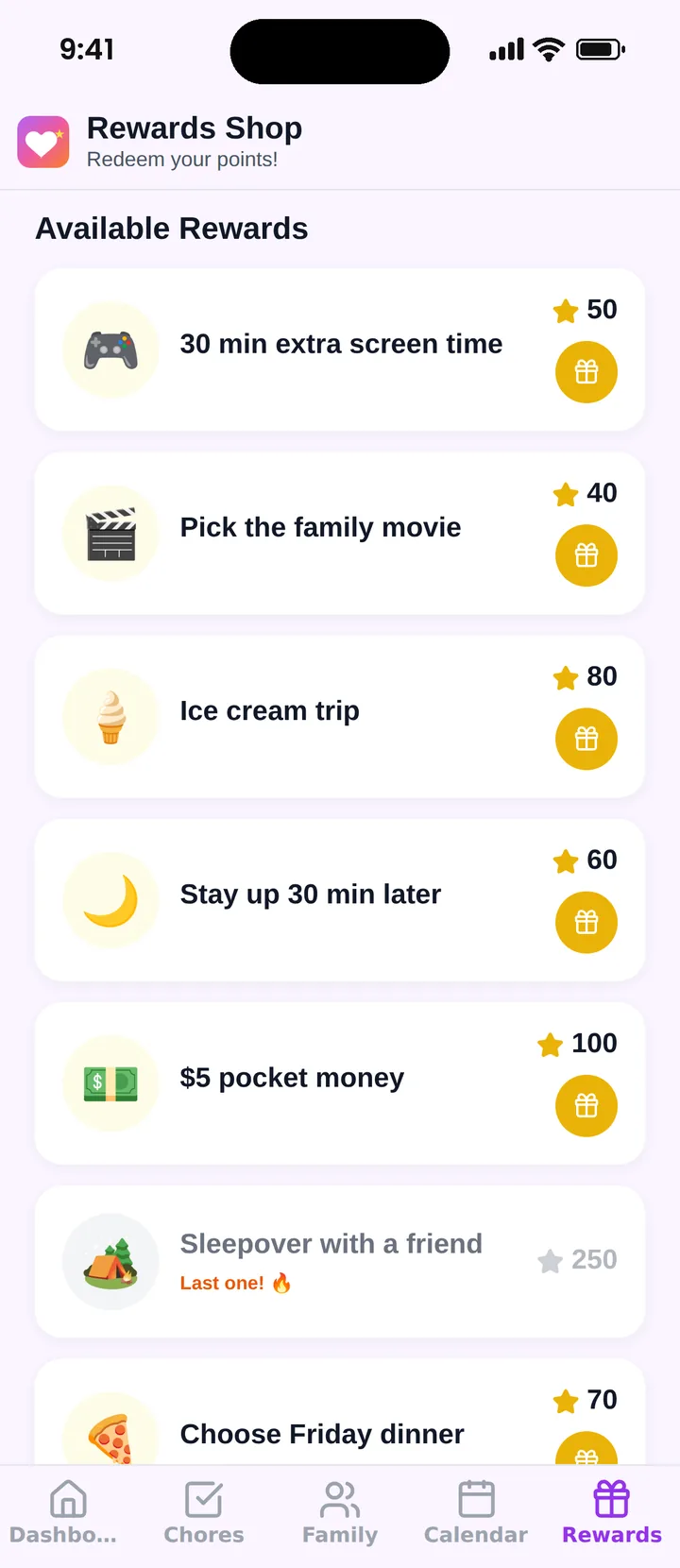
Famiyo is a free family app for iPhone and Android that combines a shared family calendar, chores with points and a rewards shop; kids join with a code, no email needed. You set the extra jobs as chores with points, and your 7-year-old checks them off on their own phone, or you approve them first. Points go toward rewards you create in the rewards shop, and pocket money can be one of those rewards, with the cash handed over by you, since Famiyo does not hold or move money. See our list of the best allowance apps for kids for options.
Pick three extra jobs from the table this week, and give each a price you can pay without wincing.
Frequently asked questions
How much should a 7-year-old earn for chores?
Pay $0.25 to $1 for a small extra job and $2 to $5 for a big one. If you give an allowance too, the usual range for ages 5 to 7 is $3 to $7 a week, so chore money sits on top of a modest base.
What chores should a 7-year-old do for free?
Everyday jobs that come with living in the house: tidying their room, packing the school bag, sorting laundry by color, feeding a pet, clearing their place. Expect about 15 to 20 minutes a day of these, unpaid.
Should I pay my 7-year-old in cash or points?
Points are easier to keep track of and let a child save toward a goal before any money moves. Use 100 points to $1 when you convert. The money itself changes hands outside any app, in cash or into a jar.
Is it okay for a 7-year-old to refuse paid jobs?
Yes. Paid jobs are optional extras, so a no is allowed, and the child just doesn't earn that week. Unpaid family chores are different and stay expected, with or without a reward.
How can a 7-year-old earn money besides chores?
Outside the house, options are limited at this age. Inside the family, you can offer extra jobs such as washing the car, helping a neighbor rake with an adult nearby, or a small lemonade stand with a parent running the money.
Try Famiyo With Your Family
Chores with points, a rewards shop for kids and one shared family calendar. Set it up in a couple of minutes.



Free to download • No credit card required • Available on iOS & Android