Paid Chores for 8-Year-Olds: Jobs to Earn Money and What to Pay
Paid chores for 8-year-olds that make sense: 18 extra jobs with fair prices from $0.25 to $5, which chores stay unpaid, and how to track it all on a phone.
By Famiyo Editorial Team5 min read
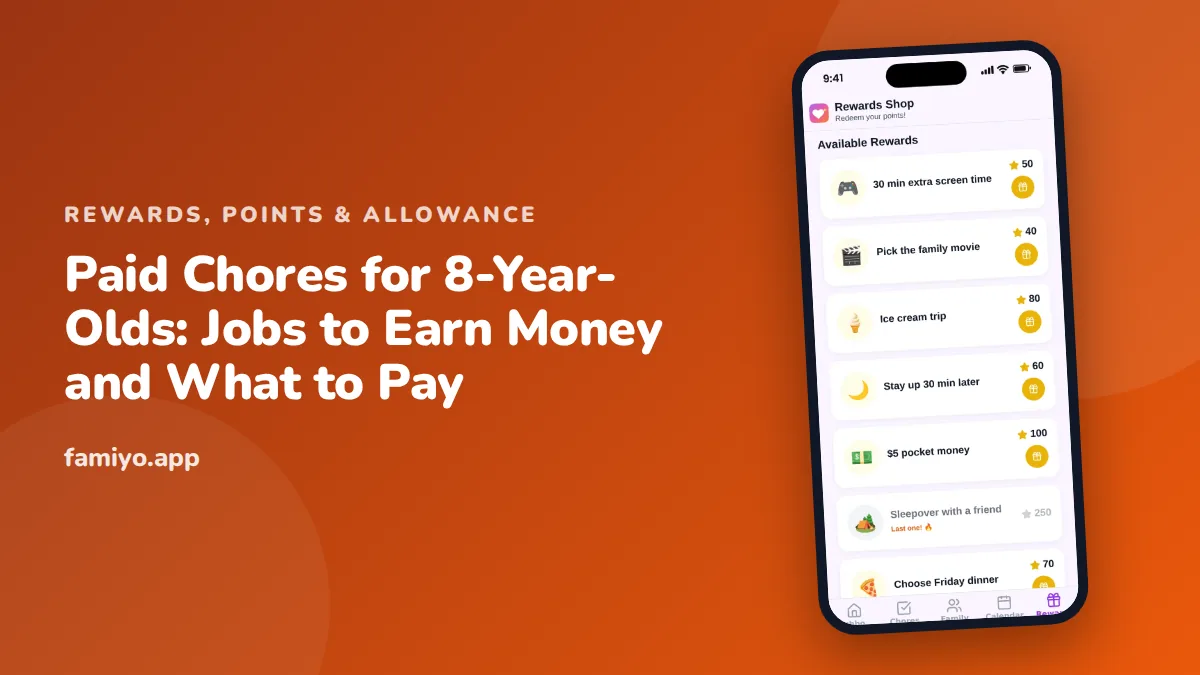
Eight is a good age to introduce earning, because kids can do real work and finally understand what a dollar buys. The trick is deciding which jobs get paid and which are simply part of living in the house. Below you'll find a pay scale, 18 extra jobs with prices, a split between paid and unpaid chores, and a way to track it on a phone so you aren't digging for quarters on Friday night.
Paid chores versus family chores
Start with the dividing line. A common approach, and the one used here, is that everyday chores are unpaid and extra jobs are paid. The unpaid category is what a person does because they live in the house: making the bed, putting dirty clothes in the hamper, clearing their plate, tidying their room, feeding a pet. At 8 these take about 20 to 30 minutes a day in total.
Paid jobs are the ones you'd otherwise do yourself or hire help for: washing the car, raking leaves, cleaning out the garage shelf. If you'd like to think through the bigger question first, see our pros and cons on whether kids should get paid for chores.
This split protects you from a problem that shows up often: a child who says "how much will you pay me?" to carry a plate. With a clear line, the answer to that is "that one's free, and here's the list of jobs that pay."
What to pay an 8-year-old
The guideline in most families is $0.25 to $1 for a small extra job and $2 to $5 for a big one. Think in time and effort:
| Job size | Time | Pay |
|---|---|---|
| Small | 5 to 10 minutes | $0.25 to $1 |
| Medium | 15 to 30 minutes | $1 to $2 |
| Big | 30 minutes or more | $2 to $5 |
If you use points instead of cash, the Famiyo-style scale maps neatly: 100 points equals $1, so a small job is 25 to 100 points and a big one is 200 to 500. Pay for finished, checked work. A job that's half done gets half the pay, and you say so calmly, not as a punishment.
18 paid jobs for an 8-year-old
| Job | What "done" looks like | Typical pay |
|---|---|---|
| Sort the recycling | Paper, plastic and glass in the right bins | $0.50 |
| Wipe the patio or porch table | Clean and dry, chairs pushed in | $0.50 |
| Wipe baseboards in one room | No visible dust along the edges | $1 |
| Clean the car's inside (hand vacuum) | Floor mats shaken, seats vacuumed | $1 |
| Water the garden or pots | Every plant watered, hose coiled | $0.50 |
| Pull weeds from one bed | Bed visibly clear, weeds in the bucket | $1 to $2 |
| Wash the windows (low ones) | Streak-free, with an adult spot-check | $1 |
| Vacuum the stairs | Every step, edges included | $1 |
| Organize a shoe or coat closet | Pairs matched, items back in place | $1 to $2 |
| Rake a section of the yard | Pile bagged or on the tarp | $2 |
| Wash the car (outside) | Soaped, rinsed, wheels done | $3 to $5 |
| Help wash and dry the dog | Dog clean, towels in the hamper | $1 to $2 |
| Dust the whole living room | Shelves and tables, with a cloth | $1 |
| Clean out a kitchen drawer | Items sorted, wiped, back in order | $1 |
| Fold and put away a family's towels | Every towel folded, in the closet | $1 |
| Sweep the garage or entryway | Floor swept, dustpan emptied | $1 to $2 |
| Wipe down the bathroom counters and mirror | Streak-free, items back | $1 |
| Help with a big weekend clean | Specific list agreed in advance | $3 to $5 |
Pick three or four to put on offer each week rather than showing the whole list. Choice keeps it feeling like a deal instead of an order. For comparison, our guides to paid chores for 7-year-olds and 9-year-olds show how the list grows from one age to the next.
Set the rules before the first job
Money conversations go better when the rules exist before the first dollar changes hands. Four are enough:
- Paid jobs are optional and listed. A child can say no.
- The job is finished before it's paid, and a parent or the child checks it against what "done" means.
- Pay day is the same day each week.
- Everyday chores happen first. Paid jobs come after.
Once the system is in place, add the money lesson. Give your 8-year-old a simple split, like 50% to spend, 40% to save and 10% to give. A jar for each works. When they say they want something that costs $20, show them how many weeks it takes. For more on teaching that, see teaching kids money management.
Doing it with points in Famiyo
Famiyo is a free family app for iPhone and Android that combines a shared family calendar, chores with points and a rewards shop; kids join with a code, no email needed. Many parents of 8-year-olds use it as the tracking layer for paid chores: each extra job is a chore with points, and the child sees their total on their own phone.
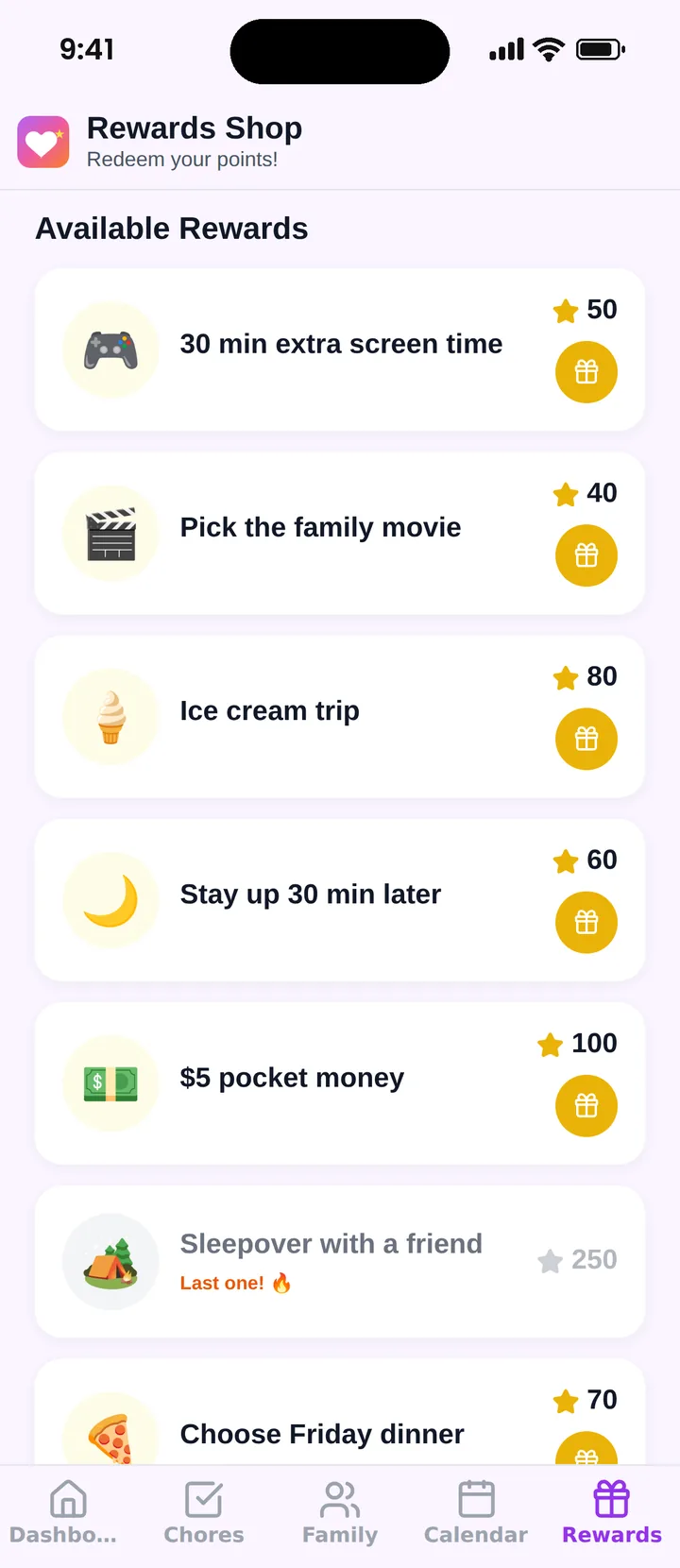
In the rewards shop, you create rewards with a price in points, how many are available and when. Pocket money can be one of those rewards, for example $5 for 500 points, and you hand over the cash yourself, because the app doesn't hold or move real money. Your child redeems from their phone, and you get a notification. If you're comparing tools, see our list of the best allowance apps for kids.
A sample week of earning
Say your 8-year-old does the unpaid basics every day and picks from the weekly list on offer. Here's what a realistic week might look like.
| Day | Paid job | Pay |
|---|---|---|
| Tuesday | Sort the recycling | $0.50 |
| Thursday | Vacuum the stairs | $1 |
| Saturday | Weed one bed | $1.50 |
| Saturday | Wash the car with a parent | $3 |
That's $6 for the week, which sits close to the usual range for this age once you add a small allowance on top. Some weeks will be zero, because it was a busy week or the child didn't feel like it. That's allowed. The point of optional jobs is that the child learns the link between effort and income, including the weeks without any.
Talking about the money itself
An 8-year-old can handle a short conversation about what the money is for. Ask what they'd like to buy and write the price down. Divide it by what they usually earn and show them the number of weeks. Kids this age often change their mind once they see "9 weeks," and that is the lesson working, not a failure.
Let them make small mistakes with their own money. A $3 toy that breaks on day two teaches more at 8 than a lecture will at 14. Step in only for anything unsafe or truly unreasonable.
When it stops working
If your 8-year-old only works when there's money on the table, look at the balance. Too many paid jobs crowds out the unpaid ones. If they lose interest after two weeks, the prices may be too low or the list too boring, so refresh it. And if they earn the same $5 in one day and then never look at the list again, they may just have enough, which is itself a lesson in what they value.
Start this week with three paid jobs, one weekly pay day and a clear rule that everyday chores stay free.
Frequently asked questions
How much should an 8-year-old earn for chores?
Small extra jobs pay $0.25 to $1 and big ones $2 to $5. Many 8-year-olds end up with roughly $7 to $10 a week in total if allowance and paid jobs are combined. Start lower, because you can always raise prices.
Which chores should an 8-year-old not be paid for?
Everyday family-member jobs: making the bed, clearing their plate, putting laundry in the hamper, tidying their room and feeding the family pet. These build responsibility and belong to everyone who lives in the house, so they stay unpaid.
What are easy ways for an 8-year-old to earn money at home?
Washing the car, weeding a garden bed, sorting recycling, vacuuming the stairs, wiping baseboards, helping wash windows, organizing a closet or garage shelf, or raking leaves. Each is an extra job with a clear finish, and each can be priced separately.
Should I pay in cash or points?
Either works. Points let a child save toward something bigger and you decide what each point buys. If you want cash, a simple rate is 100 points to $1, and you hand the money over outside the app, on a set day each week.
Try Famiyo With Your Family
Chores with points, a rewards shop for kids and one shared family calendar. Set it up in a couple of minutes.



Free to download • No credit card required • Available on iOS & Android