Positive Reinforcement for Kids: Examples That Work
How positive reinforcement works for kids, with examples by age, the difference between praise, rewards and bribes, and how to use it without backfiring.
By Famiyo Editorial Team5 min read
Positive reinforcement is one of the most studied ideas in child behavior, and one of the most misunderstood. People hear it and think "bribes" or "sticker charts." The idea is simpler: when a child does something you want more of, something good follows soon after, and the behavior becomes more likely next time.
This guide explains how it works, gives examples by age and situation, separates it from bribery and punishment, and shows how to use it without raising a child who only acts when paid.
What positive reinforcement actually is
The term comes from behavioral psychology. "Positive" means something is added, and "reinforcement" means the behavior becomes more likely. It does not mean "being nice," and it doesn't have to be a prize. A hug, a smile, a specific compliment or an extra story at bedtime can all do the job.
The American Academy of Pediatrics lists praise and positive attention among the most effective tools for shaping behavior, and recommends focusing on what a child does right instead of mostly pointing out mistakes. Child development guidance from the CDC says much the same. Neither claims one approach fits every child, so watch how yours responds.
Three conditions make it work:
- It follows the behavior quickly, ideally within seconds or minutes for young kids.
- It's specific: the child knows exactly what earned it.
- It happens reliably, at least until the behavior is established.
Types of positive reinforcement, with examples
| Type | What it looks like | Good for |
|---|---|---|
| Specific praise | "You put your shoes on the shelf without me asking. Thank you." | Daily habits, all ages |
| Attention and touch | A hug, a high five, sitting down to play for 10 minutes | Toddlers and preschoolers |
| Privileges | Picking the family movie, choosing dessert, staying up 30 minutes later | School-age kids |
| Points or tokens | 5 points for a bed made, 10 for emptying the dishwasher | Ages 5 and up |
| Activities | A trip to the park, baking together, a day out | Bigger milestones |
| Small treats | A sticker, a favorite snack | Hard-to-start habits |
For something to count as reinforcement, the child has to actually want it. A reward you think is great but your child shrugs at won't change anything. Ask them what they would like to work toward, then offer from that list.
Examples by age
Ages 2 to 4. Reinforcement has to be immediate and simple. "Great job putting your toys in the bin!" followed by a high five. A sticker on a chart right after the action. Don't wait until bedtime to mention what happened at 3 p.m.
Ages 5 to 7. Kids this age respond to charts and tokens. Five points for making the bed, ten for emptying unbreakable dishes from the dishwasher, and a small reward after a few days. Keep it visible so they can see progress. Our guide to the point system for kids shows how this works at home.
Ages 8 to 11. They can wait longer and care more about choice. Offer a menu: a bigger reward for a week of finished chores, or small ones every few days. Let them have a say in what's on the menu.
Ages 12 and up. Privileges and autonomy matter more than stickers. Later curfew on weekends, a bit more control over their schedule, money toward something they want. For earning with cash, see how much to pay kids for chores.
Examples of praise that works
Vague praise ("Good job!") isn't useless, but specific praise tells a child what to repeat. Compare these.
- "You waited for your turn even though it was hard." (Names the behavior and the effort.)
- "I saw you help your brother with his shoes. That was kind." (Names the action and the value.)
- "You kept working on that math problem after the first try didn't work." (Praises effort, not talent.)
- "You put the dishes in the dishwasher and didn't wait to be told." (Names independence.)
Skip "You're so smart" or "You're the best." Praise for effort and strategy tends to build more persistence than praise for traits, because it tells the child what they can control.
Positive reinforcement vs. bribery
The two look alike but work in opposite order. A bribe is offered during misbehavior to make it stop: "Stop screaming and I'll give you a cookie." The child learns that screaming is how to get a cookie.
Reinforcement is set up in advance and given after the good behavior: "When your room is tidy, you get 10 points." The child learns that tidying earns something. If you catch yourself negotiating in the middle of a meltdown, step back, calm down and set up the deal later when everyone is level.
What it looks like on an ordinary Tuesday
Say your 7-year-old packs her school bag the night before without being asked. In the moment, you say, "You packed your bag already, so tomorrow morning is easier for everyone." She gets 2 bonus points on top of the 10 for the job. On Friday, those points buy 15 extra minutes of screen time. Nothing dramatic happened, yet every piece followed the rules: quick, specific and tied to the action.
Now say your 10-year-old argues about homework for 20 minutes and then starts. Reinforce the start, not the argument: "You got going, thanks." Ignore the grumbling when you can. Attention is a reinforcer too, and kids repeat what gets it.
Common mistakes
- Inconsistency. Rewarding the behavior on Monday and ignoring it on Tuesday weakens it.
- Rewards that are too big. A $20 toy for brushing teeth will not hold up. Match the reward to the effort.
- Waiting too long. For young children, a prize at the end of the week is too far off.
- Rewarding what's already fun. Paying a child to do something they love can reduce their interest, a pattern covered in our article on kids motivation.
- Never fading. Start with frequent rewards, then space them out and lean on praise as the habit forms.
When a child needs a different approach
Some children respond differently to reinforcement, including kids with ADHD, autism or oppositional behavior. If your child falls into one of these groups, our guides to positive reinforcement for kids with ADHD and for kids with autism cover adjustments such as shorter steps and immediate feedback. Talk to your child's pediatrician or therapist if you have concerns.
Using a rewards shop in Famiyo
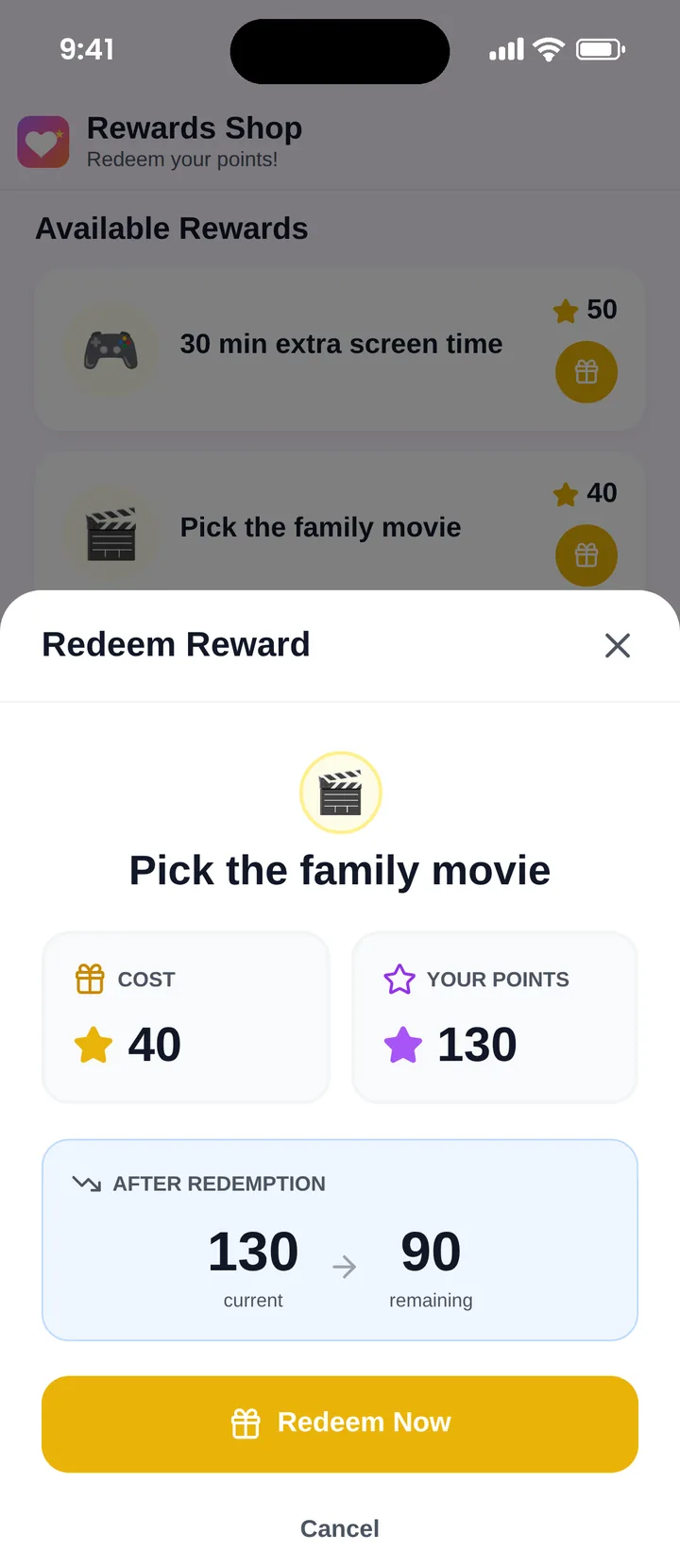
Famiyo is a free family app for iPhone and Android that combines a shared family calendar, chores with points and a rewards shop; kids join with a code, no email needed. Chores and events can be worth points, and a child can earn a different number of points than their sibling for the same task. In the rewards shop, parents create rewards with a price in points, how many are available and when. Kids redeem from their own phone and see how many points they will have left. That gives positive reinforcement a clear shape: do the thing, get points, choose a reward. Our list of the best reward chart apps for kids compares the choices.
A small place to start
Pick one behavior you want to see more of this week. Decide what the child will earn, tell them the plan, and reinforce it within a minute, every time, for two to three weeks. Then shift toward praise.
Frequently asked questions
What is positive reinforcement for kids in simple terms?
It is adding something pleasant right after a behavior you want, so the child is more likely to repeat it. A specific compliment, a high five, a sticker, a point toward a reward or ten extra minutes of play can all count.
What is the difference between positive reinforcement and bribery?
Timing and order. A bribe is offered in the middle of misbehavior to stop it. Reinforcement is set up in advance and given after the good behavior. 'If you stop screaming I will buy a toy' is a bribe. 'Finish your chores and earn points' is reinforcement.
Can positive reinforcement backfire?
It can if rewards are inconsistent, too big, or used for things a child already enjoys. Kids may start to expect payment for every task. Fade rewards gradually, keep praise specific, and rely more on encouragement as the habit sticks.
Should I use praise or rewards?
Both have a place. Specific praise is free and works for everyday behavior. Tangible rewards help when a behavior is hard to start, like a new chore or routine. Many families begin with both and shift toward praise as the habit forms.
Try Famiyo With Your Family
Chores with points, a rewards shop for kids and one shared family calendar. Set it up in a couple of minutes.



Free to download • No credit card required • Available on iOS & Android