Point System for Kids' Behavior: How to Set One Up
How to build a point system for kids' behavior: pick 2 or 3 target behaviors, award points quickly, price rewards fairly and avoid taking points away.
By Famiyo Editorial Team6 min read
Your 6-year-old yells when the tablet goes off. Your 9-year-old ignores the first four requests to put on shoes. You want something better than another round of "I've asked you three times." A behavior point system can help, but only if it is narrower and faster than most parents expect. This page covers which behaviors to pick, how to award points, how to price rewards and what to do when the chart stops working. For the household chore version, see our general guide to a point system for kids.
What a behavior point system does
A point system for behavior pairs a specific action with a quick reward. Child does the thing, hears what they did right, earns points, and later spends those points on something they want. The principle is called positive reinforcement, and it is the same one behind most child behavior guidance, including recommendations from the American Academy of Pediatrics: notice and reward what you want to see more of, and keep consequences calm and predictable.
What it does not do is repair a relationship, treat a medical or developmental condition or replace warm attention. Points are a tool for building a habit. Treat them as one tool among several.
Step 1: pick 2 or 3 target behaviors
Choose behaviors that are specific, observable and positive. Compare:
| Too vague | Better |
|---|---|
| Be good | Use words instead of hitting |
| Have a good attitude | Say "okay" the first time you are asked |
| Listen | Come to the table when called |
| Be nice to your sister | Ask before taking her toy |
| Behave at school | Keep hands to yourself in line |
A good target is something you could film. If a stranger watching could not tell whether it happened, narrow it. And phrase it as what to do, not what to stop. "Walk" works better than "no running."
Choose the one or two behaviors that cause the most daily friction. Leave the rest for later. Trying to fix six things at once means fixing none.
Step 2: decide how many points each is worth
Keep it simple. Here is a scale that most families can copy.
| Behavior | Example | Points |
|---|---|---|
| Small | Says "please" without a prompt, stops when asked | 2 to 5 |
| Medium | Uses words when angry instead of yelling, shares a toy | 5 to 10 |
| Big | Handles a hard moment well, like leaving the park without a fight | 10 to 20 |
| Bonus | Does it without a reminder | +2 |
The numbers matter less than the ratio. Harder moments pay more. Easy wins should still pay, because the child needs to feel the system works in the first days.
Step 3: award points right away and say why
Timing is the biggest lever. A point given at once, with a short description, teaches faster than a bigger prize at night. Use a pattern like: "You stopped, took a breath and told me you were mad. That is 5 points."
Keep the praise specific and warm. Skip the sarcastic "wow, finally." If you are tracking points on paper, carry a pen. If you are using an app, award them while the moment is fresh.
Step 4: price the rewards
Most behavior charts die because the rewards are too far away. Aim for a child to afford a small reward every 2 to 3 days and a big one every 3 to 4 weeks.
| Reward size | Examples | Price |
|---|---|---|
| Small | 15 extra minutes of screen time, choose dessert | 30 to 50 points |
| Medium | Pick the family movie, stay up 30 minutes later | 100 points |
| Big | A day out, a toy around $20 | 300 to 500 points |
Let your child help build the menu. For younger children, include quick wins: a sticker, a choice of bedtime book, time with a parent. Time together often works better than stuff, and it costs less.
Behaviors worth rewarding at different ages
The right targets shift as children grow, so adjust the list instead of reusing last year's.
| Age | Example target behaviors |
|---|---|
| 3 to 5 | Uses words instead of hitting, comes when called, asks before taking a toy |
| 6 to 8 | Stops an activity when asked, tells the truth about a mistake, waits a turn |
| 9 to 12 | Handles disagreement without name-calling, starts homework without being asked |
| 13 and up | Checks in when plans change, keeps a calm tone in an argument |
Teens usually respond better to an agreement they helped write than to a chart on the fridge. Bring them into the design, and keep the rewards tied to things they care about. If you also use points for chores, our article on the motivation behind kids' behavior is a useful companion.
Never take earned points away
This is the rule that matters most, and the one families break most. Points a child has earned are theirs. If you take them back as punishment, three things tend to happen: the child stops caring about the points, the chart becomes a source of conflict and the link between good behavior and reward gets muddy.
Use two separate tracks:
- The point system rewards what you want more of.
- Consequences handle rule-breaking, and they stay calm, short and tied to the problem. "You threw the ball at the window, so the ball goes away until tomorrow."
If the point system and the consequences blur, children see one big scoreboard, and mistakes feel like losses instead of lessons.
A sample week for a 6-year-old
Targets: "Uses words when angry" and "Puts shoes on the first time." Rewards: sticker for 10 points, movie pick for 100.
| Day | What happened | Points |
|---|---|---|
| Mon | Shoes on first ask (5), used words after losing at a game (10) | 15 |
| Tue | Shoes on first ask (5), yelled when tablet went off (0) | 5 |
| Wed | Shoes on first ask with no reminder (5+2), used words in the car (10) | 17 |
| Thu | Shoes took three asks (0), used words at bedtime (10) | 10 |
| Fri | Shoes on first ask (5), handled leaving the park (15) | 20 |
Total: 67 points. The child could spend 30 on dessert on Wednesday and keep saving for the movie. Notice that bad moments just earn zero. They do not drain the balance.
When the chart stops working
Check these first.
- Too many targets. Cut back to two.
- Rewards too far away. Lower prices or add a small reward that is reachable today.
- Points arriving late. Award them on the spot.
- Boring rewards. Ask what they would work for.
- Inconsistent parents. If one adult awards points and the other forgets, the child tests the edges.
- The behavior is bigger than a chart. Frequent aggression, intense meltdowns or a sudden change in behavior are reasons to talk to your child's pediatrician. Our articles on positive reinforcement for kids with ADHD and autism cover how the same ideas adapt.
Plan to fade the system. After a few weeks of steady success, raise the bar slightly, stretch the time between points or retire a target that has become routine.
Tracking behavior points in Famiyo
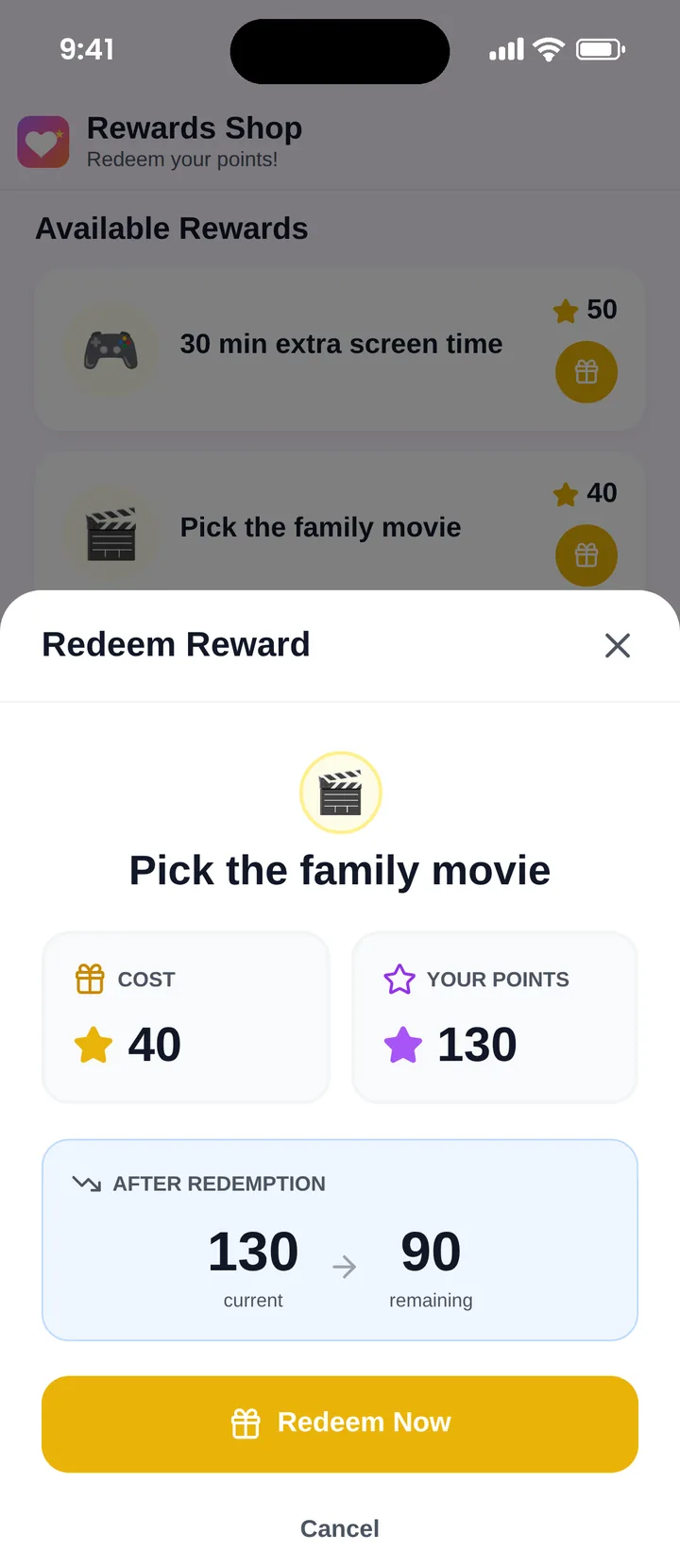
Famiyo is a free family app for iPhone and Android that combines a shared family calendar, chores with points and a rewards shop; kids join with a code, no email needed. You can give a behavior a point value like any other task, so a child earns points for a calm hand-off and sees the total on their own phone. In the rewards shop you set the prices, how many are available and when, and kids redeem from their phone, where they see how many points they will have left. You get a notification when a reward is redeemed.
To compare options, see our list of the best reward chart apps for kids.
Try it for one behavior
Pick the single behavior that causes the most friction in your week, write it as an action and give points the next time you see it. Two weeks from now you will know whether this fits your child.
Frequently asked questions
How many behaviors should a point system target?
Start with two or three. More than that and kids lose track and parents lose consistency. Pick behaviors you can see and count, like 'comes to dinner when called' rather than 'has a good attitude.'
How quickly should points be given for behavior?
As soon as possible, ideally within seconds or minutes. A delay weakens the link between the action and the reward, especially for children under 7. Say what earned the points: 'You stopped and used words. That is 5 points.'
Should kids lose points for bad behavior?
Usually not. Removing earned points feels unfair and can make kids stop trying. Use a separate, predictable consequence for rule-breaking and let the point system do one thing: reward the behavior you want more of.
How long should a behavior point system last?
Give it 2 to 3 weeks to see whether it works. Many families keep it for a few months, then fade the points as the behavior becomes routine and praise carries more of the load.
Does a point system work for every child?
It works for many children, but not all. Some need faster rewards, simpler targets or a different approach altogether. If behavior is a serious concern, talk with your child's pediatrician or a therapist.
Try Famiyo With Your Family
Chores with points, a rewards shop for kids and one shared family calendar. Set it up in a couple of minutes.



Free to download • No credit card required • Available on iOS & Android