Chores for 8-Year-Olds: 25 Jobs and How to Reward Them
25 chores an 8-year-old can really do, sorted by room, with minutes, point values and a simple reward plan. Aim for 20 to 30 minutes of work a day.
By Famiyo Editorial Team5 min read

Eight is a good age for chores. Kids are strong enough to handle real equipment, patient enough to finish a job, and still keen to be treated as capable. The list below has 25 jobs, grouped by room, with a realistic time and a point value for each, plus a plan for rewarding them without turning your house into a payroll office.
What an 8-year-old can realistically handle
At this age, the shift is from helping you to owning a job. A 6- or 7-year-old tends to do a chore alongside you or right after you ask. An 8-year-old can hold a small routine in their head: after dinner, plates go in the dishwasher, no reminder needed. They can also follow three or four steps in order, which opens up folding laundry, making a sandwich and vacuuming a room.
Their limits are just as real. Hot stoves, sharp knives and strong cleaning chemicals still need an adult nearby. Hands get tired fast, so a job that takes 30 minutes will usually fall apart at minute 12. And their idea of done is looser than yours. That's normal, and it improves with practice, not with criticism.
If your child is still building up to this level, our list of chores for 7-year-olds is a gentler starting point.
25 chores for 8-year-olds, room by room
Points follow the usual scale: 5 for a small task of 2 to 5 minutes, 10 for a medium one of 10 to 15 minutes, 20 for a big one of 30 minutes or more.
Kitchen and dining room
| Chore | Time | Points |
|---|---|---|
| Load the dishwasher after dinner | 10 min | 10 |
| Unload the dishwasher and put everything away | 10 min | 10 |
| Set the table | 3 min | 5 |
| Clear and wipe the table | 5 min | 5 |
| Make a simple snack, like a sandwich or fruit plate | 10 min | 10 |
| Pack their own lunch with a checklist | 10 min | 10 |
| Put away groceries | 10 min | 10 |
Bedroom and laundry
| Chore | Time | Points |
|---|---|---|
| Make the bed | 3 min | 5 |
| Tidy their room, floor clear and toys in bins | 10 min | 10 |
| Fold and put away their own laundry | 10 min | 10 |
| Carry the laundry basket to the machine and sort darks and lights | 5 min | 5 |
| Change their own bed sheets with help | 15 min | 10 |
| Pack the school bag the night before | 5 min | 5 |
Cleaning and the rest of the house
| Chore | Time | Points |
|---|---|---|
| Vacuum one room | 10 min | 10 |
| Sweep the kitchen floor | 5 min | 5 |
| Take out the trash and recycling | 5 min | 5 |
| Wipe the bathroom sink and mirror | 5 min | 5 |
| Dust shelves and low surfaces | 10 min | 10 |
| Clean the windows or glass doors they can reach | 15 min | 10 |
| Tidy the shoe and coat area by the door | 5 min | 5 |
Outside and pets
| Chore | Time | Points |
|---|---|---|
| Feed the pet and refill the water bowl | 3 min | 5 |
| Water the garden or house plants | 5 min | 5 |
| Rake leaves or pull weeds in one bed | 30 min | 20 |
| Wash the family car with a bucket and sponge | 30 min | 20 |
| Walk the dog with an adult or in a safe area | 20 min | 10 |
Nobody should do all 25. That's a menu, not a schedule.
How to pick 3 to 4 daily jobs and one weekly job
Start with a rule of thumb: 3 to 4 daily tasks for a school-age child, and add one weekly "big" job from age 8. That keeps the total in the 20 to 30 minute range that suits this age.
A sample week might look like this.
| Day | Daily tasks | Weekly job |
|---|---|---|
| Mon to Fri | Make the bed, pack the school bag, set the table, feed the pet | |
| Tue | plus unload the dishwasher | |
| Thu | plus take out the trash | |
| Sat | Make the bed, feed the pet | Vacuum one room |
| Sun | Make the bed, feed the pet | Fold and put away laundry |
Notice that the daily tasks are tied to a moment in the day: bed in the morning, bag before bed, table before dinner. A task hooked to something that already happens is far easier to remember than one floating free. If you want a visual to hang on the fridge, our guide on how to make a chore chart walks through it, and the chore chart for a 9-year-old shows where this age group is heading.
Teaching a new chore so it sticks
Most "bad" chores are really untaught chores. Try this order with anything new, like loading the dishwasher.
- Do it yourself while your child watches, and say each step out loud.
- Do it together, and let them handle a bit more each time.
- Let them do it alone while you stay nearby for the first few rounds.
- Name what done looks like in one sentence: "Plates on the bottom, cups on top, nothing blocking the spray."
- Give one specific bit of feedback: "You got every cup facing down, great. Next time, bowls go on the top rack."
A short checklist taped inside a cupboard door beats any amount of reminding. Eight-year-olds read well enough to use one.
Rewarding chores without ruining them
Everyday jobs are part of living in a family, so they shouldn't be sold like piecework. A good middle path: give points for the routine tasks, let those points buy small privileges, and keep real money for extra jobs.
A workable scale looks like this.
| Reward | Price |
|---|---|
| 15 extra minutes of screen time, choose dessert | 30 to 50 points |
| Pick the family movie, stay up 30 minutes later | 100 points |
| A day out, a toy around $20 | 300 to 500 points |
With 3 to 4 daily tasks at 5 to 10 points each, a child will afford a small reward every 2 to 3 days and a big one every 3 to 4 weeks. That rhythm matters. If the first reward arrives too slowly, an 8-year-old stops caring. A bonus of 2 extra points for doing a task without a reminder rewards the habit you actually want.
If you'd rather pay cash for extra jobs, $0.25 to $1 for a small one and $2 to $5 for a big one is a fair range. Keep the basics unpaid.
Chores for 8-year-old boys and girls
The list is the same. An 8-year-old boy can fold towels, and an 8-year-old girl can take out the trash and rake leaves. Splitting jobs by gender at this age quietly teaches kids that some work is for someone else, and it halves the skills each child leaves home with.
Keeping track in Famiyo
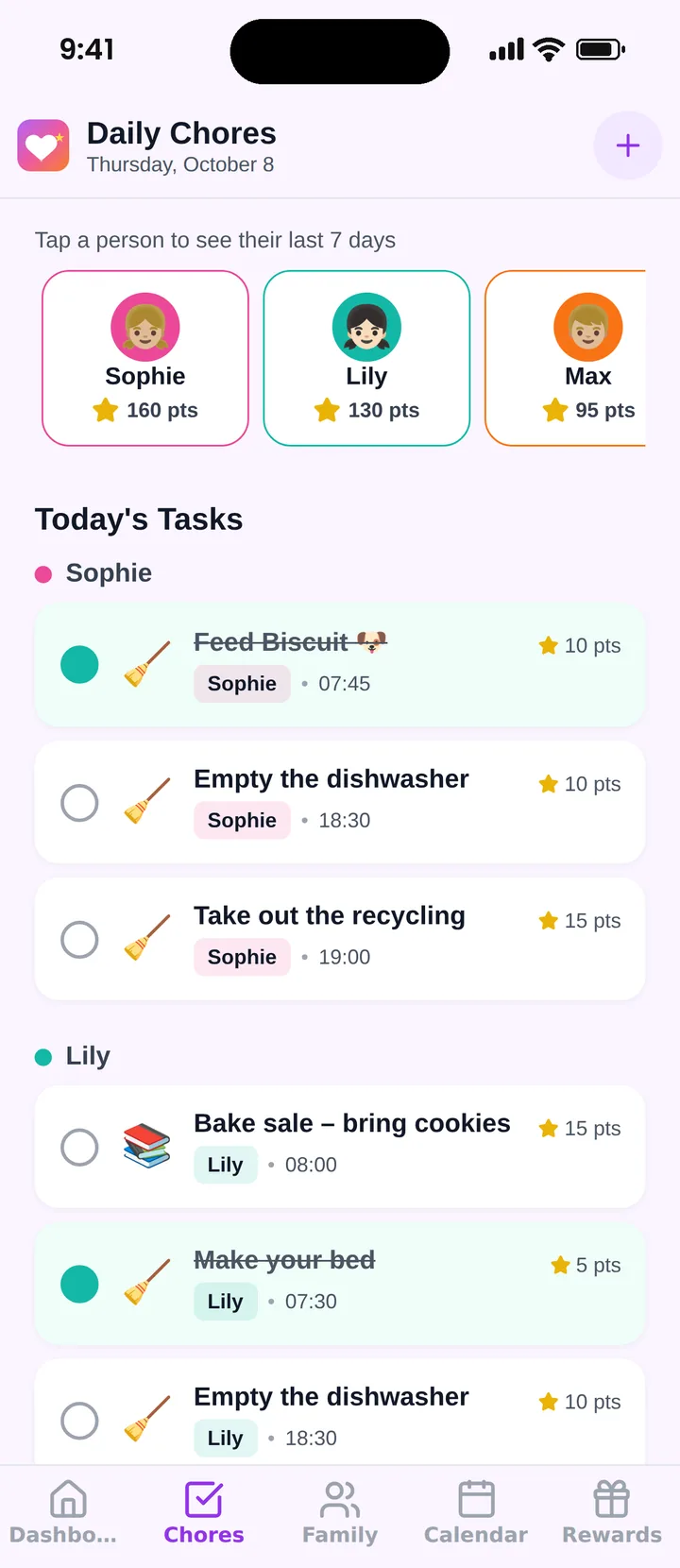
Famiyo is a free family app for iPhone and Android that combines a shared family calendar, chores with points and a rewards shop; kids join with a code, no email needed. You can add each chore once, pick which child does it, set the points, and make it repeat. Your 8-year-old sees their own tasks on their own phone and checks them off, or you can approve them first.
You can compare it with other tools in our list of the best chore apps for kids.
Pick four chores from the tables tonight, tell your child which ones are theirs, and start with just those for two weeks before changing anything.
Frequently asked questions
How many chores should an 8-year-old have?
Three to four daily tasks and one bigger weekly job is a good fit. That adds up to roughly 20 to 30 minutes a day. If chores keep turning into arguments, cut the list down before you add any pressure.
Should an 8-year-old get paid for chores?
Treat everyday jobs like making the bed as part of belonging to the family, and keep them unpaid. Extra jobs, like washing the car, can earn points or a small payment of $0.25 to $1 for a small task and $2 to $5 for a big one.
Are chores for 8-year-old boys different from chores for girls?
No. Skill, not gender, decides the list. Every 8-year-old can learn to load a dishwasher, fold towels and sweep a floor. Giving everyone the same jobs also stops the odd idea that some tasks belong to one sex.
What if my 8-year-old does a chore badly?
Check that they know what done looks like, then show it once more. Praise what they got right and fix one thing, not five. Redoing the job in front of them tells them their effort didn't count.
Try Famiyo With Your Family
Chores with points, a rewards shop for kids and one shared family calendar. Set it up in a couple of minutes.



Free to download • No credit card required • Available on iOS & Android