How to Make a Chore Chart for 3 Kids (Without a Fight)
Make one chore chart that works for three kids of different ages: split the jobs fairly, rotate them, set up the grid and keep it running past week two.
By Famiyo Editorial Team5 min read

Three kids means three ability levels, three moods and at least one argument about who got the easier job. A chore chart for one child is a list. For three, it has to be a system, with a clear split, a rotation and one place everyone looks.
This guide takes you from a blank page to a working chart in about 30 minutes, with a sample for kids aged 5, 9 and 12 and a fix for the things that usually go wrong by Wednesday.
Step 1: Write down every job in the house
Before anyone gets a chore, list everything that needs doing in a normal week. Walk through each room with a notepad. You will probably end up with 25 to 40 items, from "feed the cat" to "clean the bathroom."
Then sort them into three groups:
- Daily: bed, dishes, pet, tidy-up.
- Weekly: bathroom, vacuum, trash, laundry.
- Occasional: car, yard, closets.
This list is your menu. Every kid picks from it. If you need ideas, our guide on what to put on a chore chart has plenty.
Step 2: Match jobs to each child's age
The chores-by-age ranges below are a good starting point. Rule of thumb: 2 to 3 daily tasks for preschoolers and 3 to 4 for school-age kids, plus one weekly big job from age 8.
| Age | Typical jobs | Time per day |
|---|---|---|
| 4 to 5 | Make the bed (roughly), set and clear their own place, water plants, feed a pet | 10 to 15 minutes |
| 8 to 9 | Load the dishwasher, fold and put away laundry, vacuum one room, take out the trash | 20 to 30 minutes |
| 10 to 12 | Clean the bathroom sink and toilet, cook a simple meal with an adult nearby, change bed sheets | 30 minutes |
Fair does not mean identical. A 5-year-old and a 12-year-old can each take about 15 to 30 minutes, and the younger one will have easier jobs. Say that out loud to the kids: "Everyone helps, and the jobs get bigger as you grow."
Step 3: Split shared jobs with a rotation
Some jobs nobody wants, like the bathroom or the trash. Put those on a weekly rotation so everyone takes a turn. With three kids, rotation is simple: three jobs, three kids, and each moves one slot every Monday.
| Job | Week 1 | Week 2 | Week 3 |
|---|---|---|---|
| Bathroom | Mia (12) | Leo (9) | Zoe (5, wipes sink) |
| Kitchen floor | Leo (9) | Zoe (5, sweeps crumbs) | Mia (12) |
| Trash and recycling | Zoe (5, carries lighter bags) | Mia (12) | Leo (9) |
Where a job is too big for the youngest, give her a smaller version of the same task. She still gets her turn, and nobody feels excluded. For more rotation styles, see our chore wheel generator guide.
Step 4: Build the grid
A basic chart is a grid. Put the kids' names in a column down the left, and the days of the week across the top. Under each day, list or draw the tasks. Check a box when it's done.
A simple layout that works for three kids:
- One row per child, with their daily tasks listed inside it.
- A separate box at the bottom for the weekly rotation jobs.
- A points column on the right, with a total for the week.
- One color per child so everyone can find their row at a glance.
Hang it in the kitchen at kid height. If you want ready-made layouts, the DIY chore chart for kids guide shows several, and the sticker chart for kids works well for the youngest.
Step 5: Add points and a small payoff
Give each task a point value so effort is visible. A simple scale: small tasks (2 to 5 minutes) are 5 points, medium ones (10 to 15 minutes) are 10, and big ones (30 minutes or more) are 20. Add 2 bonus points when it's done without a reminder.
For three kids, one rule saves a lot of arguments: points follow effort, not age. If the 5-year-old makes her bed, that's 5 points, same as her brother's. A child can afford a small reward every 2 to 3 days, which is about right to keep motivation going.
Step 6: Hold a five-minute start meeting
Don't hand the chart down from above. Call the three kids together and walk through it. Say something like: "We all live here, so we all help. Here is what each person does. If a job feels unfair after the first week, tell me and we'll look at it."
Then let each child pick one job from the menu. Kids stick to a list they helped build. Check the chart at the same time each day, such as right after dinner, so it becomes a routine rather than a surprise.
What usually goes wrong with three kids
- One child finishes, the others don't. Keep individual rows. Don't let the group wait on one kid.
- The oldest does everything. Resist the urge to hand the hard stuff to the most capable child every time. Rotate.
- Sibling checking. Tell kids that only they check off their own jobs, or that a parent approves. No policing each other.
- The chart stops working by week three. Review after 2 to 3 weeks and change what's not working. It is normal to adjust.
If your kids are resisting no matter what, see how to get kids to do chores without yelling for what to say when a job just isn't getting done.
Running the chart in Famiyo
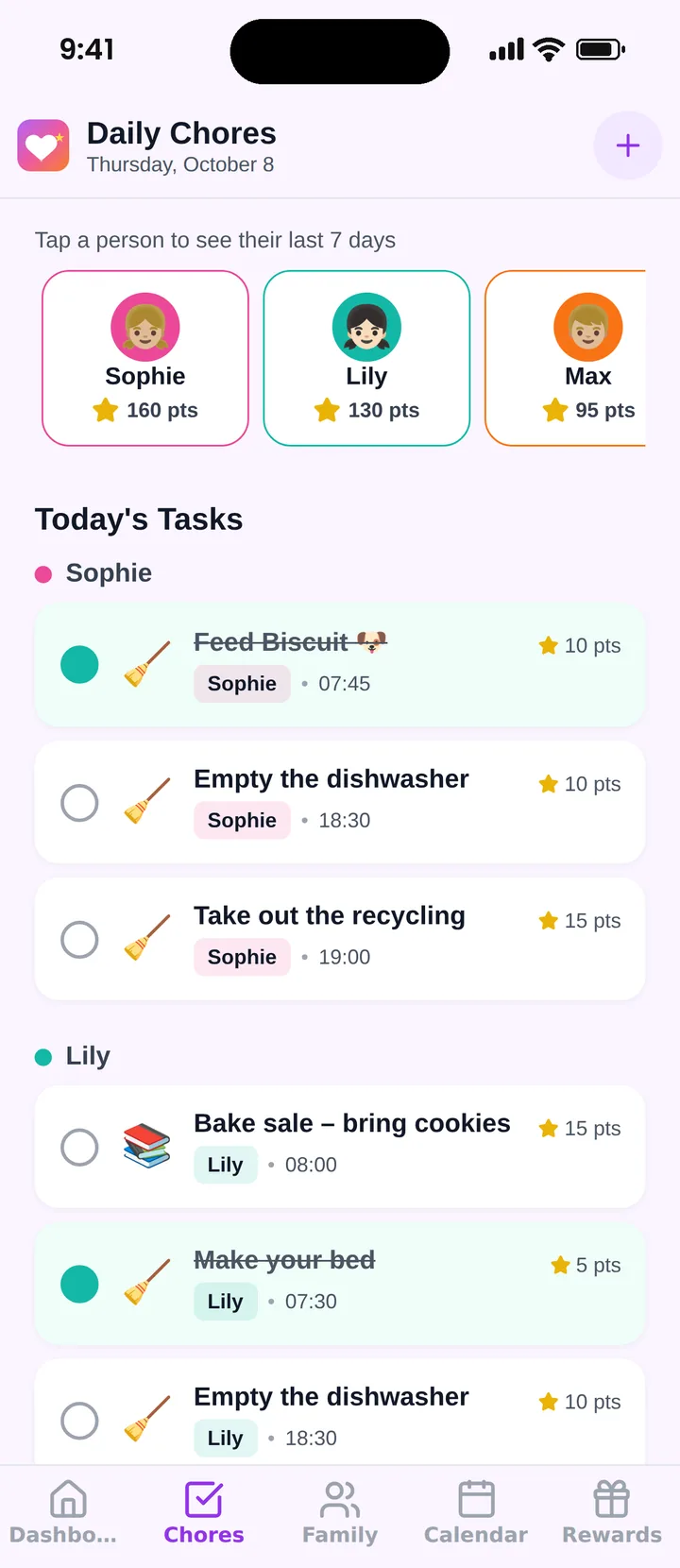
Famiyo is a free family app for iPhone and Android that combines a shared family calendar, chores with points and a rewards shop; kids join with a code, no email needed. Instead of a paper grid, you create each chore once, choose who does it, set the points and repeat it daily or weekly. All three kids see their own list on their own phone, you see everyone's progress today, and everything syncs live. Kids hear about new tasks by push notification, and you hear when a chore is done. The free plan covers up to 3 family members and 1 repeating task, and Premium removes the limits, which matters for a family with three children. Our list of the best chore chart apps compares the options.
Start with one week
Pick three daily jobs per child, set one rotation and hold the start meeting this weekend. Run it for a week and fix only what's actually broken.
Frequently asked questions
How many chores should each of 3 kids have?
Three to four daily tasks per school-age child is plenty, and 2 to 3 for a preschooler. Add one weekly bigger job from about age 8. Younger kids take fewer and simpler jobs, but everyone has some.
How do I keep chores fair when the kids are different ages?
Match jobs to ability and time, not to identical tasks. A 5-year-old waters plants while a 12-year-old cleans a bathroom, and both take about the same share of effort. Rotate the shared jobs so nobody is stuck with the worst one.
Should I make one chart or three?
One shared chart usually works better. Kids see what everyone does, which cuts down on 'that's not fair' arguments, and you check a single place. If you need privacy for a teen, give them a separate column or a separate view.
How often should I change the chart?
Give it two to three weeks of consistent use before judging it. After that, rotate shared jobs weekly, and refresh the whole chart every few months or when a child has a birthday and can take on more.
Try Famiyo With Your Family
Chores with points, a rewards shop for kids and one shared family calendar. Set it up in a couple of minutes.



Free to download • No credit card required • Available on iOS & Android