Free Printable Chore Chart for Kids With Pictures
A free printable chore chart with pictures for kids who can't read yet: which chores to include, which pictures to use, and how to set it up in 10 minutes.
By Famiyo Editorial Team4 min read
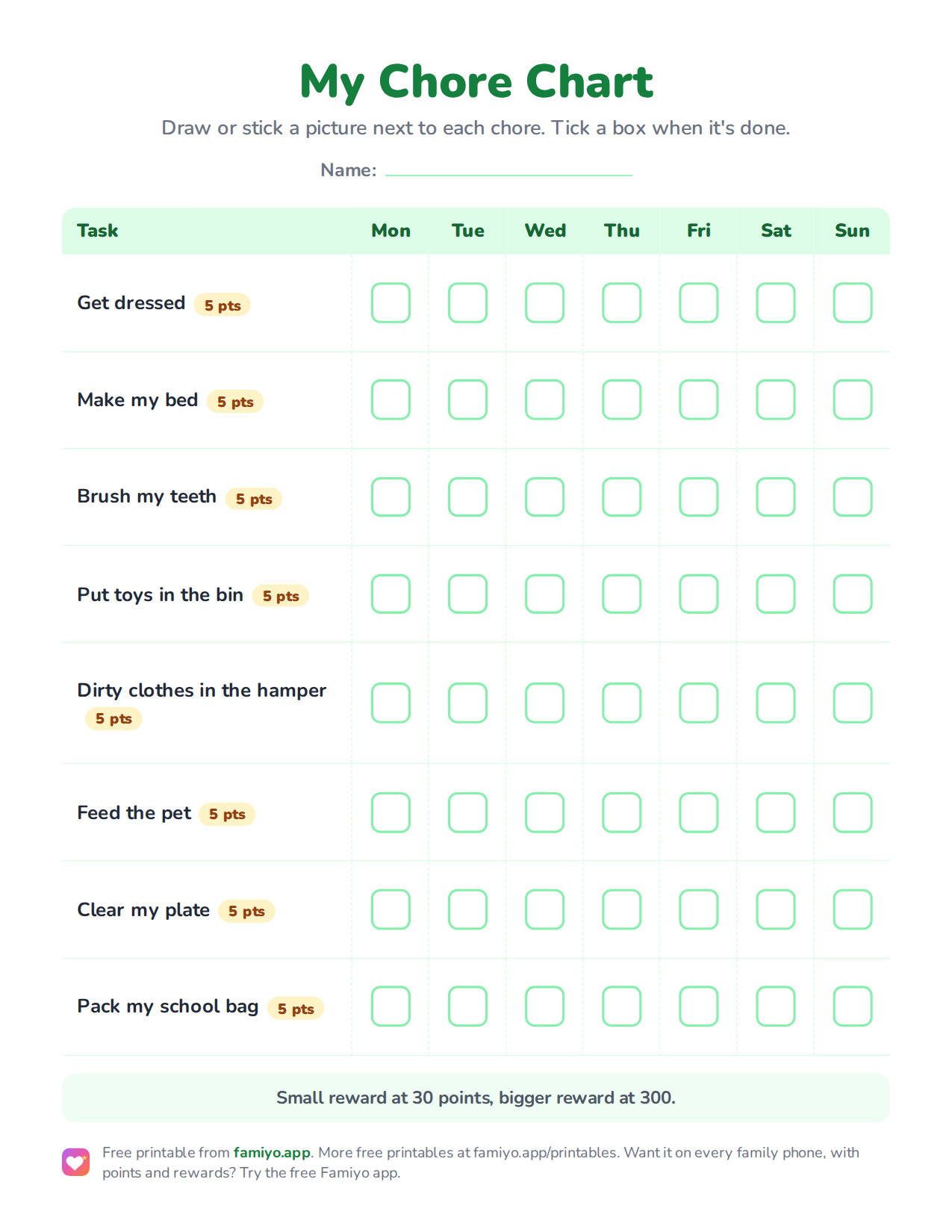
Free printable
My Chore Chart
A weekly chart on one US Letter page. Download the PDF to print it, or save the image to use it on a tablet or in a document.
Free for home, classroom and nonprofit use, see the license. More free printables.
A child who can't read yet can't use a chart that says "Tidy room". A child who can see a picture of a toy bin knows exactly what to do. This page gives you a free printable chart built for that, a list of chores with picture ideas, and a simple way to set it up tonight.
What a picture chore chart needs
Three things make the difference between a chart that gets used and one that gets ignored.
First, one picture per chore, and the picture shows the finished job, not the mess. A made bed. A bin with toys inside. A bowl of pet food.
Second, a small number of rows. Preschoolers do well with 3 to 5 chores a day. Toddlers need only 2 or 3. The chart should be readable in five seconds from across the room.
Third, a clear "done" mark. A box to tick, a sticker spot or a magnet that moves from one column to the next. The child should be able to do it alone.
The printable chart
The printable below has eight common chores, seven daily boxes for each and a points column. Leave the chore text in place for the grown-ups and add a picture beside each one with a marker, stickers or small photos. It suits kids from about 3 to 7. For younger toddlers, cross out all but two or three rows.
If your child is older and reading well, our job chart for kids uses job titles and a weekly rotation instead of pictures.
Chores with picture ideas
Here are chores that translate well into a picture, with something simple to draw or photograph for each.
| Chore | Picture idea | Typical age |
|---|---|---|
| Get dressed | A shirt and pants laid out | 3 and up |
| Make my bed | Your child's own bed, neat | 4 and up |
| Brush my teeth | A toothbrush with foam | 2 and up |
| Put toys in the bin | The actual toy bin, full | 2 and up |
| Dirty clothes in the hamper | The hamper with a sock on top | 2 and up |
| Feed the pet | The pet's bowl or the pet itself | 4 and up |
| Clear my plate | A plate going to the counter | 3 and up |
| Water the plants | A small watering can | 4 and up |
| Pack my school bag | A backpack | 5 and up |
| Set the table | A fork, spoon and napkin | 5 and up |
Photos beat drawings for most children. Snap the real bed, the real bin and the real pet, print them small and tape them next to the rows. For ideas on what suits a specific age, see our chore chart for a 3-year-old.
Making the pictures stick
A few small choices change how well the pictures work. Put the picture on the left and the tick boxes on the right, so the child's eye moves the same way each time. Keep the pictures the same size. Use real colors, because a red toy bin is easier to match to the real one than a gray outline. And order the rows the way the day goes: get dressed, brush teeth, school bag in the morning, then toys, plate and pet in the afternoon. Children learn the chart as a sequence, and the order itself becomes a cue.
If your child has more than one chart, for example a morning routine and a chore chart, give each its own color of paper. That way "the green one" means something.
How to set it up in 10 minutes
- Print the chart and pick the 3 to 5 chores your child can already do with a little help.
- Take or draw one picture per chore and stick it in the row.
- Hang the chart at your child's eye level, near where the chores happen or by their bedroom door.
- Show the chart once. Say: "This is your job list. When you finish a job, you tick the box." Then do the first chore together.
- Tick the first few boxes alongside them for a day or two, then step back.
- Give a small reward at the points mark. Thirty points is six small chores, which most children reach in a day or two.
Give it two to three weeks of consistent use before you judge it. Habits take that long to settle, and the first week is mostly about learning where the chart lives.
When to drop the pictures
Pictures are scaffolding. Around age 6 or 7, most children can read the words, and you can shrink the pictures to small icons or remove them. Keep the pictures for any chore that is new. A 7-year-old learning to sweep still benefits from a photo of what "done" looks like, and our chore chart ideas for 7-year-olds shows what to add next.
Doing this with Famiyo
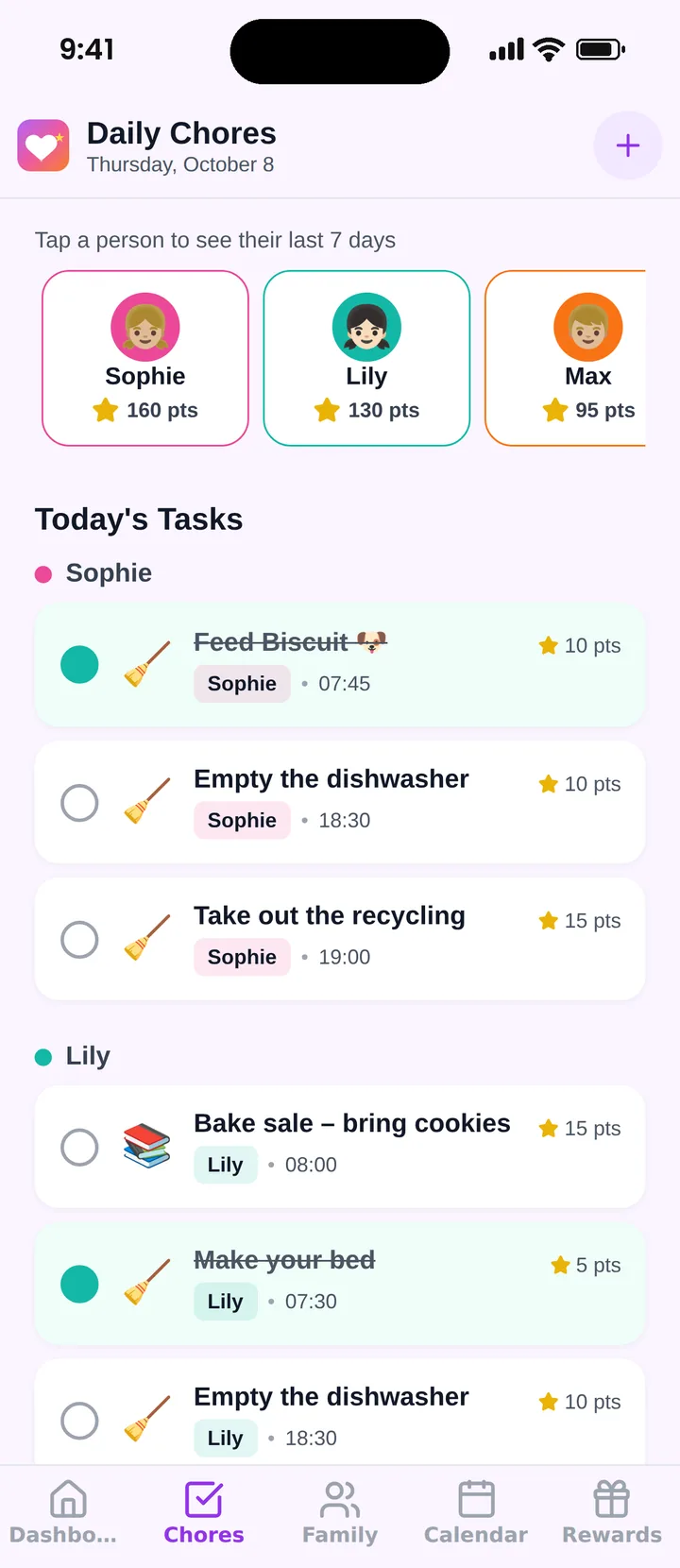
Famiyo is a free family app for iPhone and Android that combines a shared family calendar, chores with points and a rewards shop; kids join with a code, no email needed. If paper keeps getting lost, the chart can live on the phone instead. You add each chore once, set it to repeat daily, choose who does it and how many points it is worth. Kids get a notification about new tasks, tick off their own chores or wait for your approval, and everything stays in sync across phones.
Compare the options in our list of the best chore chart apps.
Print the chart first. If it is still on the wall in three weeks, you have a system.
Frequently asked questions
What age is a picture chore chart for?
Picture charts suit ages 2 to 6, or any child who is not yet a confident reader. Toddlers need just 2 or 3 pictures. By 6 or 7 most kids read the words and can switch to a plain list, with the pictures kept only for new chores.
Where can I get pictures for a chore chart?
You have three easy options: draw a simple stick figure for each chore, take a quick phone photo of your child doing it, or cut small pictures from a magazine or packaging. A photo of their own bed or their own pet works especially well.
How many chores should be on a picture chart?
Two to three for a toddler, three to five for a child aged 4 to 6. More than that and the chart turns into a wall of boxes. Add a new chore only after the current ones have been done without help for about two weeks.
Should a picture chore chart have rewards?
It can, but keep them small and quick. Give each chore a few points and let the total buy something small, like choosing dessert, after a day or two. Young children lose interest in rewards that are a month away.
Try Famiyo With Your Family
Chores with points, a rewards shop for kids and one shared family calendar. Set it up in a couple of minutes.



Free to download • No credit card required • Available on iOS & Android