Homeschool Chore Chart: Chores That Fit the School Day
A homeschool chore chart that builds chores into the school day: morning jobs, movement breaks, a lunch reset and a 15-minute end-of-day sweep, with a printable.
By Famiyo Editorial Team4 min read
Free printable
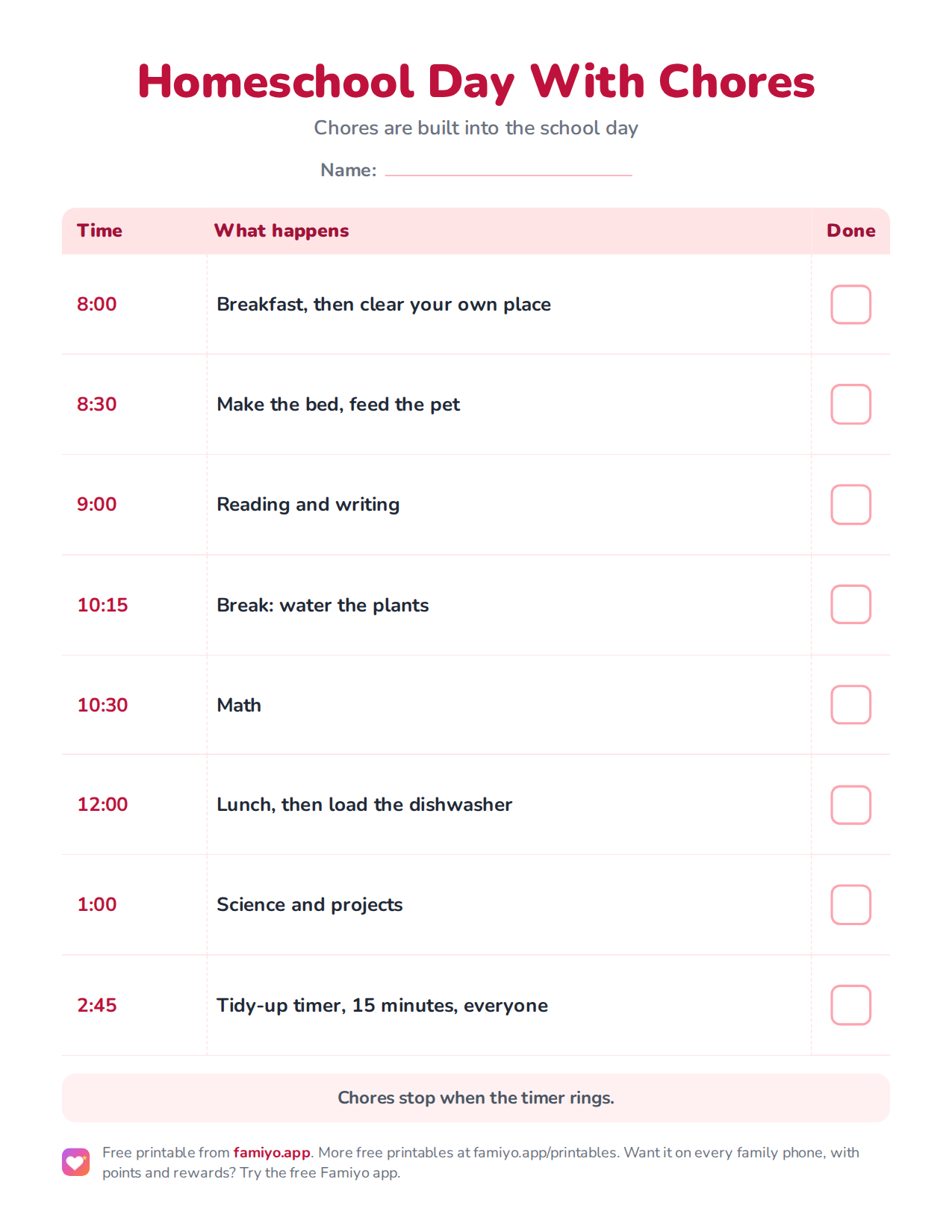
Homeschool Day With Chores
A daily schedule on one US Letter page. Download the PDF to print it, or save the image to use it on a tablet or in a document.
Free for home, classroom and nonprofit use, see the license. More free printables.
When home is also school, the house is never empty and never finished. Dishes from breakfast are still there at lesson time, and by 3 p.m. the day has left a trail. A homeschool chore chart handles this by tying jobs to the rhythm of the school day, so tidying is part of the schedule and not a second shift after dinner. Below you get the setup, a sample day, and a printable.
Why a homeschool chart is different
A regular chore chart assumes kids leave in the morning and come back worn out. Chores happen in the gap between dinner and bed, which is the worst possible time. In a homeschool day, you have the opposite: lots of hours at home, plenty of small gaps, and a child who has nowhere else to be.
That is both good news and a trap. You can spread chores thinly across the day, which makes each one small. But because you are all at home, chores also tend to creep. A "quick" tidy turns into an hour, and the lesson plan slides. The fix is structure: fixed slots, short jobs, a visible end.
The four chore slots in a school day
Most homeschool days have natural pauses. Attach a job to each, and the chart almost runs itself.
- Before lessons. Two or three starter jobs: make the bed, clear the breakfast dishes, feed the pet. This tells everyone the day has begun, and it takes 10 to 15 minutes.
- Between subjects. One short job as a movement break, such as watering plants, wiping the table or sweeping. After a long sit-down lesson, a child often focuses better after 5 minutes on their feet.
- After lunch. A reset: load the dishwasher, wipe the counters, set the table for the next meal. Kids take the whole kitchen back to neutral.
- End of the day. A 15-minute shared tidy of the learning area. Books back on the shelf, supplies in the bin, floor cleared. Everybody does it, including you.
Use a timer for slots 1 and 4. When it rings, the block is over, whether or not it is perfect.
What to put on the chart by age
Use the usual ranges for how much a child can handle, then place each job in a slot.
| Age | Before lessons | Between subjects or lunch | End of day |
|---|---|---|---|
| 4-5 | Make the bed (roughly), feed a pet | Set and clear own place | Put supplies in the bin |
| 6-7 | Tidy their room, pack the learning bag | Sweep, empty unbreakable dishes | Return books to the shelf |
| 8-9 | Make bed, load dishwasher | Fold laundry, wipe the table | Vacuum the learning area |
| 10-12 | Take out the trash, feed pets | Cook part of lunch with an adult nearby | Clean the sink area |
| 13+ | Start own laundry | Make lunch for a younger sibling | Reset the kitchen |
Total daily time stays at 10 to 15 minutes for 4 and 5, 15 to 20 for 6 and 7, 20 to 30 for 8 and 9, and about 30 minutes from age 10. Our list of kitchen chores for kids by age gives more options for the lunch reset, and our chore chart for a 5-year-old shows how to keep the youngest on track.
A sample school day with chores built in
The printable below follows this plan for an 8-year-old. Change the times to match your own day.
| Time | What happens |
|---|---|
| 8:00 | Breakfast, then clear own place |
| 8:30 | Make bed, feed the pet |
| 9:00 | Reading and writing |
| 10:15 | Break: water the plants |
| 10:30 | Math |
| 12:00 | Lunch, then load the dishwasher |
| 1:00 | Science and projects |
| 2:45 | Tidy-up timer, 15 minutes, everyone |
Notice that only 4 of the 8 lines are chores, and none is longer than 15 minutes. That is the shape to copy.
Making it work with several ages at once
With a 5-year-old and a 12-year-old at the same table, the older child will finish first and the younger one will want to help. Give each child jobs they can finish alone, so you are not the bottleneck. A teen can own a weekly job that runs the house, like the Saturday kitchen, which we cover in weekly chores for teenagers. Younger kids take the small daily ones.
One rule helps with fairness: balance minutes, not the number of rows. Three 3-minute jobs and one 10-minute job are about equal.
Running the chart in Famiyo
Famiyo is a free family app for iPhone and Android that combines a shared family calendar, chores with points and a rewards shop; kids join with a code, no email needed. For a homeschool day, you add each chore once, set it to repeat daily or weekly, and pick the points. Each child sees their own list on their phone or a spare tablet, ticks jobs off or waits for your approval, and you get a push notification when something is done, without leaving the lesson to check.
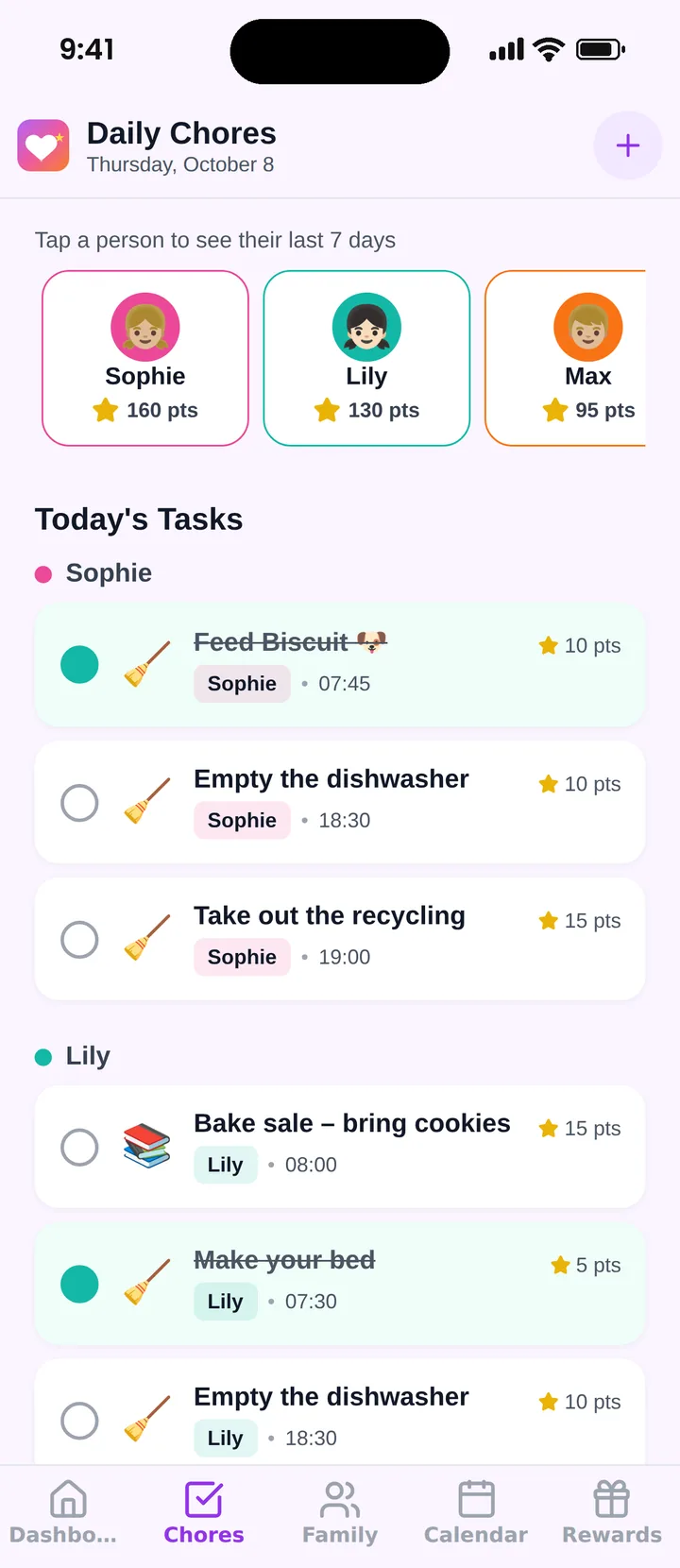
Points can go toward rewards you choose, such as a family movie pick. See our list of the best chore chart apps to compare.
Pick one slot to start, such as the 15-minute end-of-day tidy, and add the others one at a time over the next two weeks.
Frequently asked questions
How many chores should homeschool kids do?
The same as other kids their age: 2 to 3 daily tasks for preschoolers, 3 to 4 for school-age kids, and one bigger weekly job from age 8. Being home all day makes it tempting to pile on more. Resist, because lessons still need the energy.
Should chores count as part of the school day?
Some families count cooking, laundry or garden work as life skills time, and that is a choice for you to make under your own state's rules. Keep the daily upkeep jobs separate, so a chore does not quietly eat a lesson.
When is the best time for chores in a homeschool day?
Short jobs before lessons give the day a clear start, and a 5 to 10 minute job between subjects works as a movement break. Save the larger shared tidy for the end of the day, when everyone stops together.
How do I stop chores from taking over the morning?
Set a visible limit, such as 15 minutes on a kitchen timer, and end the block when it rings even if a job is half done. A fixed stop teaches kids to work steadily, and it protects the time you set aside for lessons.
What chores can a child do while I teach a younger sibling?
An older child can set the table, load a dishwasher, fold laundry, water plants or wipe the kitchen counters while you work with someone else. Pick jobs that are quiet, do not need your help and have a clear end.
Try Famiyo With Your Family
Chores with points, a rewards shop for kids and one shared family calendar. Set it up in a couple of minutes.



Free to download • No credit card required • Available on iOS & Android