How Much Allowance for a 14 Year Old?
Most 14-year-olds get $15 to $25 a week. See what that should cover, how to decide where your teen lands in the range, and how to pay it in a digital world.
By Famiyo Editorial Team4 min read
A 14-year-old is old enough to run a small budget and young enough to make cheap mistakes with it. That is the real reason to give an allowance at this age. This page gives you a number, then shows how to adjust it for your family and how to pay it when most of your teen's money lives on a phone.
What is a normal allowance for a 14-year-old?
The usual range is $15 to $25 a week. The classic rule of $1 per year of age gives $14, so think of that as the floor rather than the target. It is a starting point, not a standard, and families in expensive cities or with teens who have real costs often go higher.
What matters more than the exact figure is what it is meant to pay for. A teen with a defined list of expenses learns more from $18 than a teen with $30 and no job for it.
| Weekly amount | Works well when it covers |
|---|---|
| $15 | Pure spending money: snacks, apps, small treats |
| $20 | Spending money plus social outings with friends |
| $25 | All of the above plus a few small clothing or hobby items |
What should a 14-year-old's allowance cover?
Write the list down together. Vague arrangements lead to arguments in month two. A few items that fit this age:
- Snacks and drinks away from home
- Movie tickets, arcade, bowling and similar outings
- In-app purchases, game currency and subscriptions your teen chooses
- Music, headphones and phone accessories
- Gifts for friends' birthdays
Leave out the things you would buy anyway: school supplies, basic clothing, medical costs, the family phone plan. If you want your teen to manage clothes too, that is a separate step, covered in our guide to allowance for teenagers.
How do you choose between $15 and $25?
Use three questions, in this order.
- What did you plan to spend on this teen's wants each week anyway? Start there.
- How much of the list above will they now buy themselves? Add that.
- What can your budget carry for the next year without resentment? Cap it there.
If your teen already earns money from babysitting or yard work, you can sit at the lower end. If they have no income yet, the middle of the range gives them room to practice saving without feeling stuck.
Should allowance depend on chores?
Mostly no, at least for the base amount. A 14-year-old does laundry, dishes and room care because they live in the house, and that is part of the deal. Tying every chore to cash tends to produce the question "how much will you pay me?" every time you ask for help.
What works better is a two-part setup:
- A base allowance for the household basics.
- Paid extras for jobs beyond the basics, at $2 to $5 for a big one (washing the car, raking the yard, a deep clean of the garage).
If you want ideas for the extras, our look at reward systems for teenagers shows what actually motivates this age group. Teens tend to respond to autonomy and fairness more than to nagging.
How do you pay a teen when money is digital?
Cash makes spending visible, but most 14-year-olds shop on a phone. Pick the method that matches how they really spend.
- Cash in hand each Friday, if they mostly buy in person.
- A transfer to a teen bank account or parent-managed debit card, if they have one.
- A fixed amount of game or app credit, if that is where most of it goes.
Whichever you choose, keep the payday fixed and never pay early "just this once". And agree up front that you will not cover shortfalls. If they want more, the answer is a paid extra or a conversation about raising the amount at the next review.
Review the number every six months, or when their costs clearly change. Our tips on getting a teenager to study cover how to link bigger goals to extra earnings without turning grades into a pay scale.
Doing this with points in Famiyo
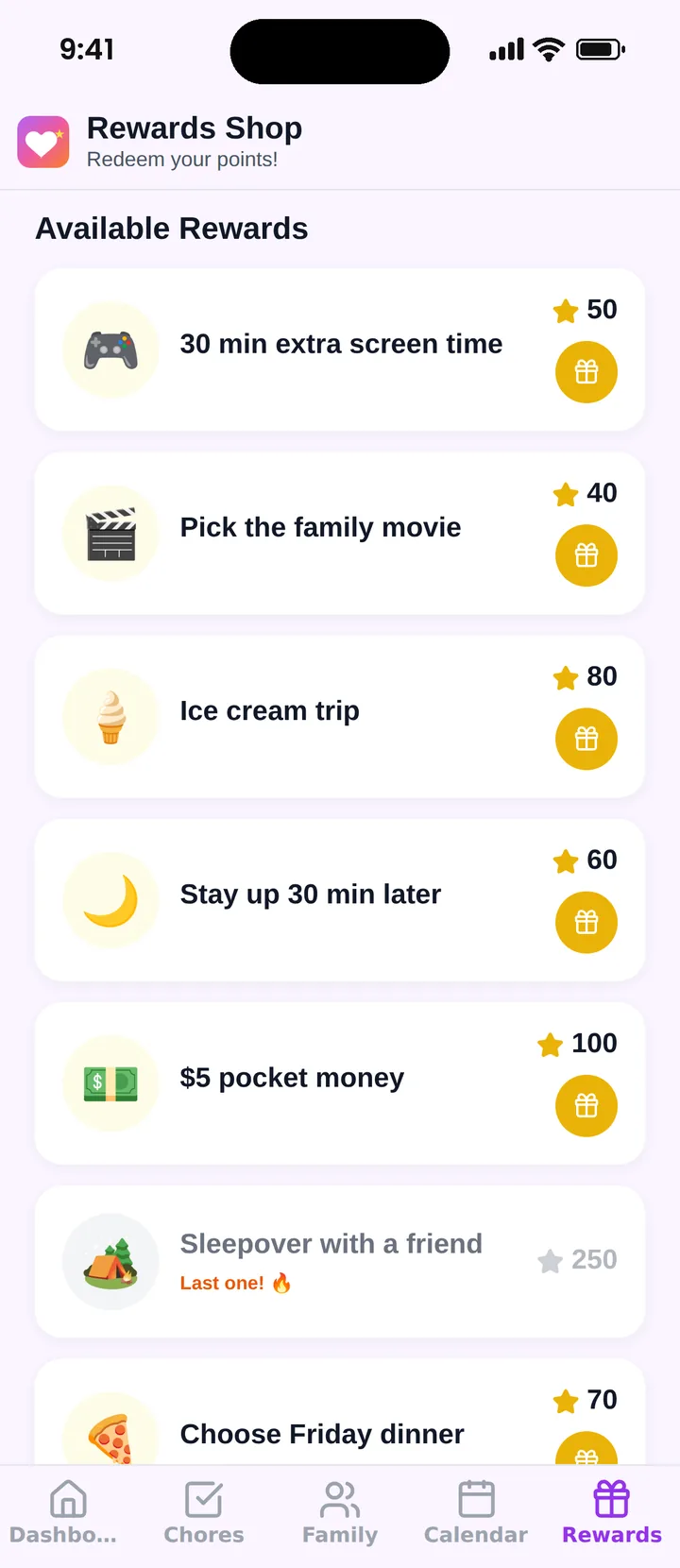
Famiyo is a free family app for iPhone and Android that combines a shared family calendar, chores with points and a rewards shop; kids join with a code, no email needed. Many families use it to split the two parts above. Chores earn points, and the rewards shop holds the things your teen can buy with them, including pocket money, such as a $10 payout for 1,000 points (100 points = $1). You set the prices and how many are available each week, and your teen redeems from their own phone and sees how many points they will have left. The money itself still changes hands outside the app.
See our list of the best allowance apps for kids if you want to compare options.
A first step for this week
Pick the number, write the list of what it covers, and tell your teen the payday. Put a reminder in your own phone to review it in six months.
Frequently asked questions
Is $20 a week too much for a 14-year-old?
No. $20 sits in the middle of the usual $15 to $25 range. It becomes too much only if it covers nothing, because then it is just free money. Decide what it must pay for, such as outings and snacks, and $20 usually works.
Should a 14-year-old's allowance be tied to chores?
Split it. Keep a base amount for being part of the household, with basic chores unpaid, and let bigger extra jobs like washing the car or mowing the lawn earn more on top, at $2 to $5 for a big one.
How often should a 14-year-old be paid?
Weekly is easiest to start with. Many families move teens to every two weeks or monthly by 15 or 16, because a larger lump sum forces real budgeting. Keep the payday fixed so it never turns into a negotiation.
What if my teen spends it all in one day?
Let it happen once and do not top it up. Running out on Tuesday teaches more than any talk. Afterward, sit down together and make a simple plan for the next week.
Try Famiyo With Your Family
Chores with points, a rewards shop for kids and one shared family calendar. Set it up in a couple of minutes.



Free to download • No credit card required • Available on iOS & Android