How Much Allowance for a 9 Year Old?
A 9 year old's allowance is usually $7 to $10 a week, with $9 as the rule of thumb. Learn how to choose, what chores it covers and how to add paid extras.
By Famiyo Editorial Team4 min read
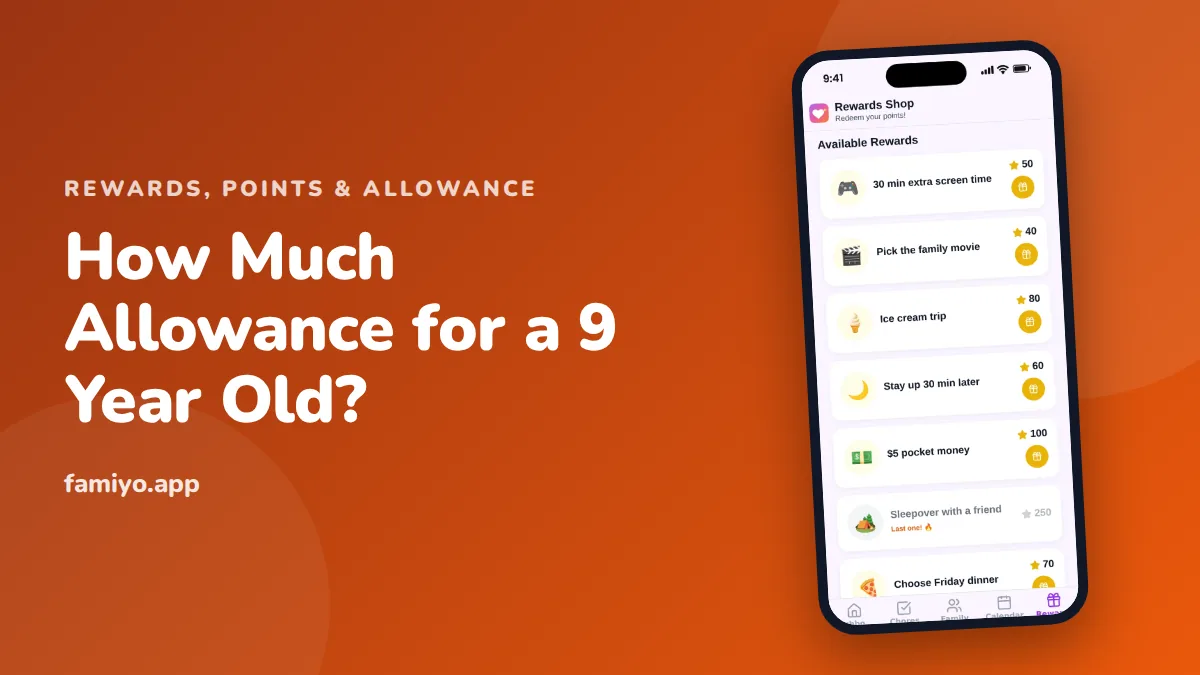
Nine is a turning point for allowance. Your child is better with numbers, notices prices and compares what they have with what their friends have. They are also old enough to save for something that takes a month or more. This page gives you the usual amount, how it differs from last year, what to tie it to and the jobs that earn extra.
What is the right allowance for a 9 year old?
The range most families use is $7 to $10 a week. The rule of thumb is $1 per week for each year of age, which gives $9. Treat that as a starting point. A family in a high-cost area may sit near $10, and one that also buys snacks and small items may sit nearer $7.
Compared with an 8-year-old, a 9-year-old is usually given about a dollar more, plus more responsibility. If you are coming from the younger age, our guide to how much allowance for an 8 year old shows where the amount starts.
What matters more than the amount:
- It arrives on the same day every week.
- It is never docked for bad behavior.
- It covers specific things your child decides about, and you do not buy those things in the meantime.
What should allowance cover at 9?
Decide before you start. A clear list prevents "but you always buy me that" arguments.
| Covered by allowance | Still covered by you |
|---|---|
| Treats at the store | Food, clothes and school supplies |
| Toys, trading cards, small games | Birthday and holiday gifts |
| Extras for hobbies, like a new brush set | Lessons and equipment |
| Gifts for friends | Medical and safety items |
The point is to put a real, if small, set of choices in your child's hands. If your child asks for a $15 toy, the honest answer is "that is two weeks of saving", which is more useful than "no".
Does a 9 year old earn allowance by doing chores?
Not directly. At 9, children can usually load the dishwasher, fold and put away laundry, vacuum a room, make a simple snack and take out the trash, within about 20 to 30 minutes a day. These are family jobs, and no pay is attached.
If you want your child to experience pay for effort, create a short list of paid extras. These are jobs you would otherwise do yourself.
- Small jobs, $0.25 to $1: wipe the baseboards in one room, wash the car windows, sort a pile of mismatched socks.
- Big jobs, $2 to $5: rake the yard, wash the whole car with supervision, help clean the garage.
- Mix: a 9-year-old might do two small jobs a week and one big one a month.
You can keep a list of options on the fridge or use our chore jar ideas for kids to let your child draw a job at random. Extras are always optional. A child who skips them still does the family chores and still gets allowance.
How do you teach saving at 9?
A 9-year-old can save toward a real goal. Use the spend, save, give jars, with a split such as 50%, 40% and 10%. On $9 a week that is $4.50, $3.60 and $0.90.
Add a goal chart. Draw a thermometer or a row of boxes, one for each dollar of the goal. If the goal is a $24 game and the save jar gets $3.60 a week, it will take about seven weeks. Color in the boxes each Saturday. A visible line is more motivating than a number.
Some parents add a small bonus for saving, such as 10 cents on the dollar when the goal is reached. It shows how savings can grow without a lecture about interest.
What if they spend everything immediately?
It is the most common problem, and the best fix is to do nothing. A child who spends $9 on day one and then wants a $2 snack on day four will feel the cost. That feeling teaches more than a rule.
What to say: "It sounds like you wish you had kept a little. What will you do with next week's?" Then do not bail them out. If you do, the lesson disappears and the next request comes sooner.
The other side matters too. If your child saves everything and never spends, do not praise it too hard. Money is for using, and a spend jar is there for a reason. Our article on how to reward kids for chores covers the difference between rewards and routine pay.
Using points and a rewards shop in Famiyo
Famiyo is a free family app for iPhone and Android that combines a shared family calendar, chores with points and a rewards shop; kids join with a code, no email needed. For a 9-year-old, you can give chores points (5 for a small one, 10 for a medium one, 20 for a big one) and add pocket money to the rewards shop at a price in points. The default suggestion is 100 points to $1. Your child redeems from their own phone and sees how many points they will have left, while the money changes hands outside the app. Compare other tools in our list of the best allowance apps for kids.
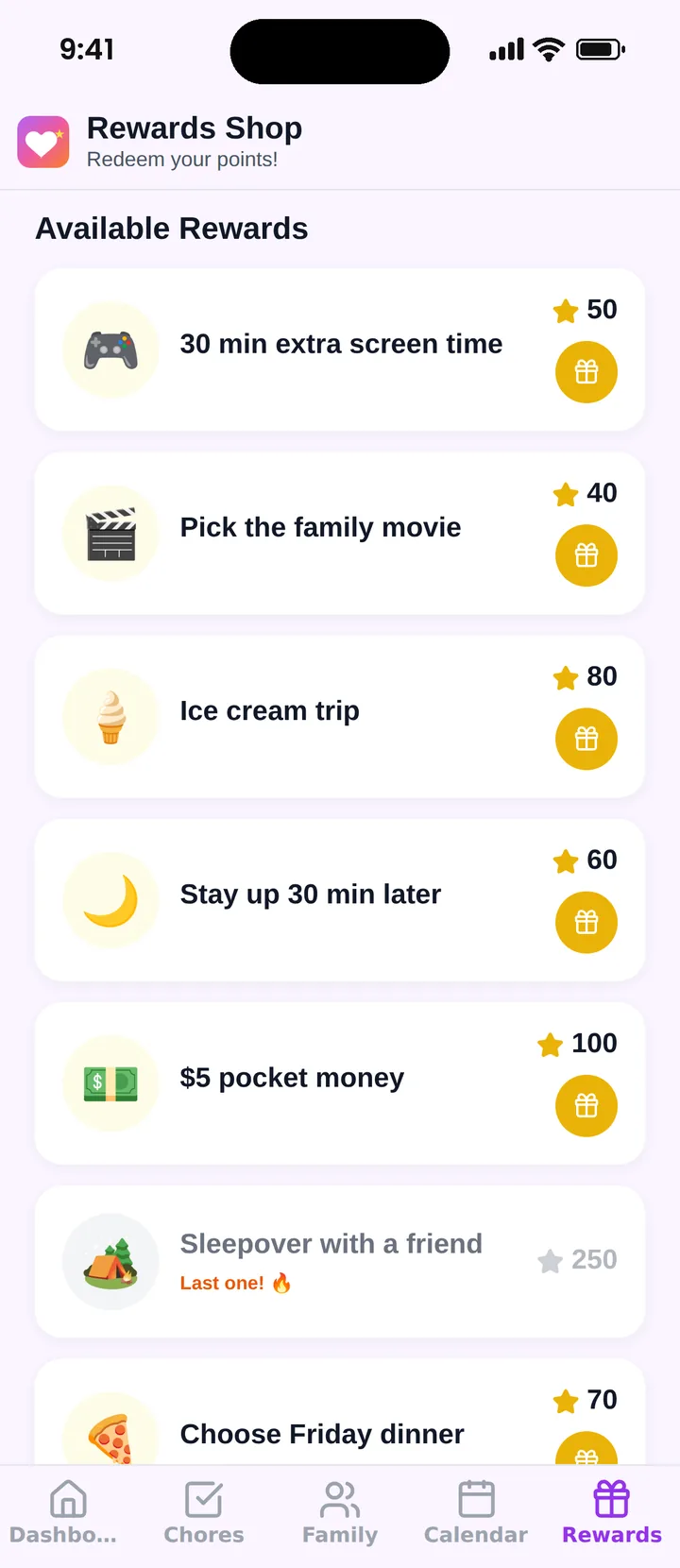
You can mix the two approaches. A flat allowance in cash for practice with money, plus points for chores that kids spend on screen time or a family movie pick, works well for many families.
When do you raise it?
Once or twice a year is enough, usually around the birthday. Raise it a dollar, or tie the increase to a new responsibility, such as caring for the pet or helping a younger sibling with the school bag. If your child asks for more in between, ask them to explain what they would do with it and listen to the answer.
Choose a payday and an amount between $7 and $10 this week, write down what it covers and tell your child before the first payment.
Frequently asked questions
How much allowance should a 9 year old get a week?
Between $7 and $10 a week is typical for ages 8 to 10. The rule of thumb of $1 for each year of age gives $9. Choose an amount you can pay reliably every week, and review it once or twice a year.
Should a 9 year old have to do chores to get allowance?
Everyday chores such as setting the table, taking out the trash and tidying their room should happen whether or not there is money. Allowance is for practicing with money. If you want to connect work with pay, add optional extras on top.
What should a 9 year old do with their allowance?
Spend some, save some and give some. A common split is 50% spend, 40% save and 10% give. At 9, children can save for a goal that takes a month or two, such as a $20 game, and see the savings grow.
Should allowance be paid every week or every month?
Weekly. A 9-year-old can usually wait a week, but a month feels too far away to teach anything. A fixed payday also removes daily requests for money. Skipping it as a punishment or adding as a prize weakens the lesson.
How do I handle a 9 year old who spends it all on day one?
Let it happen, and talk about it without judgment. Running out of money before the next payday is the lesson. Do not top it up. A child who spends everything and then wants something else will remember the feeling longer than any lecture.
Try Famiyo With Your Family
Chores with points, a rewards shop for kids and one shared family calendar. Set it up in a couple of minutes.



Free to download • No credit card required • Available on iOS & Android