How Much Allowance for a 16-Year-Old? Typical Amounts and How to Decide
Most families give a 16-year-old $15 to $25 a week. See what that money should cover, how to scale it to your budget, and when to switch to a monthly sum.
By Famiyo Editorial Team5 min read
At 16, the question changes. A younger child needs candy money. A teenager who drives, goes out with friends and has a phone full of subscriptions needs an actual budget. This page gives you the usual numbers, a way to build your own, and a few rules that keep the arrangement from turning into a weekly argument.
What is a normal allowance for a 16-year-old?
The common range for ages 14 and up is $15 to $25 a week. That works out to about $60 to $100 a month. The old rule of $1 per week for each year of age would give $16, which lands near the bottom of that range, so treat it as a floor and not a target.
Where you fall in the range depends on one thing: how much of their spending you hand over. The more a teen has to cover from the allowance, the closer to the top it should sit.
| What the allowance covers | Weekly amount | Monthly amount |
|---|---|---|
| Fun money only (snacks, small purchases, apps) | $15 | $60 |
| Fun money plus outings with friends | $20 | $80 |
| All of the above plus gifts and a phone add-on | $25 | $100 |
| Everything above plus part of their clothes | Agree a separate budget | See our guide to a clothing allowance |
These are starting points, not standards. A family in a small town with free weekend options needs a different number than one where a movie and a meal costs $30.
How to decide the amount for your family
A number copied from a neighbor tends to be wrong for you, so build it from your own list.
- Write down what your teen currently asks you to pay for in a normal month: food out, outings, apps, games, small gifts, rides.
- Circle the items you are willing to hand over to them completely.
- Add up the monthly cost of the circled items, using the last two or three months as a guide.
- Round to a clean number and state it plainly: "From now on, this is $80 a month and it covers these things."
- Pick a review date, usually 2 to 3 months out, to adjust.
The point of step two is that an allowance only teaches budgeting when it replaces something you would have paid for anyway. If you keep paying for everything and add cash on top, they never meet a trade-off.
Weekly or monthly at 16?
Weekly works fine for a first-time budgeter. By 16, most teens can handle a monthly sum, and it better matches how adult money works: bills and paychecks arrive monthly, not on Fridays.
Try this sequence if your teen has never managed a month at a time:
- Weeks 1 to 4: pay weekly, and let them run out once if they do.
- Month 2: pay half at the start of the month and half in the middle.
- Month 3 onward: pay it all on the first of the month.
Running out on day 12 is the lesson. The hard part is not rescuing them. If you top it up every time, the number stops meaning anything.
Should the allowance be tied to chores?
Mostly not. At this age, the cleaner split is this: basic household help is part of living in the family and is unpaid, and the allowance is a budget for them to manage. Paid work is the third piece. Extra jobs like washing the car, mowing the lawn or deep-cleaning the garage can earn roughly $2 to $5 for a big one, on top of the allowance.
Mixing all three together causes the classic standoff: "I'll skip the allowance, I don't need it this week" and the dishes stay in the sink. Keeping them separate takes that lever away. If you want to see how the same logic looks when the amounts are smaller, compare how much allowance a 13-year-old gets.
What a 16-year-old's allowance should and should not cover
Write the list down. Vague coverage is where most teen allowance fights start.
- Usually covered: snacks and food out with friends, entertainment, in-app purchases, small gifts for friends, a share of a phone plan add-on.
- Usually not covered: school supplies, required fees, medical costs, and basic clothing and shoes. (A teen who wants brand-name sneakers can pay the difference.)
- Worth deciding explicitly: car costs such as gas and insurance. Many families treat these as a separate arrangement that rises with a part-time job.
Once the list is agreed, hold to it.
Giving pocket money in a digital world
Teens rarely carry cash. That is a good reason to pay into a bank account or a teen debit account so the money is visible and spendable the way they actually spend. Seeing the balance fall is a better teacher than a jar of bills.
If you also run a points system at home, you can keep it separate from the money. Points handle privileges and small treats, while the allowance handles real purchases. You can see the same distinction in our advice on how much allowance a 17-year-old needs and, for the step before this one, in how much allowance a 15-year-old gets.
Rewards and pocket money in Famiyo
Famiyo is a free family app for iPhone and Android that combines a shared family calendar, chores with points and a rewards shop; kids join with a code, no email needed.
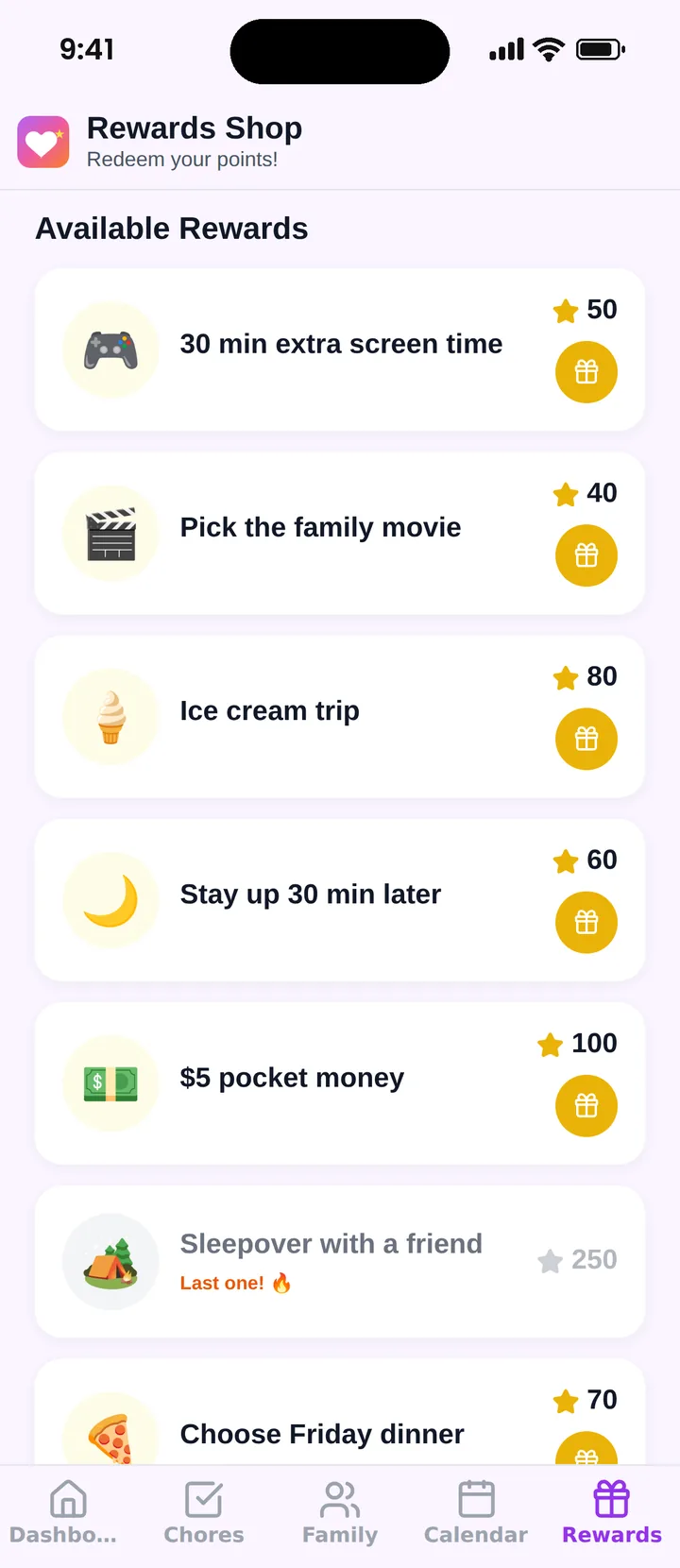
Famiyo does not hold or move money. But the rewards shop works well for the extras around an allowance: you add a reward such as "$10 extra pocket money" or "choose Friday's dinner", set a price in points, and kids redeem it from their own phone, seeing how many points they will have left. The money itself still changes hands outside the app. If you want to compare tools that track allowances, see our list of the best allowance apps for kids.
Adjusting as they get closer to 17
Plan one raise a year, or one at each natural change: a driver's license, a first job, or a new expense you want them to own. When you raise it, add a responsibility alongside the money. "You're now at $90 a month and you pay your own phone add-on" is a trade teens understand. A raise with nothing attached is just a bigger gift.
Frequently asked questions
Is $20 a week too much for a 16-year-old?
No. It sits in the middle of the usual $15 to $25 range for teens. What matters more than the number is what it covers. If $20 pays for outings, snacks and apps, it is a real budget. If you still pay for all of those, it is just extra spending money.
Should a 16-year-old get a weekly or monthly allowance?
Monthly suits most 16-year-olds. A bigger, less frequent payment forces them to plan around rent-style costs like phone add-ons, gifts and a night out. Start with weekly if they struggle to make money last, then switch after a month or two of steady budgeting.
Should a 16-year-old still do chores for allowance?
Keep everyday chores unpaid, since everyone in the household helps. Pay separately for extra jobs, such as washing the car or mowing the lawn. Paid extras run roughly $2 to $5 for a big job. A flat allowance then covers budgeting practice, not housework.
What if my 16-year-old has a part-time job?
A paycheck usually replaces some or all of the allowance. Many parents keep a smaller amount for things they still choose to cover, such as a phone plan share, and let the job pay for fun spending. Agree the new split in writing so nobody feels surprised.
Try Famiyo With Your Family
Chores with points, a rewards shop for kids and one shared family calendar. Set it up in a couple of minutes.



Free to download • No credit card required • Available on iOS & Android