How Much Allowance for an 8 Year Old?
An 8 year old's allowance is usually $7 to $10 a week. See how to choose within that range, what it should cover, the spend, save, give split and a sample week.
By Famiyo Editorial Team4 min read
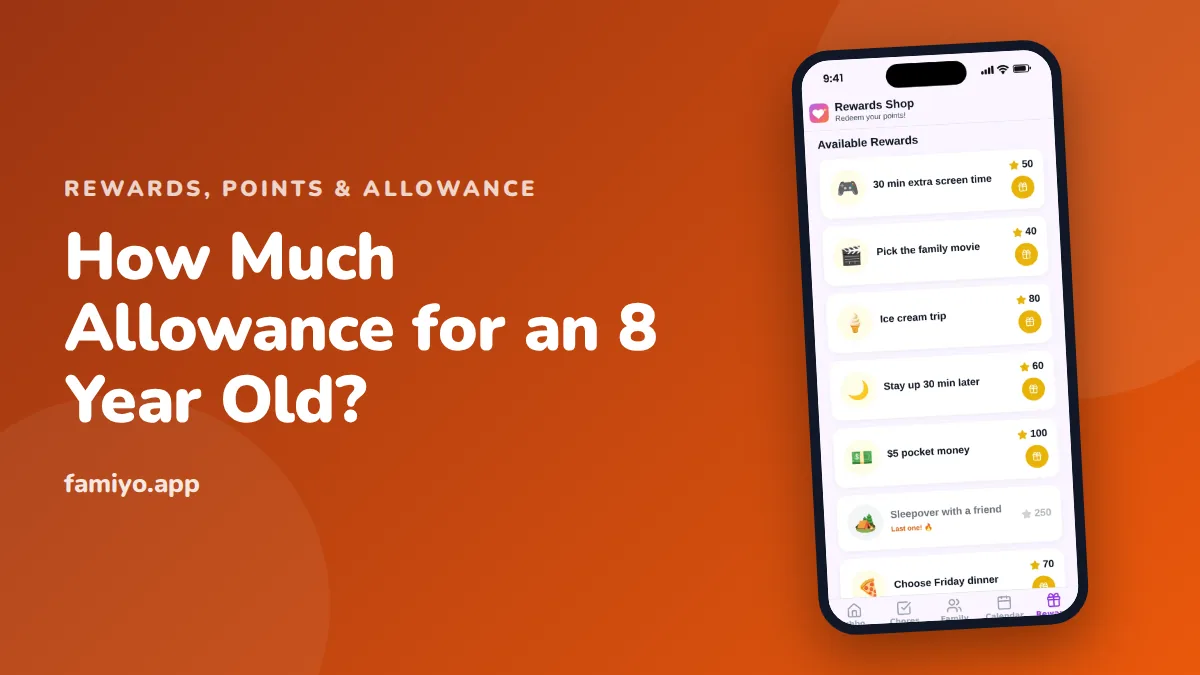
Eight is a good age to start an allowance. Your child can count money, understands that a toy costs more than a gum drop and is old enough to want something badly enough to wait for it. The real questions are how much, how often and what it is for. Here is a direct answer, then how to pick a number and a plan.
What is a normal allowance for an 8 year old?
The typical range is $7 to $10 a week. One common rule of thumb is $1 per week for each year of age, which gives $8. It is a starting point, not a standard.
Where you land inside the range depends on three things.
| Factor | Pushes toward $7 | Pushes toward $10 |
|---|---|---|
| What it covers | Only fun spending | Includes some small purchases like a school snack |
| Local costs | Lower | Higher |
| Chores tied to it | None, allowance is separate | Some jobs earn extra on top |
Do not set it by what other families give. Set it by what you can afford to pay every single week for years, because an allowance that is skipped is worse than a smaller one that never is.
Is allowance pay for chores?
Mostly no. At this age, the best advice is to keep two things separate.
Regular chores are part of being in the household. An 8-year-old can usually load the dishwasher, fold and put away laundry, vacuum one room and take out the trash, for about 20 to 30 minutes a day. These are not paid.
Allowance is money for your child to practice with. It teaches saving, choosing and living with the results.
If you want your child to see how effort turns into money, add paid extras on top. A small extra job, such as washing the car windows or sorting the recycling, can pay $0.25 to $1. A big one, such as raking the whole yard, can pay $2 to $5. Our chore point system template shows how to set up the points side, if you prefer to count in points rather than dollars.
How should an 8 year old split their allowance?
A simple split makes allowance a lesson rather than a pile of coins. For an 8-year-old, one that works is spend, save, give, in roughly 50%, 40% and 10%.
On $8 a week, that comes to this:
| Jar | Share | Amount | What it is for |
|---|---|---|---|
| Spend | 50% | $4.00 | Anything they choose, no questions |
| Save | 40% | $3.20 | A goal, such as a $20 toy in six weeks |
| Give | 10% | $0.80 | A donation, a gift or a treat for someone else |
Three jars or three labeled envelopes are enough. The idea is that the spend money really is theirs. If they blow it on a toy that breaks in two days, that is the lesson. Do not rescue them, and do not say "I told you so". Say, "That was disappointing. What would you do differently next time?"
For a child who struggles to wait, our guide to delayed gratification for kids has small practice steps that fit this age.
What does a sample week look like?
Say your 8-year-old gets $8 on Saturday morning.
- Saturday: allowance is paid, and your child puts $4 in the spend jar, $3.20 in the save jar and $0.80 in the give jar.
- Sunday to Friday: regular chores happen, unpaid. Your child may take on one paid extra, say rinsing the recycling for $0.50.
- The next Saturday: before the new allowance arrives, you and your child look at the save jar together and talk about how close the goal is. A chart with a line to color in helps.
Do not use allowance as a reward or punishment. Withholding it for bad behavior turns money into a threat, and adding to it for good behavior turns it into a bribe. If you want to reward behavior, use a separate system, such as points.
What if my 8 year old asks for more?
They will. Use the request as a teaching moment rather than a negotiation.
Ask them to make a case. "How much would you like, and what would you do with it?" An 8-year-old who says "$12, because I want to save for a bike and I need more spending money" has just practiced a skill. You can say yes, no or a smaller increase, and give a reason. Review the amount once or twice a year, around the birthday.
If a sibling gets more because they are older, say so plainly. "Your sister is 11, so her allowance is higher. When you are 11, yours will be too." That is easy for a child to understand.
Using points and a rewards shop in Famiyo
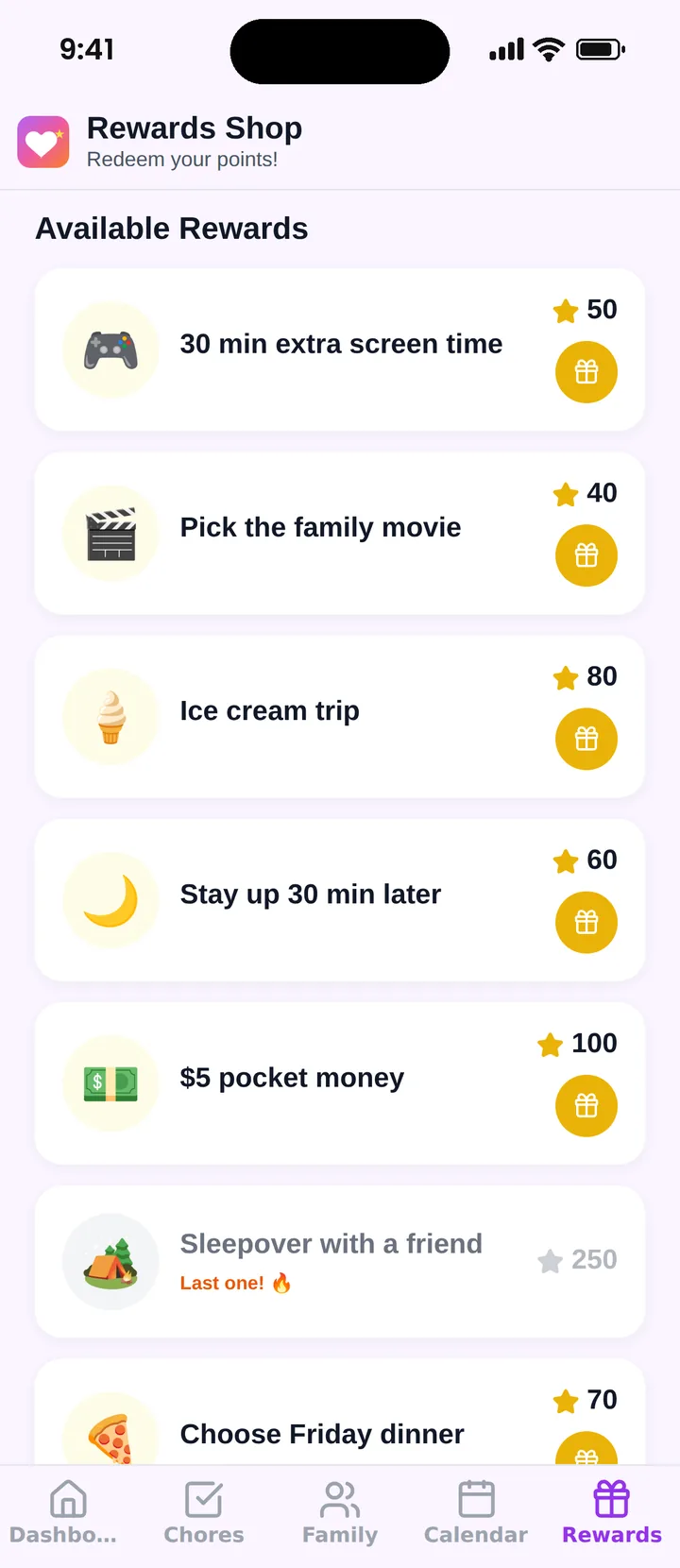
Famiyo is a free family app for iPhone and Android that combines a shared family calendar, chores with points and a rewards shop; kids join with a code, no email needed. If you prefer to count in points rather than hand out cash each week, you can give chores points (5 for a small one, 10 for a medium one, 20 for a big one) and add pocket money to the rewards shop at a price in points. In the default suggestion, 100 points equal $1. Your child redeems from their own phone and sees how many points are left, while the money itself changes hands outside the app. See our list of the best allowance apps for kids for other ways to run this.
When your child turns 9, the amount and the jobs move up a notch, and our guide to how much allowance for a 9 year old shows what changes.
Pick a number between $7 and $10 this week, choose a payday and tell your child the plan in one sentence.
Frequently asked questions
How much allowance should an 8 year old get per week?
A typical range is $7 to $10 a week. The usual rule of thumb is $1 for each year of age, so $8 for an 8-year-old. Choose a number you can sustain every week without stress, and adjust it once or twice a year.
Should an 8 year old get allowance for doing chores?
Keep everyday chores like making the bed and clearing the table unpaid, because they come with being in the family. Allowance can stand alone as money to practice with. Pay extra, at $0.25 to $1 for small jobs and $2 to $5 for big ones, for work beyond the basics.
What should an 8 year old spend their allowance on?
Small treats, toys, books, games or a pocket-sized goal they are saving toward. Avoid making the allowance cover things you would normally buy. At this age the point is to practice choosing, making small mistakes and learning that money runs out.
How often should an 8 year old get allowance?
Weekly. At 8, a month is too long for a child to feel the link between money and time. Pay on the same day each week, such as Saturday morning, and do not skip it as a punishment or add to it as a prize.
Can I give allowance in points instead of money?
Yes. Many families use points for chores and let kids exchange them for rewards, including pocket money, at a fixed rate such as 100 points to $1. Points are easy to count, make tracking simple and let a child choose between money and other rewards.
Try Famiyo With Your Family
Chores with points, a rewards shop for kids and one shared family calendar. Set it up in a couple of minutes.



Free to download • No credit card required • Available on iOS & Android