Earn Screen Time With Chores: A Fair System
How to let kids earn screen time with chores without daily fights: a base amount that isn't earned, a fair points price, daily caps and a sample week.
By Famiyo Editorial Team6 min read
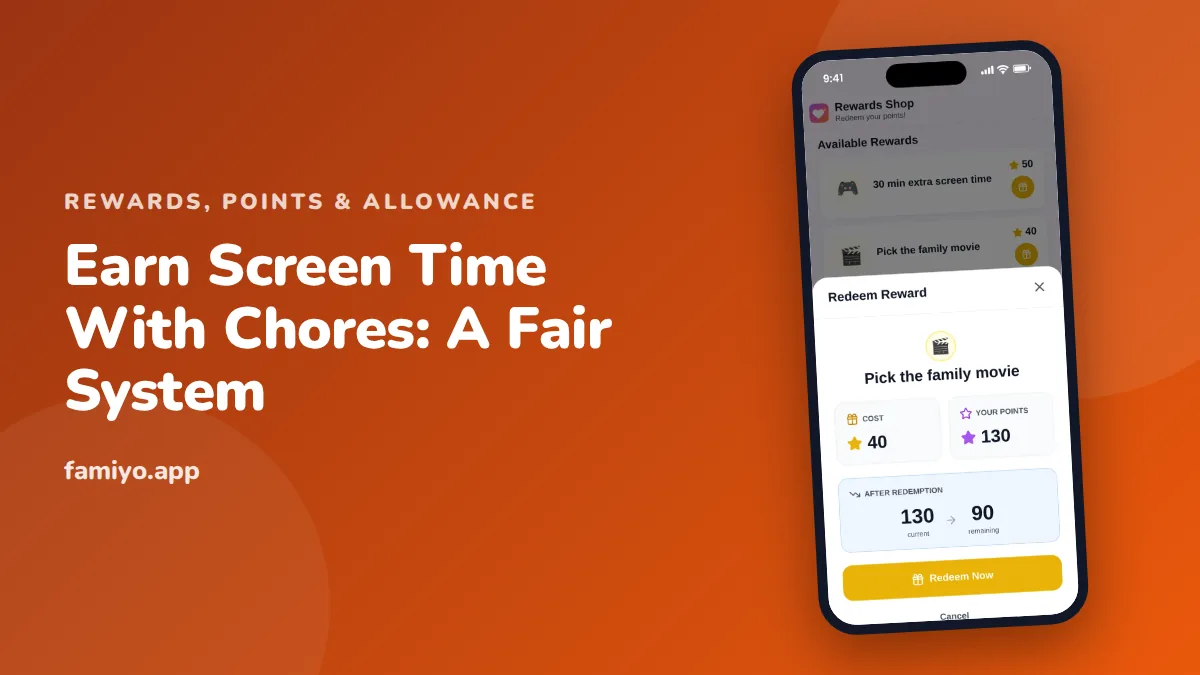
Screen time is the one reward almost every kid will work for, which is exactly why it's tempting to tie it to chores and also why it goes wrong so often. Done carelessly, it turns every request into a bargaining session. Done with a few rules, it's one of the simplest motivators a family can use. This page lays out a fair system: what to keep unearned, what to charge, what to cap and how a real week adds up.
Does earning screen time with chores work?
For most school-age kids, it can. The reasons are fairly well understood. A reward works best when it's something the child actually wants, when it follows the effort quickly, and when the rules are predictable. Screen time ticks all three boxes. A point system adds one more useful piece: kids can see their progress before they get the payoff, which is good practice in waiting for something (our piece on delayed gratification in kids explains why that skill matters).
The risks are just as clear. When screens become the only currency in the house, three problems show up. Kids start pricing every request ("how many minutes do I get for clearing my plate?"). Screen time grows into the most valued thing in their day, because the family keeps treating it as the top prize. And some kids stop doing anything that isn't paid. Psychologists have long discussed the idea that strong external rewards can crowd out a child's own reasons for doing something, so it's worth reading about intrinsic motivation in kids before you build the whole household around a reward.
How much of this you'll see depends on the child. Some kids treat points as a game and move on. Others will test every edge of the rules. The system below is designed to limit the downsides either way.
Start with screen time that isn't earned
The single biggest fairness rule: don't make all screen time earned. Decide on a base amount that your child gets when the day's basics are done (homework, getting ready, their everyday jobs), then let chores buy extra time on top.
This matters for two reasons. It takes the pressure off ordinary family chores, which are part of living in a home, not a transaction. And it keeps the total within a limit you've chosen on purpose, instead of a limit set by how many chores a determined 10-year-old can find.
Here's how to set the base, using the American Academy of Pediatrics guidance as the starting point:
| Age | AAP guidance | Base screen time | Earned extra |
|---|---|---|---|
| Under 18 months | Avoid screens other than video chatting | None | Not used |
| 18 to 24 months | If any, high-quality programs watched with a parent | Optional, co-viewed | Not used |
| 2 to 5 | About 1 hour a day of high-quality programming, ideally co-viewed | Up to about 1 hour | Not used; reward with activities instead |
| 6 and up | Consistent limits set by the family, protecting sleep, physical activity and homework | Your family's limit | Capped per day, on top of the base |
For every age, two lines hold regardless of points: screens off about an hour before bed, and no screens during meals. Earned time can't be spent in those windows.
What should 15 minutes of screen time cost?
Use a points scale your kids can understand and keep it stable. A common one is 5 points for a small chore (2 to 5 minutes), 10 for a medium one (10 to 15 minutes) and 20 for a big one (30 minutes or more), with a 2-point bonus for doing it without a reminder. Our guide to the chore point system explains how to set those values in detail.
On that scale, 15 extra minutes of screen time sits well at 30 to 50 points. The goal is for a child to afford a small reward every 2 to 3 days. A 9-year-old doing three or four chores a day earns roughly 20 to 30 points, so a price of 40 points means 15 extra minutes about every other day. That's frequent enough to motivate and rare enough to keep the base amount meaningful.
Then add caps. A cap is what keeps the system fair to you as well as to your child:
- A daily cap on earned time, for example two 15-minute blocks on a weekend day and one on a school day.
- A weekly cap if you want one, so a big Saturday of chores doesn't turn into six hours of gaming.
- Earned time expires at bedtime or can be saved, but only up to the daily cap. Pick one rule and keep it.
A sample week for a 9-year-old
Here's a hypothetical week at 40 points per 15 minutes, with a cap of one block on school days and two on weekends.
| Day | Chores done | Points earned | Screen time bought | Points left |
|---|---|---|---|---|
| Mon | Make bed, feed the dog, empty the dishwasher | 20 | None | 20 |
| Tue | Make bed, feed the dog, tidy room (no reminder, +2) | 22 | 15 minutes | 2 |
| Wed | Make bed, feed the dog, sweep the kitchen | 20 | None | 22 |
| Thu | Make bed, feed the dog, empty the dishwasher | 20 | None, saving up | 42 |
| Fri | Make bed, feed the dog, tidy room (no reminder, +2) | 22 | 15 minutes | 24 |
| Sat | Make bed, feed the dog, vacuum one room, wash the car with a parent | 40 | 15 minutes | 24 |
| Sun | Make bed, feed the dog, fold laundry | 20 | 15 minutes | 4 |
That's an extra hour across the week, spread over four days, on top of whatever base the family allows. Notice that Thursday's choice to save was the child's. That's the system working: they weighed now against later.
Rules that keep it from turning into a fight
Write these down where everyone can see them, and agree on them before the first week:
- Base time comes first and isn't earned. Points buy extras only.
- Homework and the daily basics come before any screen time, earned or not.
- Earned time has a daily cap, and it can't be used at meals or in the hour before bed.
- Once points are earned, they stay earned. Misbehavior gets a separate consequence.
- Use a timer your child can see, and give a 5-minute warning before time is up.
- Prices don't change mid-week. If something needs adjusting, change it on a set day.
- Give the system 2 to 3 weeks before judging it. The first week always has some testing.
The timer and the warning do more than they seem to. A lot of the conflict at the end of screen time comes from surprise, and a visible countdown removes most of it.
When to change the system
Watch for a few signs. If your child refuses any chore that doesn't earn points, lower the role of screen time and put more non-screen rewards in reach: choosing dessert, picking the family movie, staying up 30 minutes later on a Friday. If the end of every earned block ends in tears, shorten the blocks rather than raising the price. And if screen time is already a source of real conflict, or you're concerned about how your child reacts when it ends, the child's pediatrician is a good person to talk it through with.
Setting up screen time rewards in Famiyo
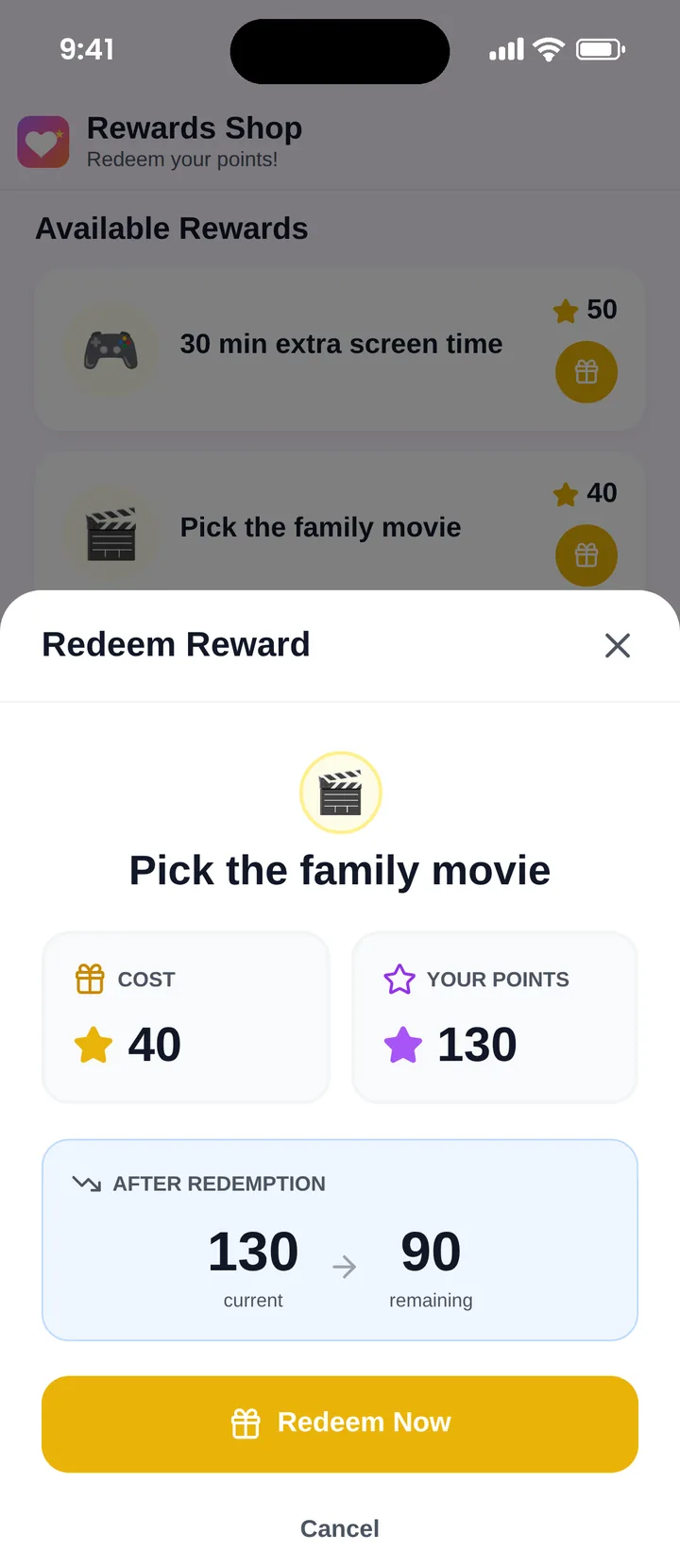
Famiyo is a free family app for iPhone and Android that combines a shared family calendar, chores with points and a rewards shop; kids join with a code, no email needed. Chores earn points, and in the rewards shop you create a reward like "15 minutes of tablet time" with a price, how many are available and when, so the daily cap is built in. Your child redeems it from their own phone and sees the cost and the points they'll have left before confirming, and you get a notification when they do. The app doesn't control devices, so you still start the timer.
For other options, see our list of the best reward chart apps for kids.
Decide your base amount and your price tonight, write the seven rules on one page, and start on Monday.
Frequently asked questions
Is it a good idea to make kids earn screen time with chores?
It can work well as a motivator for extra time, because the reward is concrete and comes quickly. It tends to backfire when all screen time has to be earned, since every chore turns into a negotiation. Keep a base amount, cap the extra, and offer other rewards too.
How many points should 15 minutes of screen time cost?
Somewhere between 30 and 50 points works with a common scale of 5 points for a small chore, 10 for a medium one and 20 for a big one. That lets a child doing 3 or 4 chores a day buy 15 extra minutes every 2 to 3 days.
Should earned screen time be taken away as a punishment?
Generally no. Once a child has earned time, removing it for an unrelated problem makes the system feel unreliable, and kids stop working for it. Handle misbehavior with a separate consequence that's directly related to what happened.
Should toddlers and preschoolers earn screen time with chores?
It's better not to. The American Academy of Pediatrics suggests about 1 hour a day of high-quality programming for ages 2 to 5, ideally watched with a parent, which leaves little room for bonus time. Use rewards like choosing the bedtime book or extra park time instead.
Try Famiyo With Your Family
Chores with points, a rewards shop for kids and one shared family calendar. Set it up in a couple of minutes.



Free to download • No credit card required • Available on iOS & Android