Kids Saving Money: How to Build the Habit Early
How to get kids saving money: goals that fit their age, a simple save split, parent matching, and how to keep savings visible when most money is digital.
By Famiyo Editorial Team6 min read
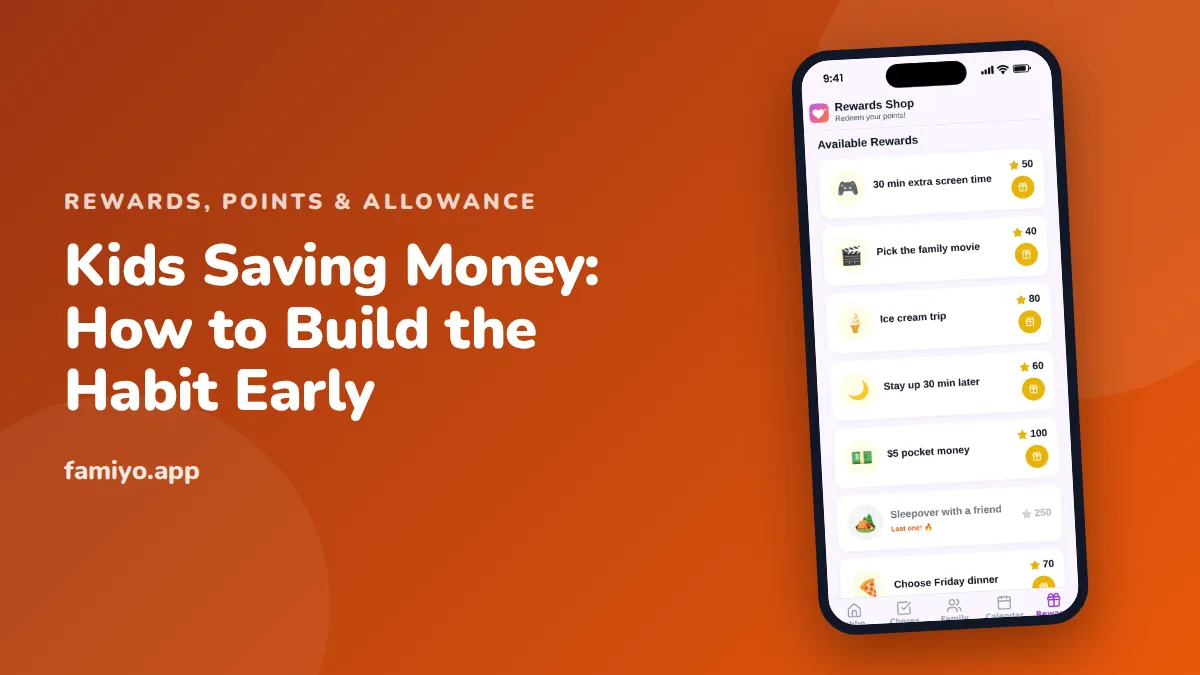
Telling a child to save rarely works. Saving only makes sense to a kid when there's money coming in, something specific to save for and a way to see the pile grow. This guide covers how to set those three things up at each age, plus how to keep saving real for kids who almost never see cash.
Why most kids don't save on their own
Saving means choosing a later reward over a sooner one. Younger children find that hard, which is normal. Their sense of time is still short, and "in six weeks" feels the same as "never." Our guide to delayed gratification for kids explains how that ability grows with age and practice.
There's also a practical barrier. A child can't practice saving without regular money of their own. Birthday cash once a year isn't enough repetitions. Kids get good at saving the same way they get good at anything: by doing it every week, making small mistakes and trying again.
And then there's the digital problem. Many families pay by card or phone, so kids rarely see money change hands. To a 7-year-old, tapping a phone at the checkout looks free. Saving has to be made visible on purpose.
What saving looks like at each age
| Age | First goal size | How long to wait | Where the money lives |
|---|---|---|---|
| 3 to 5 | $2 to $5 | 1 to 2 weeks | A clear jar on a shelf |
| 6 to 8 | $10 to $25 | 3 to 6 weeks | Jars or envelopes, plus a written tally |
| 9 to 12 | $30 to $100 | 1 to 3 months | A kids' bank account or allowance app, checked weekly |
| 13 and up | $100 or more | Several months | A savings account they can log into, with a teen debit card for spending if you choose |
These ranges are starting points. A child who has never saved should start with a short, easy win at any age. A 10-year-old who reaches a $15 goal in two weeks learns more than one who gives up halfway to $150.
The amount coming in sets the pace. Typical weekly allowances run $3 to $7 for ages 5 to 7, $7 to $10 for ages 8 to 10, $10 to $15 for ages 11 to 13 and $15 to $25 for ages 14 and up. If your child earns money from chores too, our guide on how much to pay kids for chores covers fair rates.
Set up a first savings goal in 6 steps
- Pick one thing your child wants. Let them choose. A specific toy, game or outing works much better than "something nice later."
- Find the real price, including tax and shipping. Write it down where they can see it.
- Do the math together. "The scooter costs $40. You save $4 a week. How many weeks?" Ten weeks is the answer, and working it out together makes the goal feel real.
- Make it visible. Print a photo of the item and stick it on the jar, or set it as the goal image in a savings app. Draw a simple bar with ten boxes and color one in each payday.
- Agree on the rules before the first payment. For example: savings come out first, the jar stays on the shelf, and a withdrawal needs a one-day wait.
- Celebrate the purchase. Go to the store together, let them hand over the money or tap the card themselves, and say what they did: "You saved for ten weeks for this."
After the first goal, pick the next one right away, ideally a little bigger and a little longer.
Spend, save, give: a split that runs on autopilot
The easiest way to make saving automatic is to split every payment the moment it arrives. A common split for younger kids is 50% to spend, 40% to save and 10% to give.
Here's how that looks with a $6 weekly allowance: $3 goes in the spend jar, $2.40 in the save jar and $0.60 in the give jar. If the decimals are awkward, round to $3, $2 and $1. Kids can spend the first jar on anything, the save jar goes toward the current goal, and the give jar collects for a donation or a gift they choose.
With digital money, set up the same split as three separate balances or "pots." Many kids' banking apps let you do this, and some can split payments automatically. If yours doesn't, move the save portion yourself right after payday, while your child watches. The habit you're teaching is "save first," so the order matters.
Older kids can take over the split themselves. At 11 or 12, try telling them they must save at least 30% and letting them decide the rest. Owning the decision builds the skill.
Matching and interest: make waiting pay
Kids feel the benefit of saving more quickly when the money grows. A parent match does that in a way a child can understand.
Two simple options:
- A straight match. For every dollar your child saves toward a goal, you add 50 cents. A 9-year-old saving $5 a week gets $7.50 a week toward the goal, and the goal arrives sooner.
- Parent-paid interest. At the end of each month, add 5% or 10% of whatever is in the save jar. Real bank interest is far lower than this, and you can say so, but a generous family rate makes the idea of interest concrete. Ten percent of $40 is $4, which a child notices.
Set a cap so the match stays affordable, for example up to $5 a month. Pay the match only on money that stayed saved, not on money that was deposited and withdrawn the next day. That rewards the waiting, which is the actual skill.
Handling impulse buys and broken goals
Your child will want to raid the jar. Expect it, and decide in advance how you'll respond.
A cooling-off rule helps: before any withdrawal over a few dollars, wait one day (two days for bigger amounts). Many impulses fade overnight. If the want is still there tomorrow, let them decide.
If they spend the savings on something that turns out to be disappointing, resist the urge to replace it. Ask a neutral question instead: "Was it worth the four weeks?" Whatever they answer, they did the thinking. Kids who make small money mistakes at 8 tend to make fewer big ones at 18.
And if a goal stalls, shrink it. Pick something cheaper, or split the big goal into a first milestone. A goal that never gets reached teaches that saving doesn't work.
Saving up points in Famiyo
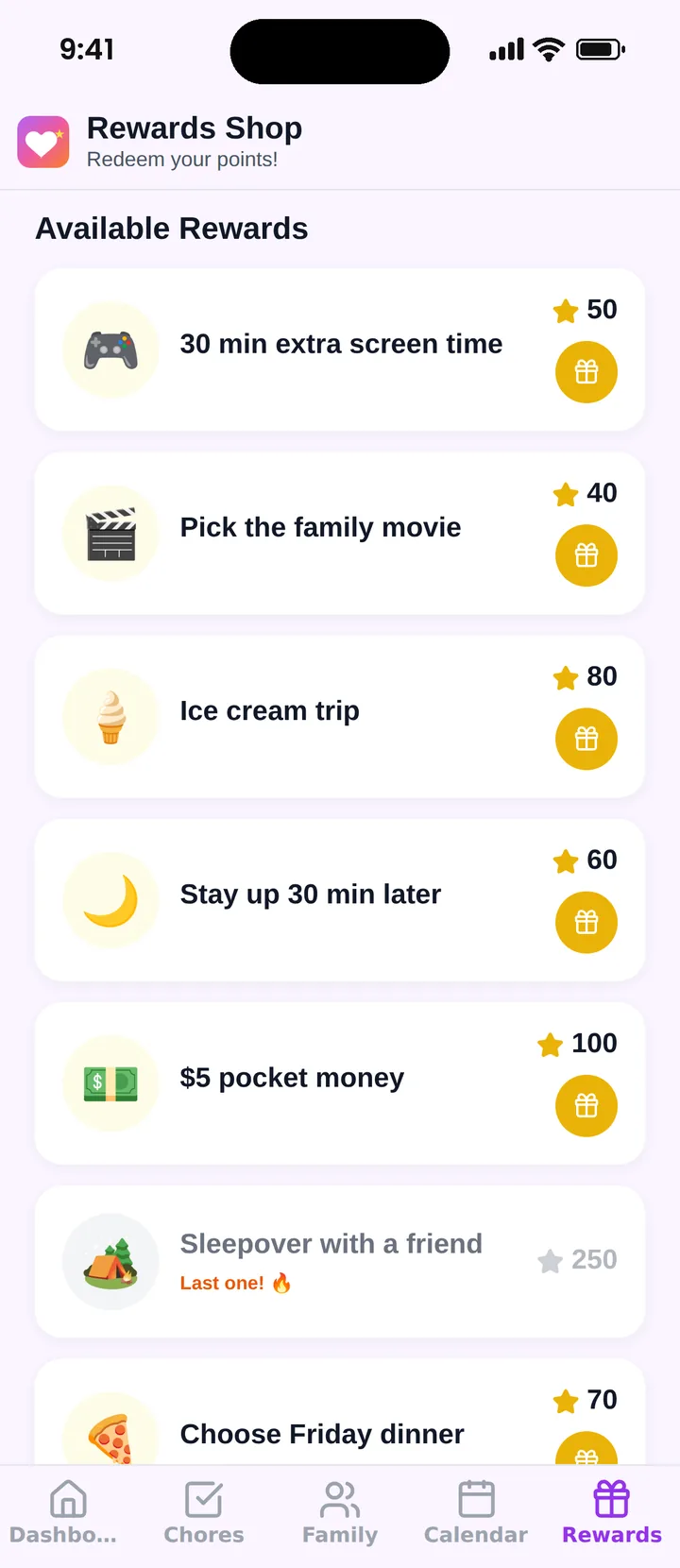
Famiyo is a free family app for iPhone and Android that combines a shared family calendar, chores with points and a rewards shop; kids join with a code, no email needed. It doesn't hold money, but it gives younger kids a low-stakes way to practice saving. Kids earn points for chores, and you fill the rewards shop with things to spend them on, including pocket money if you like (for example $1 at 100 points), which you then pay in cash or by transfer yourself. Put a few cheap rewards next to one bigger one that takes 3 to 4 weeks of points, and your child has to choose between spending now and saving up. When they redeem, they see how many points they'll have left. For apps that manage the actual money, see our list of the best allowance apps for kids.
This week, ask your child to name one thing they'd like to buy, look up the price together and work out how many weeks it will take.
Frequently asked questions
At what age should kids start saving money?
Around age 3 to 5 is a good start, as soon as a child understands that coins buy things. Keep the first goals tiny and close, like a $3 toy in a week or two. Longer goals and a real bank account make more sense from about age 8 or 9.
How much of their allowance should kids save?
A common split for younger kids is 50% to spend, 40% to save and 10% to give. The exact numbers matter less than the habit: a fixed share set aside every time money comes in, before any of it is spent.
Should I let my child spend their savings on something silly?
Usually, yes, as long as it's safe and the money is theirs. Buying something disappointing with their own savings teaches more than any lecture. You can suggest a waiting period of a day or two before big purchases, then let them decide.
Is a piggy bank or a banking app better for kids?
Young children usually learn better with something they can see and touch, like a clear jar. From around age 8, a kids' banking or allowance app can work well, as long as the child checks the balance regularly and understands that the numbers are real money.
Try Famiyo With Your Family
Chores with points, a rewards shop for kids and one shared family calendar. Set it up in a couple of minutes.



Free to download • No credit card required • Available on iOS & Android