How Much Money Should a 15 Year Old Have?
Most 15-year-olds get $15 to $25 a week in allowance. Here is how to set the amount, what it should cover and how to let a teen earn the rest.
By Famiyo Editorial Team3 min read

There is no standard amount a 15-year-old should have, and any single number you read online is a guess. What you can do is start from the typical range, decide what the money is meant to cover, and adjust from there. This page gives the range, the reasoning, and a way to set the amount without a fight.
What is a typical amount for a 15 year old?
For ages 14 and up, the typical weekly allowance is $15 to $25. The common rule of thumb of $1 a week per year of age puts a 15-year-old at $15, the low end of that range. It is a starting point, not a standard.
| What your teen pays for | Where to land |
|---|---|
| Almost nothing (you buy food, clothes, phone, outings) | About $15 a week |
| Some things (snacks, a few outings with friends) | About $20 a week |
| A good share (lunches out, clothes, phone costs, hobbies) | About $25 a week or more |
For the younger step, see how much allowance for a 14 year old. If you want the full age-by-age picture, pocket money by age lays out the ranges from 5 upward.
Decide what the money has to cover
The mistake most parents make is to pick a number first. Pick the list of costs first, then the number.
Sit down with your teen and write down what they spend in a normal month. Then mark each item as "mine" (the parent pays), "theirs" (allowance covers it) or "shared". A teen who has to buy their own movie tickets and phone games learns quickly that $15 does not go far. A teen who covers nothing will spend $25 on small things and have little to show for it.
Two rules help. Raise the amount when you hand over a new responsibility, such as clothes, and say so in advance. And don't use the money as a punishment tool. Taking it away for a bad week trains a teen to hide things.
Allowance versus earning
At 15, there are three ways money arrives:
- A base allowance, paid weekly whatever happens.
- Pay for extra jobs at home, in line with the usual rates: $2 to $5 for a big job such as washing the car or mowing the lawn.
- Outside work such as babysitting or yard jobs for neighbors, where the money belongs to the teen.
Keep the first two clearly apart. Basic chores such as their own laundry, their room and clearing the table are part of family life and stay unpaid. For ideas on setting the tone, see how to motivate a teenager.
Teaching a teen to handle it
A 15-year-old can plan more than a 9-year-old, so use that. Ask them to split their weekly money into spend, save and give. Younger kids often use 50%, 40% and 10%. A teen can pick their own numbers, as long as they can explain them.
Let them make small mistakes. If the money is gone by Tuesday, don't top it up. A week without spending money is a cheap lesson at this age and a costly one at 25. Agree on one exception, such as a real emergency, in advance.
Using points and a rewards shop in Famiyo
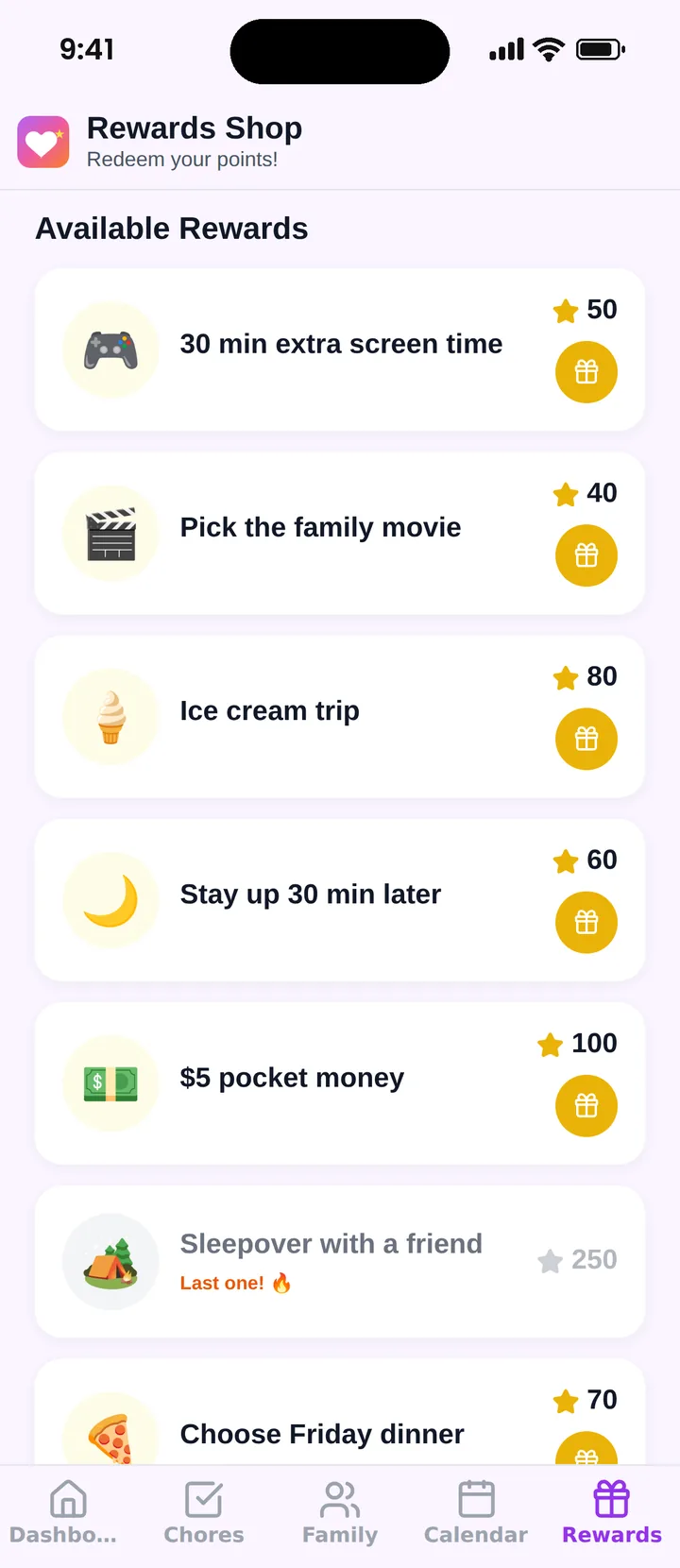
Famiyo is a free family app for iPhone and Android that combines a shared family calendar, chores with points and a rewards shop; kids join with a code, no email needed. For a teen, the points can stand in for the extra-jobs part: they earn points for bigger chores, then exchange them for rewards you create, which can include cash for the week. With 100 points equal to $1, a 20-point job is worth $0.20 on paper, so most families set bigger jobs at higher point values. The money itself changes hands outside the app.
See the best allowance apps for kids for how the options compare.
What if your teen asks for more
Teens will ask for a raise, and the useful answer is not yes or no. Ask what the extra money is for and what they will take on in return. A teen who wants $25 instead of $15 can offer to cover their own lunches out or a weekly bigger job. If the request is for one expensive item, a savings goal works better than a higher allowance: set a price, count the weeks, and let them see the progress.
Try it for a month
Choose a base amount from the table, write down what it covers and set the payday. After four weeks, sit down together and ask whether the number is too low, too high or about right.
Frequently asked questions
How much allowance should a 15 year old get a week?
Most families land between $15 and $25 a week. The $1 per year rule gives $15. Use the higher end if your teen buys their own snacks, outings or clothes, and the lower end if you still pay for those.
How much money does a 15 year old need for a night out?
It depends on what your teen does and where you live, so there is no fixed number. Ask them to list what a typical outing costs, then decide together how much of it comes from allowance and how much from you.
Should a 15 year old have a job?
A part-time job is a good option if school and sleep still come first, and local rules on teen work vary, so check what applies where you live. Many 15-year-olds earn money through babysitting, lawn work or helping neighbors instead.
Should allowance come with chores?
Keep basic chores unpaid, since everyone in the household helps. Pay a small amount for extra jobs: $2 to $5 for a big one. This lets a teen earn above the base allowance when they want something specific.
How much should a teenager save?
Aim for a share, not a number. Many families suggest a split such as 50% spend, 40% save, 10% give for younger kids, and teens can set their own once they cover some costs. The habit of splitting matters more than the exact percentages.
Try Famiyo With Your Family
Chores with points, a rewards shop for kids and one shared family calendar. Set it up in a couple of minutes.



Free to download • No credit card required • Available on iOS & Android