How to Get a Teenager to Clean Their Room
Agree on a minimum standard, set a weekly deadline, attach a small payoff and stop nagging. Here is a plan for getting a teen to clean their room, with scripts.
By Famiyo Editorial Team5 min read
You ask. They say "in a minute." Two days later you're stepping over a pile of hoodies to find a plate that has been growing something. This page lays out a plan that stops the daily argument: a standard you both agree on, a schedule, a payoff, and words to use when it still goes sideways.
Decide what "clean" means before you ask again
Most room fights are really arguments about different definitions. To you, clean means vacuumed with the bed made. To a 15-year-old, clean means "I can find my charger." Until those two pictures match, nothing you say will land.
So sit down once, on a calm day (not mid-argument), and agree on a minimum. Keep it short enough to say in one breath:
- No food, cups or dishes in the room.
- Dirty clothes in the hamper, not on the floor.
- Floor clear enough to walk across.
- Bed made or at least straightened.
- Trash in the bin.
That's it. A teen can see the end of that list, and you can check it in ten seconds. The rest (how they organize the desk, whether the posters are straight) belongs to them. Teens are working hard at building a private space, and a room they control is part of that. Giving them the inside of the drawers makes the floor easier to ask for.
Why nagging makes it worse
Every "clean your room" that comes out of your mouth tells your teen that this is your project and they're the audience. They then spend their energy resisting you, not tidying. Repeated reminders also teach them that the real deadline is whenever you finally get loud.
The fix is to move the reminder out of your voice. A shared checklist, a phone alert or a fixed day on the family routine can say "it's room day" without any tone attached. You can still be the person who checks in. You just stop being the alarm clock.
If your teen is also not great at starting tasks, see our guide on how to motivate kids to do chores for how points and praise fit together.
A weekly plan that fits a teenager's week
Daily perfection is a losing fight. A teenager with homework, practice and a phone will not make the bed at 7:00 every morning. A rhythm of small daily habits plus one bigger reset is more realistic.
| When | What | Time |
|---|---|---|
| Every day | Dishes to the kitchen, dirty clothes in the hamper | 2 to 3 minutes |
| Every day | Bed straightened (optional if the weekly reset happens) | 1 to 2 minutes |
| Once a week (pick a day) | Strip and remake the bed, trash out, clear the floor, wipe the desk, vacuum | 20 to 30 minutes |
| Once a month | Sort the closet and drawers, donate what doesn't fit | 30 to 45 minutes |
Choose the weekly day with your teen. Saturday morning before plans, or Sunday evening before the school week, both work. The point is that it's on the calendar, so nobody has to remember to be annoyed. Teens 13 and up can also do their own laundry from start to finish, and the weekly reset is a natural moment to run a load and put it away.
What to say (and what not to say)
Wording matters more with a teen than with a younger child. Compare these.
- Instead of "Your room is disgusting, clean it now," try "Room day is tomorrow. What time works for you before 5?"
- Instead of "You never do anything," try "I need the dishes back downstairs by tonight. Can you do it before dinner or after?"
- Instead of "If you don't clean it, I'm throwing everything out," try "If the floor isn't clear by Sunday night, friends can't come over until it is."
Notice the pattern. You name the job, offer a choice about when, and tie the consequence to the thing in question. You aren't announcing that their character is broken. When your teen says "fine" in that flat voice, take it. Don't make them also sound cheerful.
Rewards and consequences that don't start a war
A small payoff for the weekly reset helps because it turns "my parent wants this" into "I get something for doing this." For a teen, that can be points toward a bigger reward, extra phone time on the weekend, a later bedtime on a Friday, or pocket money.
A decent starting scale from our default suggestions: tidying the room is a medium job, worth 10 points, and finishing it without a reminder earns a bonus of 2. If you convert points to money, 100 points is $1, so this is small by design. Keep the minimum standard unpaid, because living in a clean-enough room is part of being in the family. Pay or reward the bigger weekly job.
Consequences work only when they're announced beforehand and connected to the problem. Dishes in the room can mean no snacks upstairs. Wet towels on the carpet can mean the towel goes in the laundry basket you now keep downstairs. A floor you can't walk on can pause friends coming over. Avoid grabbing whatever your teen loves most (phone, car keys) for a mess, because it feels unrelated and fuels resentment.
For more ideas on pairing chores with something to earn, see how to teach kids to do chores step by step.
When it falls apart on Wednesday
It will. A test week, a breakup, a flu: the room goes. A few things help.
Don't restart the whole system. Ask, "Do you need me to change the day this week?" Sometimes a teen who is overwhelmed just needs the deadline moved by a day.
Offer help once. Sitting on the bed while they sort the clothes pile ("You do the floor, I'll do the desk, 15 minutes") often turns a two-hour avoidance into a fifteen-minute job. This isn't giving in. It's how adults get started on dreaded tasks too.
Check for something bigger. A room that suddenly becomes a disaster, with dishes hidden and a teen withdrawn, may be a sign that more is going on than laziness. If your gut says so, talk to your teen about how they're doing, and bring in the pediatrician or school counselor if needed.
And be consistent with the consequence you announced. Wavering once teaches them that your rules are suggestions.
Letting an app do the reminding
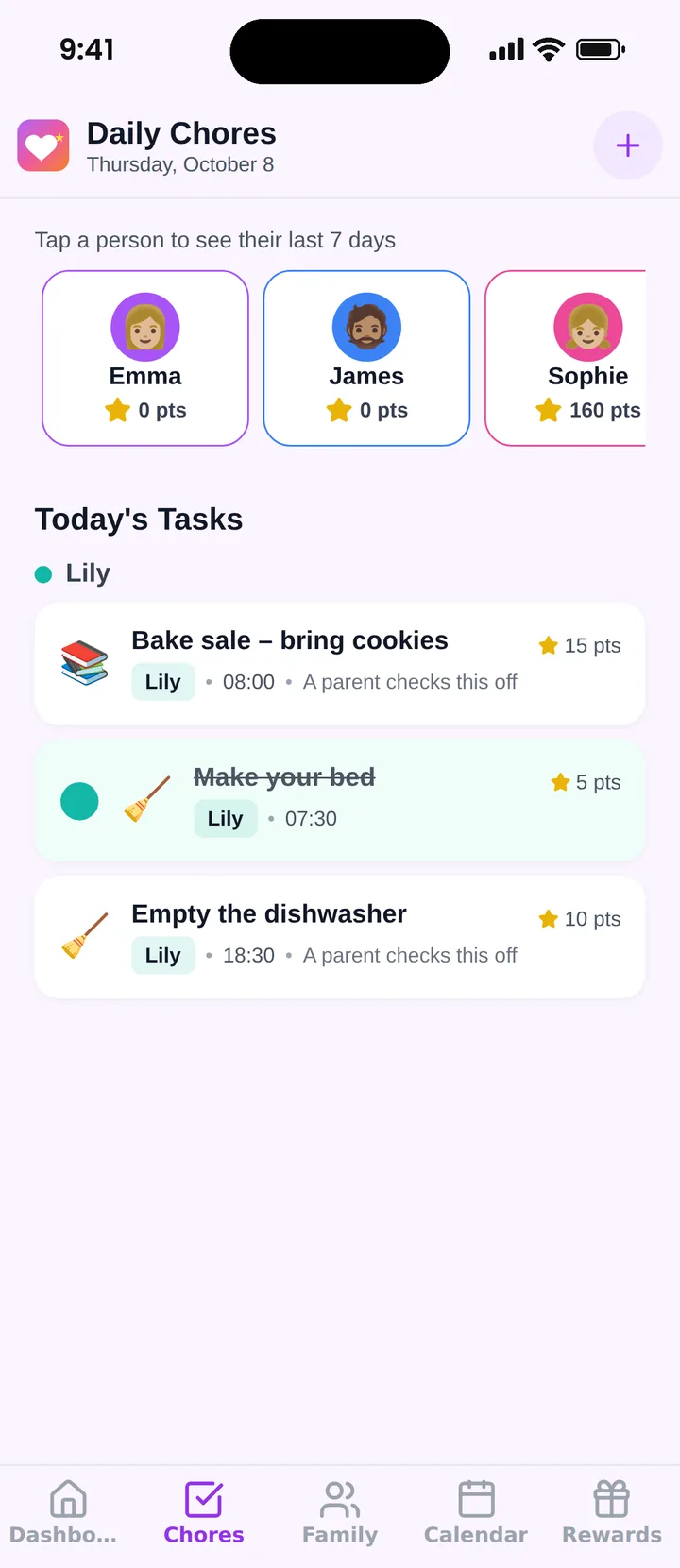
Famiyo is a free family app for iPhone and Android that combines a shared family calendar, chores with points and a rewards shop; kids join with a code, no email needed. For a messy teen room, set up "Weekly room reset" as a repeating chore worth 10 points, and add a smaller daily one for dishes and hamper. Your teen gets a push notification when a task appears and checks it off on their own phone. You get a notification when it's done, so you don't have to hunt for them. Points go toward rewards you set in the shop, and the screen below is what your teen sees. More options are in our list of the best chore apps for kids.
Try this tonight
Don't announce a new regime at dinner. Pick the five-line minimum, write it on a sticky note or in your family app, and bring it up once, calmly, with one question: "Which day should room reset be?" Let them choose. Then stay out of the way until the day arrives.
Frequently asked questions
Should I just let my teenager keep a messy room?
Mostly the door can stay closed, but a few things are not optional: no food or dishes left in the room, no wet towels, and clean laundry and dirty laundry kept apart. Set that minimum, then let the rest be their space.
What should I take away if my teen won't clean their room?
Pick a consequence that connects to the problem and tell them in advance. Dishes missing from the kitchen can mean no snacks upstairs. A floor you can't walk on can mean no friends over until it's clear. Avoid taking away things unrelated to the room.
How often should a teenager clean their room?
A quick daily reset of two to five minutes (clothes in the hamper, dishes out) plus one fuller clean per week works for most teens. That full clean usually takes 20 to 30 minutes and includes sheets, vacuuming and surfaces.
Does paying a teen to clean their room work?
It can work for the weekly deep clean, but not as the only reason to keep a room livable. Many families treat the minimum standard as unpaid and give points or money only for the bigger weekly job or for finishing without a reminder.
Try Famiyo With Your Family
Chores with points, a rewards shop for kids and one shared family calendar. Set it up in a couple of minutes.



Free to download • No credit card required • Available on iOS & Android