Intrinsic Motivation in Kids: How to Build It
Kids build intrinsic motivation when they have real choices, doable challenges and close adults. How to grow it at home and use rewards without crowding it out.
By Famiyo Editorial Team7 min read
Your child will spend two hours on a Lego build without a single reminder, then need four prompts to put their shoes away. That gap is intrinsic motivation at work, and parents can grow it on purpose. This guide covers what drives it at each age, where rewards help and where they backfire, and the exact words that make a difference at home.
What intrinsic motivation looks like at different ages
Intrinsic motivation means doing something because the doing itself is satisfying: it's interesting, it feels good to get better at it, or it matters to the child. Extrinsic motivation means doing it for something outside the activity, like points, money, praise or staying out of trouble. Most of what kids do runs on a mix of both, and that's normal.
It shows up differently as children grow:
| Age | What it often looks like | What feeds it |
|---|---|---|
| 2-3 | "Me do it!" Pouring their own water, zipping a coat, stacking cups again and again | Time to try, accepting spills, small real jobs |
| 4-6 | Asking "why" all day, pretend play that runs for an hour, practicing a cartwheel | Real answers, open-ended toys, letting them pick the activity |
| 7-9 | Collecting facts about dinosaurs or sports stats, building projects, racing through a book series | Access to materials, library trips, your interest in what they know |
| 10-12 | Getting really good at one thing: a skateboard trick, a drawing style, a hard game level | Bigger challenges, time with people who share the interest |
| 13+ | Building an identity through music, coding, a cause or a sport they chose | Respect for their choices, real responsibility, room to fail |
The pattern holds across ages. Kids push hard on things they chose, that stretch them a little, and that someone they care about notices.
The three needs behind it
The framework most researchers use here is self-determination theory, developed by psychologists Edward Deci and Richard Ryan. It holds that people of any age stay motivated from the inside when three basic needs are met. Each one is easy to spot in ordinary family life.
Autonomy: real choice inside limits
Autonomy doesn't mean kids do whatever they want. It means they have a say inside limits you set. "Homework happens before dinner. Do you want to start with math or spelling?" offers a real choice and keeps the rule. Choices about order, timing, method, or which job from a short list all count.
What drains it is control that feels arbitrary: hovering, redoing their work in front of them, or "because I said so" as the answer to everything.
Competence: hard but doable
Children care about things they can get better at. A task that's too easy is boring. One that's far too hard tells them they're bad at it. The sweet spot is effort plus visible progress. A 6-year-old who finally rides without training wheels after a week of wobbling has had this need fed, and you'll see it in how they talk about the bike for days.
Relatedness: connection to people who care
Kids take on the values of adults they feel close to. When you read in front of them, talk about something you're learning, or ask real questions about their projects, those activities start to feel like part of who your family is. It's also why a child will work harder for a coach they like than for one they don't.
Do rewards kill intrinsic motivation?
Sometimes. A well-known line of experiments that began in the 1970s with preschoolers who liked drawing with markers found that children promised a reward for drawing later chose to draw less on their own than children who were promised nothing. Psychologists call this the overjustification effect: once a reward becomes the reason, the original reason fades.
The research is more specific than the headlines, though. The effect shows up most clearly when:
- The child already enjoys the activity.
- The reward is tangible (a prize, money, a sticker) and promised in advance.
- The reward is given just for doing the activity, not for doing it well.
- The reward feels like a tool for controlling the child.
Change those conditions and the risk drops. Few kids love unloading the dishwasher, so there's little interest to undermine. Unexpected, specific recognition ("You figured out the whole bus route yourself, that was careful planning") tends not to hurt, because it tells the child something true about their own competence.
A practical rule follows from this. Use points and rewards for the dull, necessary parts of family life, like chores and routines, and keep them away from reading, drawing, music, sports and anything else your child already does for fun. For the money side of chores, our guide to how much allowance kids should get by age sets out typical amounts, and our piece on kids reward charts covers how a chart can stay light and low-pressure.
How to build intrinsic motivation at home
None of this needs a program. It's a set of small habits that add up over months.
- Offer two or three real choices a day. Which chore from the list, which order, what time within a window. Keep the limit and let them steer inside it.
- Explain the why once, briefly. "We clear our plates so the kitchen is ready for whoever cooks tomorrow." Children follow rules more willingly when they understand the purpose, even if they still grumble.
- Teach in small steps, then step back. Show the task, do it together, then let them do it alone. Don't redo it in front of them. If something needs fixing, show one thing to change next time.
- Praise the process and be specific. Name the effort or strategy you saw: "You kept trying different pieces until it fit." Swap the reflexive "good job" for a sentence about what they did, and skip "you're so smart," which ties success to a fixed trait.
- Let them set some goals. A 10-year-old who decides to learn ten chords this month owns that goal in a way a parent-set target never feels. Ask how they'll know they've reached it.
- Make room for interests you don't share. If your child loves bugs, a library book on beetles and a jar for watching them will do more than a talk about why science matters.
- Allow small failures. Forgetting the gym bag once and living with the result builds more self-direction than having it delivered to school every time.
- Fade the rewards you do use. If points got a new routine started, keep them but stop adding new reward tiers once the routine is a habit, and let the habit carry it.
What to say instead
Small changes in wording move a request from controlling to supportive. You don't need to script every conversation, but these swaps are worth practicing until they come naturally.
| Instead of | Try |
|---|---|
| "Go practice piano now." | "When do you want to practice today, before or after snack?" |
| "Good job!" | "You checked every answer before you handed it in. That's how you caught that mistake." |
| "Read for 20 minutes and you get a sticker." | "What's happening in your book right now?" |
| "Clean your room because I said so." | "The floor needs to be clear by Saturday so we can vacuum. You pick when." |
| "You're so smart." | "That was hard and you didn't quit." |
| "Why can't you just do it without being asked?" | "What would help you remember? A checklist, an alarm, something else?" |
Several of these still carry a firm expectation. Supporting autonomy isn't the same as being permissive. It changes how the expectation is delivered, not whether it exists.
When it depends on the child
Some kids seem to have a motor that never stops, and others need more structure to get going. Neither is a character flaw. Children with ADHD, for example, often find it harder to start tasks that don't pay off right away, and short-term external rewards can be a useful bridge for them. That's a sensible use of rewards, not a failure to build inner drive.
Sleep is another quiet factor. The American Academy of Pediatrics recommends 9 to 12 hours a night for kids aged 6 to 12 and 8 to 10 hours for teenagers, and a short-slept child looks unmotivated about almost everything. If a child who used to have strong interests pulls back from all of them for weeks, mention it to their pediatrician.
Teenagers may reject anything a parent suggests simply because a parent suggested it. With this age, handing over real responsibility often works better than encouragement. Letting a teen choose and price extra jobs, as in our guide to chores for teenagers to earn money, gives them control over effort and outcome, and that is autonomy in a form they'll accept.
Keeping rewards in their lane with Famiyo
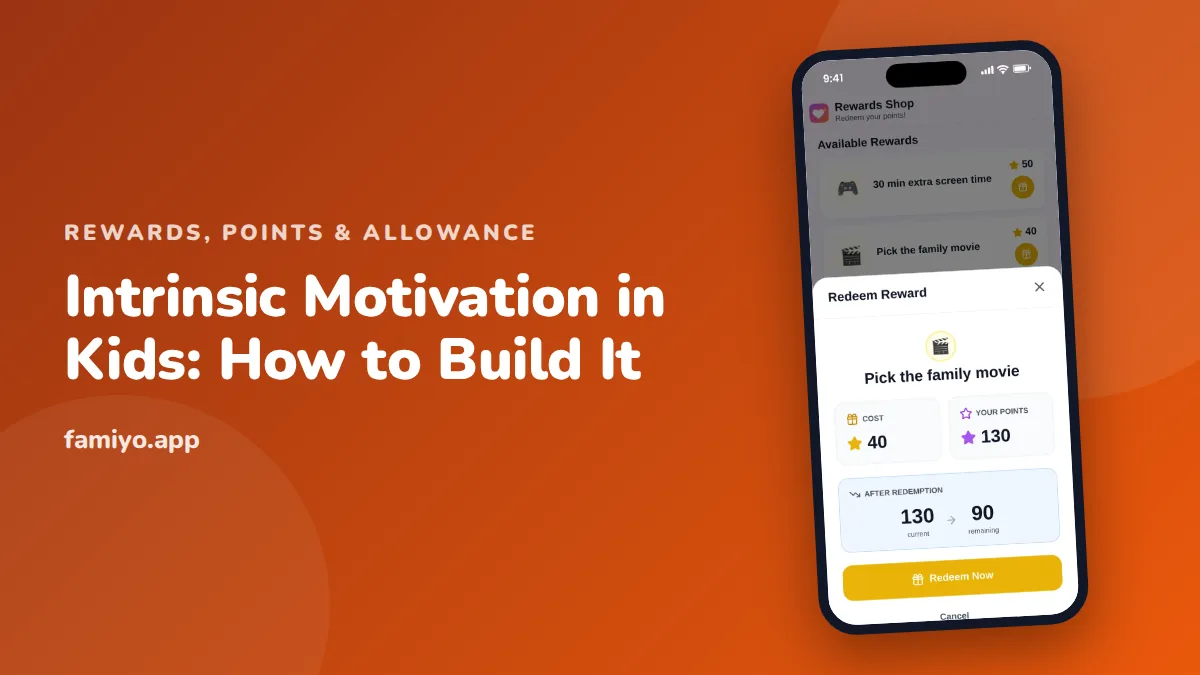
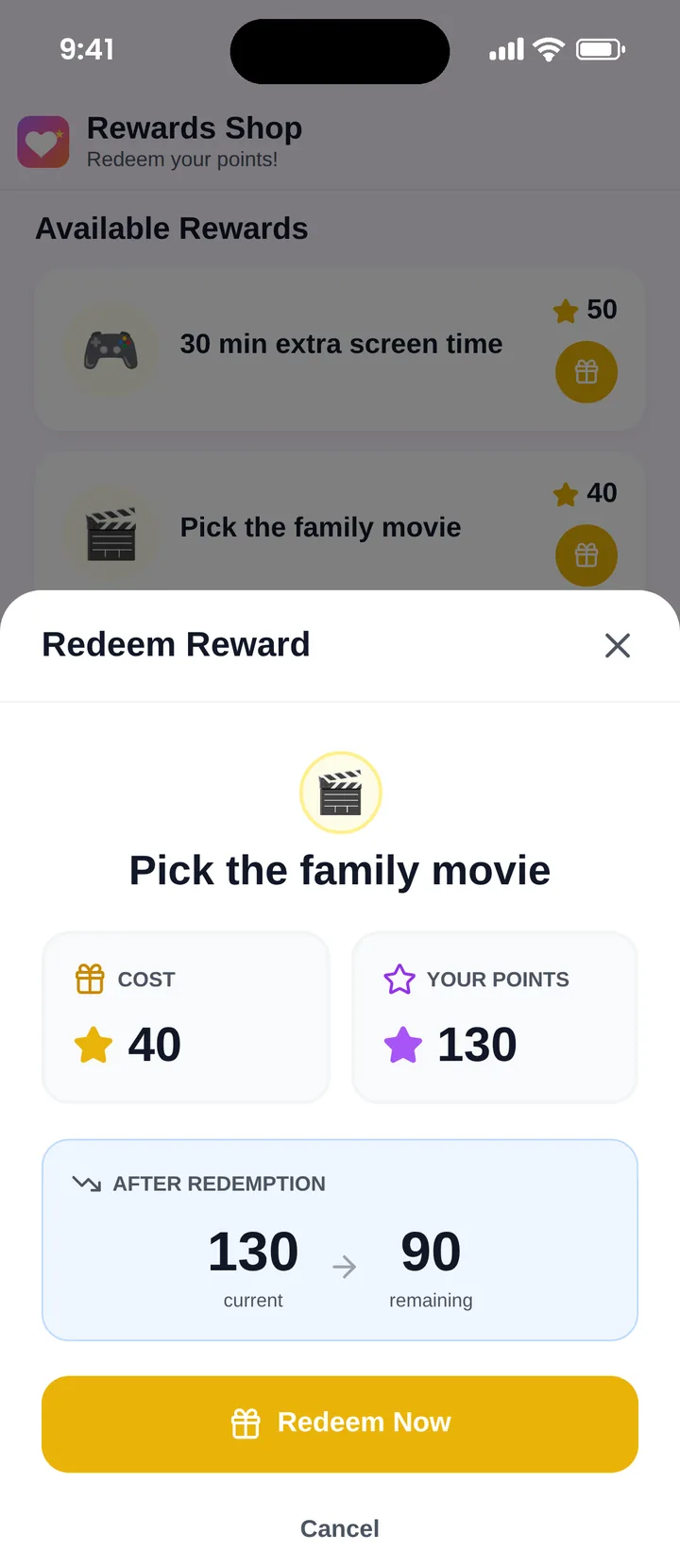
Famiyo is a free family app for iPhone and Android that combines a shared family calendar, chores with points and a rewards shop; kids join with a code, no email needed. It's built for the dull side of family life, which is exactly where rewards belong: points go on chores and routines, while reading and hobbies stay off the list. In the rewards shop you set each reward's price in points, how many are available and when, so "pick the family movie" can be limited to once a week. Kids redeem from their own phone and see how many points they'll have left, which makes saving or spending their decision. Ask your child to suggest a few rewards for the shop. For other options, see our list of the best reward chart apps for kids.
Start small this week: once a day, replace "good job" with one specific sentence about what your child did, and watch what they do with it.
Frequently asked questions
What are examples of intrinsic motivation in kids?
A 4-year-old rebuilding the same block tower to make it taller, a 9-year-old reading past lights-out because the story is good, a 13-year-old teaching herself a song on guitar from videos. In each case the activity itself is the payoff, and nobody is handing out points for it.
Do rewards ruin intrinsic motivation?
They can, under specific conditions. Research on the overjustification effect found that expected, tangible rewards for an activity a child already enjoys can lower interest once the reward stops. Rewards for tasks kids find dull, such as chores, carry much less of that risk.
At what age can you start building intrinsic motivation?
From toddlerhood. A 2-year-old who insists on doing it 'by myself' already has the drive. At that age your job is mostly to protect it: allow extra time, accept messy results and offer two simple choices. Older kids need more say in their goals and harder challenges to keep it going.
How do I motivate a child who doesn't seem to care about anything?
Look first for what's in the way: too little sleep, tasks that are too hard, or heavy pressure around one area like grades. Find one small area where the child shows a spark and give them more control there. If withdrawal or low mood lasts for weeks, talk to their pediatrician.
Try Famiyo With Your Family
Chores with points, a rewards shop for kids and one shared family calendar. Set it up in a couple of minutes.



Free to download • No credit card required • Available on iOS & Android