Point System for Kids: How It Works at Home
A point system for kids turns everyday tasks into points they spend on rewards. Here is how to set one up at home, price the rewards and keep it fair.
By Famiyo Editorial Team6 min read
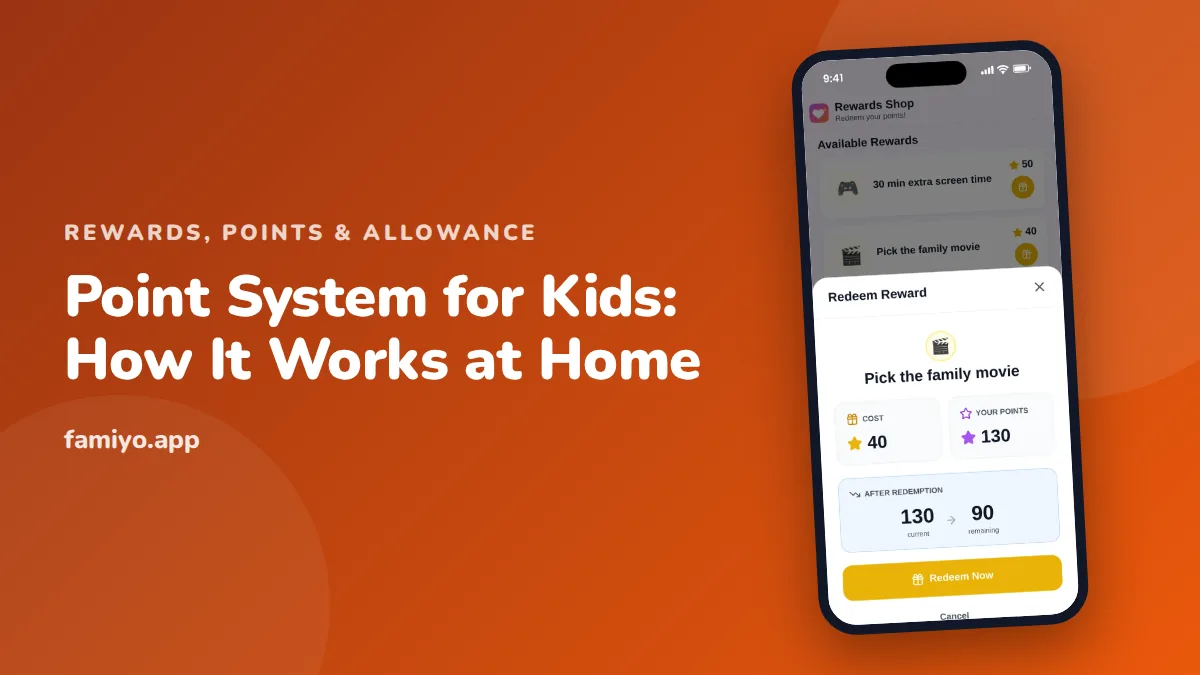
Your 7-year-old nods along when you explain the new chart, then forgets it by Thursday. That is the usual fate of a point system that is either too complicated or too slow to pay off. This guide covers how a point system works, how to set the numbers, how to run it week to week and how to spot when it is going wrong.
What a point system actually is
A point system is a small private economy. Kids do things that matter to the family, they earn points for them, and they spend those points on rewards you have agreed on ahead of time. Three parts hold it together: a list of tasks, a value for each, and a menu of rewards with prices.
Behavior researchers call this a token economy, and the idea behind it is old and well studied: a reward that follows a behavior soon after makes the behavior more likely to repeat. The points are the bridge. A child cannot be paid in ice cream the second the bed is made, but they can be paid in points right now and cash them in later. If you want the longer background on that mechanism, our guide to what really drives kids covers it.
The AAP and most pediatric guidance on behavior favor the same pattern: notice what the child does right, respond quickly and specifically, and keep consequences predictable. A point system is one way to make that routine instead of something you have to remember.
How to set up a point system, step by step
- Pick 3 to 5 tasks to start. For preschoolers use 2 to 3. Choose things that happen every day and that your child can do mostly alone.
- Define done. "Tidy room" means clothes in the hamper, toys in the bin, bed pulled up. Write it down or say it out loud once so there is no debate later.
- Give each task points by size. Use the same scale for every child so it feels fair (table below).
- Build the reward menu with your child. Ask what they would actually work for. Their list will surprise you, and a reward they chose beats one you picked.
- Price the rewards. Work backward from how often you want a child to be able to cash in.
- Choose how points are recorded. A jar of tokens, a printed chart on the fridge or an app all work. What matters is that the child can see the total.
- Run it for 2 to 3 weeks before judging. New habits need that long to settle. Adjust prices, not rules, in the meantime.
How many points should each task be worth?
Base the points on effort and time, not on how much you dislike the job. A simple scale is enough.
| Task size | Example | Points |
|---|---|---|
| Small (2 to 5 minutes) | Make the bed, feed the pet | 5 |
| Medium (10 to 15 minutes) | Empty the dishwasher, tidy the room | 10 |
| Big (30 minutes or more) | Clean the bathroom, mow the lawn | 20 |
| Bonus | Done without a reminder | +2 |
The bonus matters more than it looks. It rewards the thing parents actually want, which is a child who starts without being asked, and it gives a motivated child a way to earn a little extra without inventing new jobs.
Pricing rewards so the system does not stall
Most failed systems fail on price. If a reward costs 500 points and a child earns 25 a day, they are looking at 20 days of effort with nothing in between. That is too long for a young child to hold in mind. Aim for a child to afford a small reward every 2 to 3 days and a big one every 3 to 4 weeks.
| Reward size | Examples | Price |
|---|---|---|
| Small | 15 extra minutes of screen time, choose dessert | 30 to 50 points |
| Medium | Pick the family movie, stay up 30 minutes later | 100 points |
| Big | A day out, a toy around $20 | 300 to 500 points |
Mix experiences with things. Time with you, a picked movie or a special breakfast often motivates longer than a small toy does, and they cost you less. If screen time is on the menu, our piece on earning screen time with chores shows how to keep it from taking over everything else.
Do not give the reward away for free once the system is running. If a child can get the movie night anyway, the points stop meaning anything.
A sample week
Here is what a week might look like for a 7-year-old with four daily tasks: make the bed (5), feed the dog (5), pack the school bag (5) and tidy the room (10). That is 25 points a day, or 175 in a week if everything gets done, and the bonus can add a few more.
| Day | Points earned | Running total | Spent |
|---|---|---|---|
| Mon | 25 | 25 | |
| Tue | 27 (one bonus) | 52 | 40 on a dessert pick, leaving 12 |
| Wed | 20 (skipped the dog) | 32 | |
| Thu | 25 | 57 | |
| Fri | 25 | 82 | |
| Sat | 30 (extra big job) | 112 | 100 on the family movie, leaving 12 |
Notice the Wednesday. One missed task is not a failure of the system. It just means fewer points, and the child sees the link between what they did and what they can afford. No lecture needed.
When a point system backfires
A few patterns show up again and again.
- Points for things that should be automatic. Brushing teeth, being polite, being kind. Reward these with praise. If everything earns points, children start asking "what do I get?" before doing anything.
- Taking points away. Subtracting points for bad behavior turns the chart into a threat. Kids who have lost their points often decide the game is rigged and quit. Keep earning and consequences separate. We go deeper on this in our article on a point system for kids' behavior.
- Moving the goalposts. Changing prices after a child has saved up wrecks trust quickly. Change them at a set time, such as the start of the month, and tell the child why.
- Parent fatigue. If you are the only one remembering to hand out points, the system will die in week three. Make it as automatic as you can.
Some families worry that rewards crowd out a child's own motivation. The honest answer from the research is that it depends on how rewards are used: heavy, controlling use of rewards can backfire, while small, expected rewards for routine tasks usually do little harm. Pair points with real praise, and gradually let routines carry themselves. Our article on intrinsic motivation in kids explains how.
If your child has ADHD or autism, the same structure often helps, with shorter tasks and faster rewards. Talk with the child's pediatrician or therapist about what fits.
Running it in Famiyo
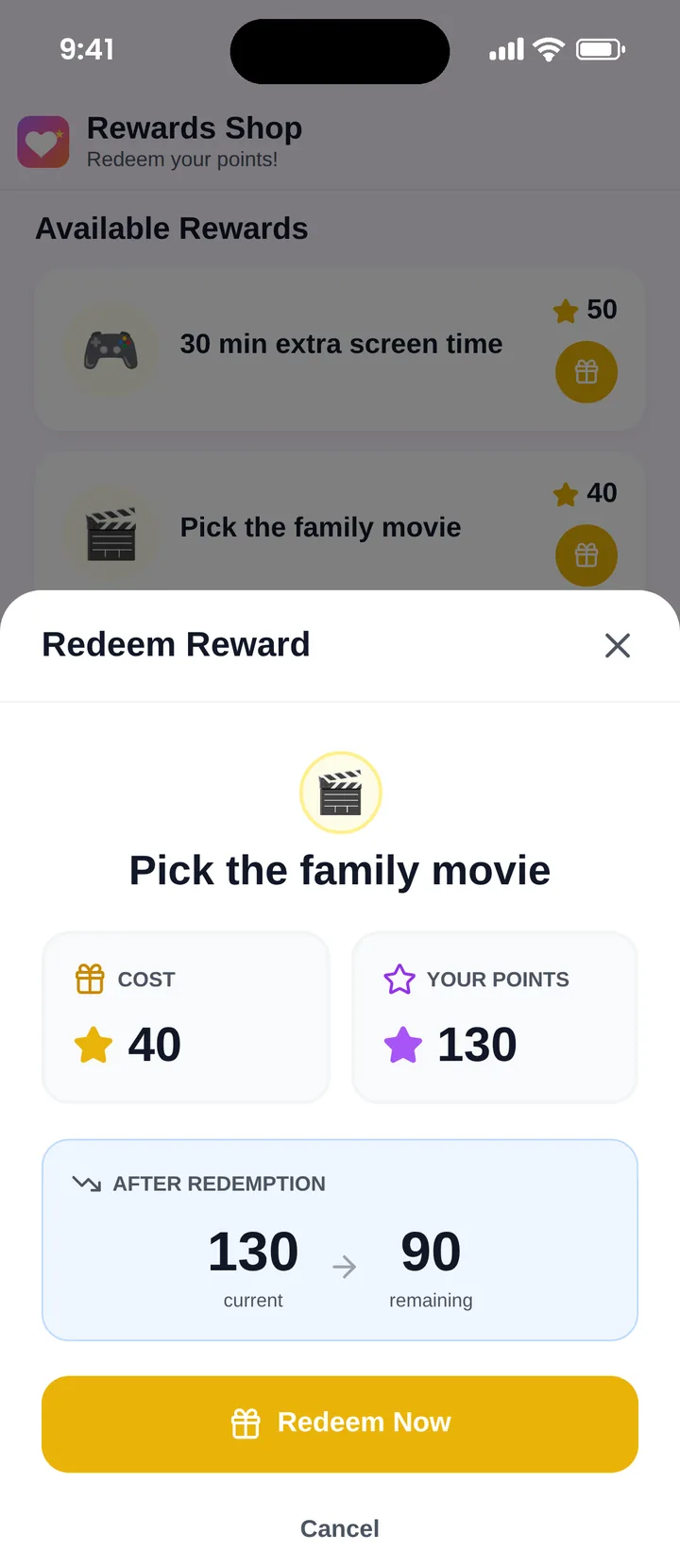
Famiyo is a free family app for iPhone and Android that combines a shared family calendar, chores with points and a rewards shop; kids join with a code, no email needed. You set up each reward with a price in points, how many are available and when, and kids redeem from their own phone, where they can see how many points they will have left before they confirm. You get a notification when a reward is redeemed, so you know to deliver the movie night or the extra 15 minutes.
Compare the options in our list of the best reward chart apps for kids if you want to see how different tools approach this.
Start smaller than you think
Pick three tasks, three rewards and one number: how many points a child will have by Friday. If that number feels reachable, you have set it right.
Frequently asked questions
At what age can a point system start working?
Most kids can follow a simple point system from about age 3 or 4, as long as rewards come quickly and points are easy to see. Younger children do better with stickers or tokens they can touch. Reading and counting skills let you move to numbers.
How many points should a reward cost?
A good target is a small reward every 2 to 3 days and a big one every 3 to 4 weeks. With 5, 10 and 20 point tasks, that usually means 30 to 50 points for small rewards, 100 for medium and 300 to 500 for big ones.
Should kids lose points when they misbehave?
Most families do better by only adding points. Taking points away feels like punishment and can make kids stop caring about the whole system. If you need consequences, keep them separate from the points a child has already earned.
What if my child stops caring about the points?
Check the rewards first. They are usually too far away, too boring or too easy to get without points. Ask your child what they would like to earn, reset prices so something is within reach this week, and keep the chores list short.
Is a point system the same as an allowance?
No. An allowance is money given on a schedule. Points are a token kids earn for specific tasks and spend on things you choose. You can offer pocket money as one reward, but the two work differently and families often use both.
Try Famiyo With Your Family
Chores with points, a rewards shop for kids and one shared family calendar. Set it up in a couple of minutes.



Free to download • No credit card required • Available on iOS & Android