Responsibility Chart for Kids: Free Printable and Ideas
A free printable responsibility chart for kids ages 5 to 10, with ideas by age, how to set it up in 10 minutes and what to do when it stops working.
By Famiyo Editorial Team4 min read
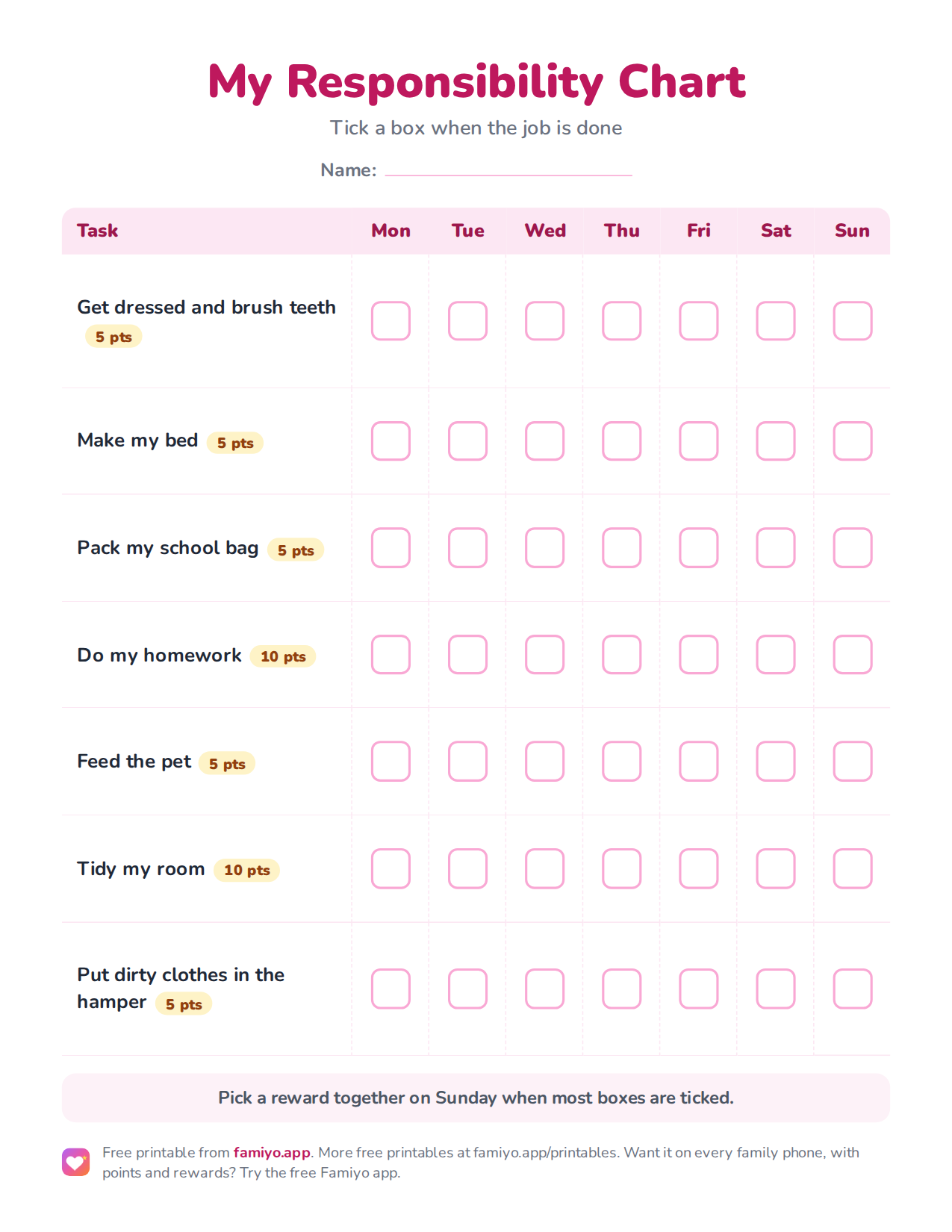
Free printable
My Responsibility Chart
A weekly chart on one US Letter page. Download the PDF to print it, or save the image to use it on a tablet or in a document.
Free for home, classroom and nonprofit use, see the license. More free printables.
A responsibility chart is a calm answer to a loud problem: the morning when nobody can find shoes, the backpack is half packed and someone is crying about homework. It puts a child's own jobs on one page, so they can see what is theirs without being told five times.
This page gives you a free printable for ages 5 to 10, ideas for what to put on it, a ten-minute setup and a few ways to fix it when it stalls.
What goes on a responsibility chart?
Think of two kinds of items. Personal responsibilities are things a child does for themselves. Household responsibilities are things they do for the family. Mixing both gives a chart that feels like "my day" and not a list of orders.
| Age | Personal responsibilities | Household responsibilities |
|---|---|---|
| 4-5 | Get dressed, brush teeth, put clothes in the hamper | Put toys away, feed a pet, set their own place |
| 6-7 | Pack the school bag, make the bed, tidy their room | Sweep, empty unbreakable dishes from the dishwasher |
| 8-9 | Do homework, lay out clothes, take care of their gear | Load the dishwasher, take out the trash, fold laundry |
| 10+ | Manage their own schedule, practice an instrument | Vacuum a room, cook a simple meal with an adult nearby |
For time, expect 10 to 15 minutes a day at ages 4 to 5, 15 to 20 minutes at ages 6 to 7 and 20 to 30 minutes at ages 8 to 9. If a child's chart takes much longer than that, cut items.
The printable chart
The printable below is a weekly grid with room for seven daily items, with Monday to Sunday boxes. It suits kids from about 5 to 10 who can read a short list, and it has a small point value beside each item so you can attach a reward later. Print it, stick it on the fridge or the back of the bedroom door at your child's eye level and fill in a pencil mark or a sticker each day.
If you want something with pictures for younger children, try our free printable chore chart with pictures. For a teenager, a different list works better, and our responsibility chart for teens covers it.
How to set it up in ten minutes
- Pick three or four daily items. Start with what causes the most friction in your house, whether that is mornings, evenings or after school.
- Write each item as an action with a finish line. "Pack school bag" is clearer than "be ready." "Toys in the bin, books on the shelf" is clearer than "tidy up."
- Sit down with your child and show them the chart. Ask which item they think will be easiest. Let them choose the order.
- Decide who ticks the boxes. A younger child can tick their own and you check at bedtime. An older child can tick and you spot-check twice a week.
- Choose a time to look at it together. Sunday evening works for many families, five minutes, no lecture.
- Run it for two to three weeks before changing anything. New routines need that long to settle.
What to say when you introduce it
Keep it short and calm. Something like: "This chart shows the jobs that are yours. I trust you to do them, and I will check at bedtime. When most boxes are ticked we pick a reward together on Sunday."
Avoid framing it as a test. If a box is empty, ask "What got in the way?" before you decide it was laziness. Often the item is too big, or it lands at a bad time.
What to do when the chart stops working
Charts rarely fail because a child is bad at them. They fail because the setup is off.
- Too many items. Cut to three.
- Nothing happens when it is done. A tick with no follow-up fades fast. Add a small weekly reward or points toward one.
- You are the only one who looks at it. Move it to the child's room or give them a pencil to hold.
- Items are vague. Rewrite them as specific actions.
- It has been the same for months. After a few weeks, swap one item for something new so it still feels fresh. The more you vary what kids do, the more skills they build. For more on why some charts last, see chore charts that actually work.
Using Famiyo instead of paper
Famiyo is a free family app for iPhone and Android that combines a shared family calendar, chores with points and a rewards shop; kids join with a code, no email needed. If paper keeps getting lost, you can add each responsibility once, set it to repeat daily or weekly and give each child their own point value for the same task.
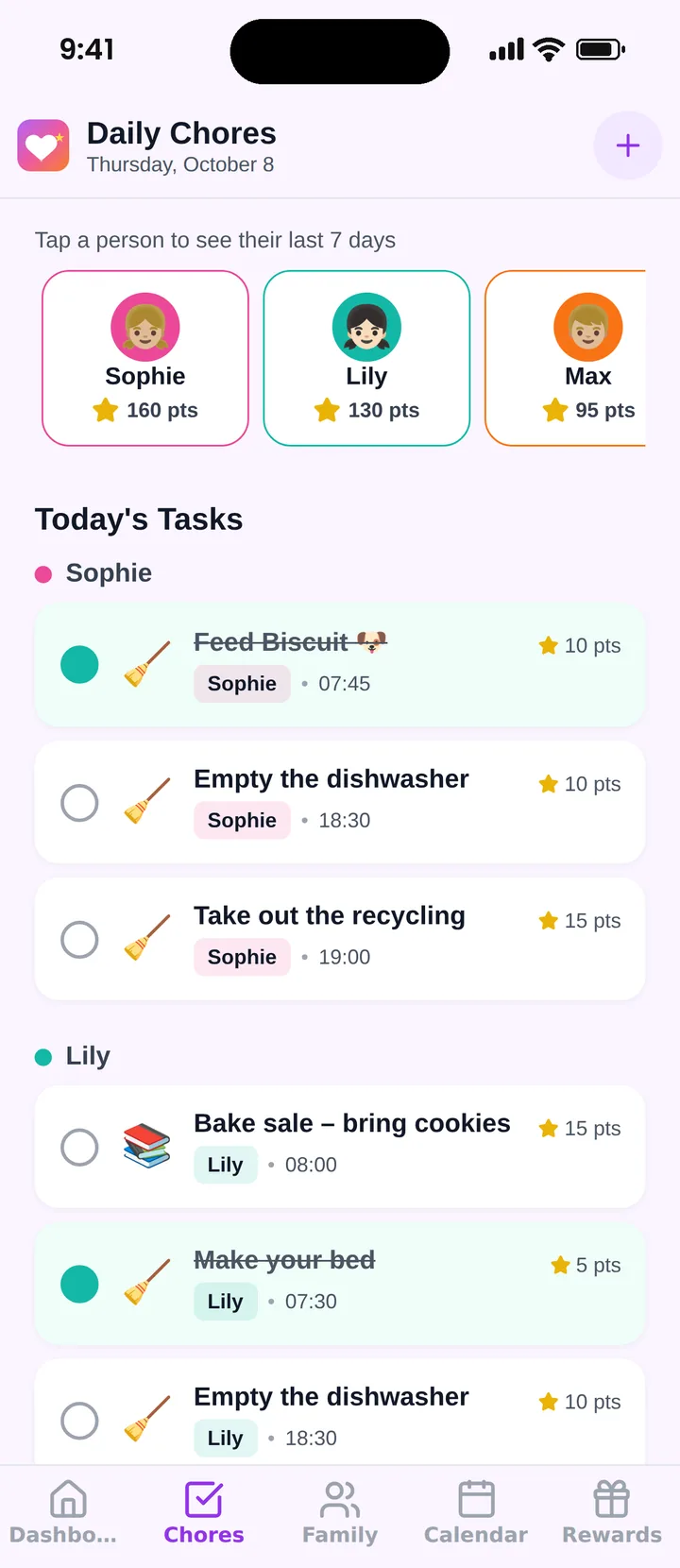
Kids hear about new tasks through a push notification and tick items off on their own phone, or you approve them, whichever you choose. Parents get a notification when something is done, and everything syncs live between phones. The free plan has one repeating task, so a bigger chart may need Premium. See our roundup of the best chore chart apps if you want to compare.
A good first week
Print the chart on Sunday, fill it in with your child and pick three items. On Wednesday check in for two minutes and change anything that is not working. The next Sunday, look at the week together and talk about what went well before anything else.
Frequently asked questions
What is a responsibility chart for kids?
It is a simple weekly grid of the jobs a child is expected to do on their own, like getting dressed, packing a bag or feeding a pet. Kids tick each box when done, so progress is visible without nagging.
How many items should be on a kid's responsibility chart?
Three to four daily items for school-age kids, and two to three for preschoolers. Add one weekly bigger job from about age 8. A short chart gets finished. A long one gets ignored by Wednesday.
What is the difference between a responsibility chart and a chore chart?
A chore chart is usually about household jobs. A responsibility chart is broader and includes personal tasks such as homework, brushing teeth, packing a school bag and looking after belongings, so the child owns their own day.
At what age can a child use a responsibility chart?
Around age 4 or 5, with pictures and two or three items. By 6 or 7 most kids can read a short list and tick their own boxes. Older kids can manage a chart with little more than a check from you each week.
Try Famiyo With Your Family
Chores with points, a rewards shop for kids and one shared family calendar. Set it up in a couple of minutes.



Free to download • No credit card required • Available on iOS & Android