Stay Organized During the School Year: A Month-by-Month Plan
A parent's plan for staying organized through the school year: what to set up in August, what to reset in January and how to handle spring crunch.
By Famiyo Editorial TeamUpdated 5 min read
A school year does not stay the same all the way through. September is a flood of forms, October gets the first big project, spring brings testing and the activities that never end. Families that stay organized do not have a better system on day one. They adjust it at the right moments. Here is a plan by month, with the habits to keep all year.
The four things to set up before school starts
Do these in the last week of August, when there is still a bit of breathing room.
- One shared calendar. Enter the school calendar first: first and last day, holidays, early dismissals, parent conferences. Then practices and lessons. A family calendar you can see on everyone's phone is the backbone. Our family calendar example shows a filled-in layout.
- A landing spot by the door. A hook for each child's bag, a shelf for shoes and one tray for paper that needs a parent. Everything school-related lands there when a child walks in.
- An after-school routine. A fixed order, such as snack, a short break, homework, then free time. It cuts the daily negotiation. For ages 5 to 7, see our after-school routine for 5- to 7-year-olds, and for 10 to 12 the after-school routine for 10- to 12-year-olds.
- A weekly 20-minute check. Same time each week. Look at the next seven days, the deadlines and what needs buying or packing.
Month by month: what to adjust and when
| When | What usually happens | What to do |
|---|---|---|
| August | New schedule, supplies, forms | Set up the four basics above. Do a practice run of the morning one week before school |
| September | Forms arrive, first routines wobble | Enter every date the day you get it. Judge nothing yet. A new routine needs 2 to 3 weeks |
| Late September | Routines settle, or do not | Hold a short review: what is working, what is not. Change one thing at a time |
| October to November | First projects, conferences | Put project deadlines on the calendar with a start date two weeks before the due date |
| December | Events and early dismissals pile up | Move the weekly check to the start of each week. Skip one optional commitment |
| January | New term, tired kids | Reset: re-read the calendar, restart the evening routine, drop what no longer fits |
| February to March | Winter slump, sports changes | Check sleep. Cut an activity if two evenings in a row are lost to it |
| April to May | Testing, spring events, field days | Protect two empty evenings a week. Plan breakfasts and bedtimes around test days |
| June | End-of-year items, supplies, paper | Sort the paper bin once. Keep what you need, recycle the rest |
A paper system that takes five minutes
Paper is the part of school most families lose control of. Keep it simple.
Give paper one inbox. Each child's bag gets emptied into the tray when they arrive home. Once a week, usually at the weekly check, go through the tray together. For each piece, you do one of three things: enter the date in the calendar and recycle the paper, sign and return it, or keep it because you will need it later. A small folder or box per child for keepers is enough.
Emails work the same way. If it has a date, it goes into the calendar when you read it, not when you "get around to it."
Hand over the system as your kids grow
Organization is a skill your children are learning, not only a service you provide. The aim is that every year they do a little more of it.
| Age | What they can own |
|---|---|
| 5 to 7 | Packing the bag with a picture checklist, putting it by the door |
| 8 to 9 | Checking tomorrow's schedule, starting homework at the set time |
| 10 to 12 | Keeping track of their own deadlines, entering their own events, packing sports gear |
| 13+ | Planning big projects in advance, managing their own week with a weekly parent check-in |
For teens, the details change, and our guide to chores for 14-year-olds shows which responsibilities fit that stage.
The weekly 20-minute check, step by step
The check is the habit that holds everything else together, so it is worth running the same way each time.
- Open the calendar and read the next seven days out loud, one day at a time.
- Ask who needs a ride, who has an early start and which evening is the heaviest.
- Check deadlines: tests, projects, forms due back, anything to buy.
- Empty the paper tray and enter any dates you find.
- Choose the one thing that will make next week easier, such as laying out sports kit on Sunday.
Older kids can run steps 1 and 3 themselves. Keep it short. If it starts to run past 20 minutes, you are probably solving next month's problems.
When things go wrong
They will. A lost permission slip, a forgotten project, a week where nobody opened the calendar. It does not mean the system has failed. Recovery is the real test.
Look for the reason, not the culprit. Was the paper never entered, was the spot by the door not used, was the evening too full? Fix the one step that failed and carry on. If you have fallen out of the weekly check, restart it this week rather than waiting for a perfect Sunday.
Keeping an eye on the whole family in Famiyo
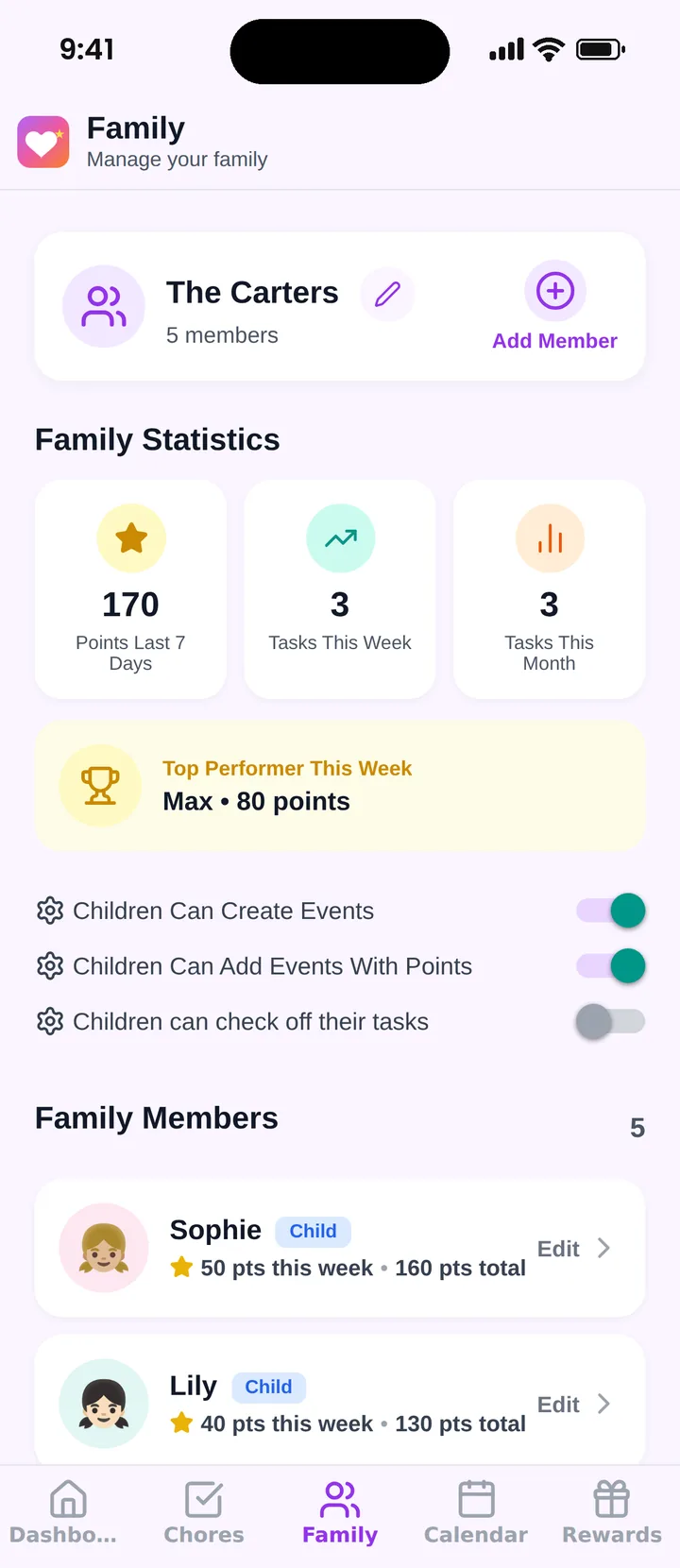
Famiyo is a free family app for iPhone and Android that combines a shared family calendar, chores with points and a rewards shop; kids join with a code, no email needed. Put school events and activities on the shared calendar with a colour for each child. Add the after-school routine as repeating chores with points, so each child sees their own tasks on their own phone. At your weekly check, open the statistics: points this week and in total per child, the last 7 days of chores, and the top performer of the week. Those numbers show at a glance whether the routine is holding.
Compare options in our list of the best family organizer apps.
Before the next school day, set up one thing from the four: pick the spot by the door and use it for a week.
Frequently asked questions
How do I stay organized with kids in school?
Keep one calendar for every school date, one place for bags and paper, a fixed after-school routine and a short weekly check. Four small habits beat a complicated system. Review the setup after three weeks and again after winter break.
How do I keep track of school papers and emails?
Use one inbox for paper, such as a tray or hook by the door, and empty it once a week. Put every date from a flyer or email into the calendar the same day, then recycle the paper. Keep only forms you must return.
How much of the school year should kids organize themselves?
It depends on age. Early elementary kids can pack a bag with a checklist. By 10 to 12 they can run their own homework slot and check the calendar. Teens can own their deadlines, with a parent checking in weekly.
What should a family do when the school year gets busy?
Expect the pressure points: the first three weeks, the weeks before holidays and spring testing. Protect two evenings with nothing scheduled, drop one optional commitment, and keep the evening routine the same.
Try Famiyo With Your Family
Chores with points, a rewards shop for kids and one shared family calendar. Set it up in a couple of minutes.



Free to download • No credit card required • Available on iOS & Android