Should Kids Get Paid for Chores? The Pros and Cons
Should kids get paid for chores? The honest pros and cons, a hybrid model that keeps basic jobs unpaid, sample pay rates and how to do it in a cashless world.
By Famiyo Editorial Team6 min read
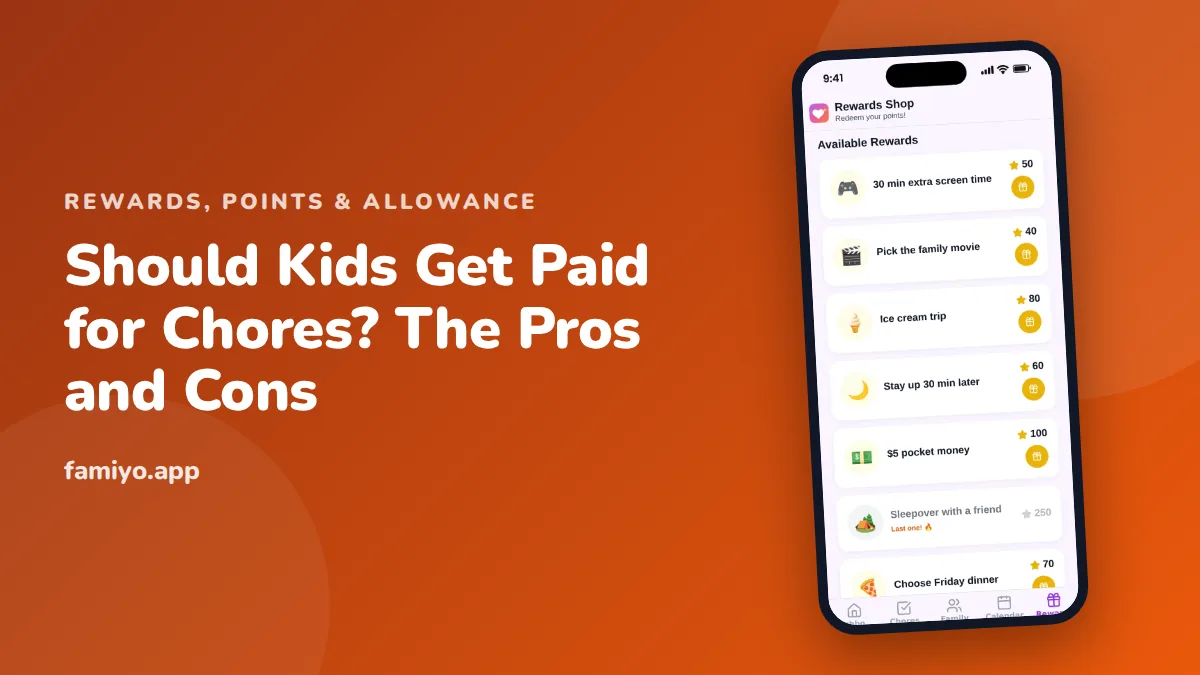
Ask ten parents whether kids should be paid for chores and you'll get a loud debate, because both sides are partly right. Pay too much and chores become a negotiation. Pay nothing and a kid never gets to connect effort with money. Below you'll find the strongest arguments on each side, a middle path that works for most households, and how to run it now that so little money is physical cash.
The case for paying kids
The main argument is that work and money are linked in real life, and children can learn that early in a small, safe way. A child who earns $3 for raking and then decides whether to save or spend it learns something no lecture covers. Some other points in favor:
- It teaches that effort has value, and that bigger jobs earn more.
- It gives a child money to practice with. Spending, saving and giving are easier to teach when there's money to move around.
- It can motivate a child who isn't moved by "because we all live here."
- It fits older kids who really want something and have a way to work toward it.
Paying also makes expectations explicit. If a job is paid, you can talk about quality and timing the way an employer would: "I'll pay for the whole yard, not half."
The case against
The strongest objection is that household work isn't a job. Everyone who lives in the house makes the mess and everyone helps clean it. If you pay for every task, you may end up hearing "How much will you give me?" before a child takes out the trash. Some other worries:
- Payment can crowd out the habit of helping without a reward. A child who always earns for helping may stop helping when nothing is on offer.
- Kids with enough money can opt out. "I don't need the $2" is a legitimate reply, and then the dishes are still dirty.
- Money turns chores into a deal you have to keep renegotiating, especially with teens.
- It can lead to unequal outcomes among siblings if jobs are valued differently.
Our companion piece on why kids should not get paid for chores makes that case in full, including when paying does make sense.
The middle path: two buckets
Most of the advice you'll find ends up in the same place. Split the work into two buckets.
| Bucket | What goes in it | Paid? |
|---|---|---|
| Family jobs | Making the bed, clearing your plate, tidying your room, feeding the pet, helping with dishes, own laundry (older kids) | No. Part of living in the house |
| Extra jobs | Washing the car, mowing the lawn, raking the whole yard, deep-cleaning the garage, helping a neighbor | Yes, a fair rate, and it can be declined |
The first bucket is expected. The second is optional and earns money. This keeps a clean line: you never pay a child to do what the rest of the family does for free, and a child who wants extra cash has a clear way to get it.
If you'd like a number for the extra jobs, the usual range is $0.25 to $1 for a small extra job and $2 to $5 for a big one. For how that scales by age, see our guides on paid chores for 8-year-olds and 9-year-olds.
Allowance vs. pay per chore
It helps to separate two ideas people mix up. An allowance is a regular sum, given weekly or monthly, so a child can practice managing money. It isn't a wage. The common rule of thumb is $1 a week per year of age, so an 8-year-old would get $8, though it's a starting point and not a standard. Typical weekly ranges run from $3 to $7 at ages 5 to 7 and up to $15 to $25 at 14 and older.
Pay per chore is different: it's earned by the job. You can run both, with a modest allowance for money practice that doesn't depend on chores, and extra pay for extra work. Or you can run neither and use points and rewards. All three are fine. What causes trouble is blurring them, for example by taking away an allowance when a bedroom isn't tidy, which turns it into a fine and confuses the lesson.
Points can stand in for money
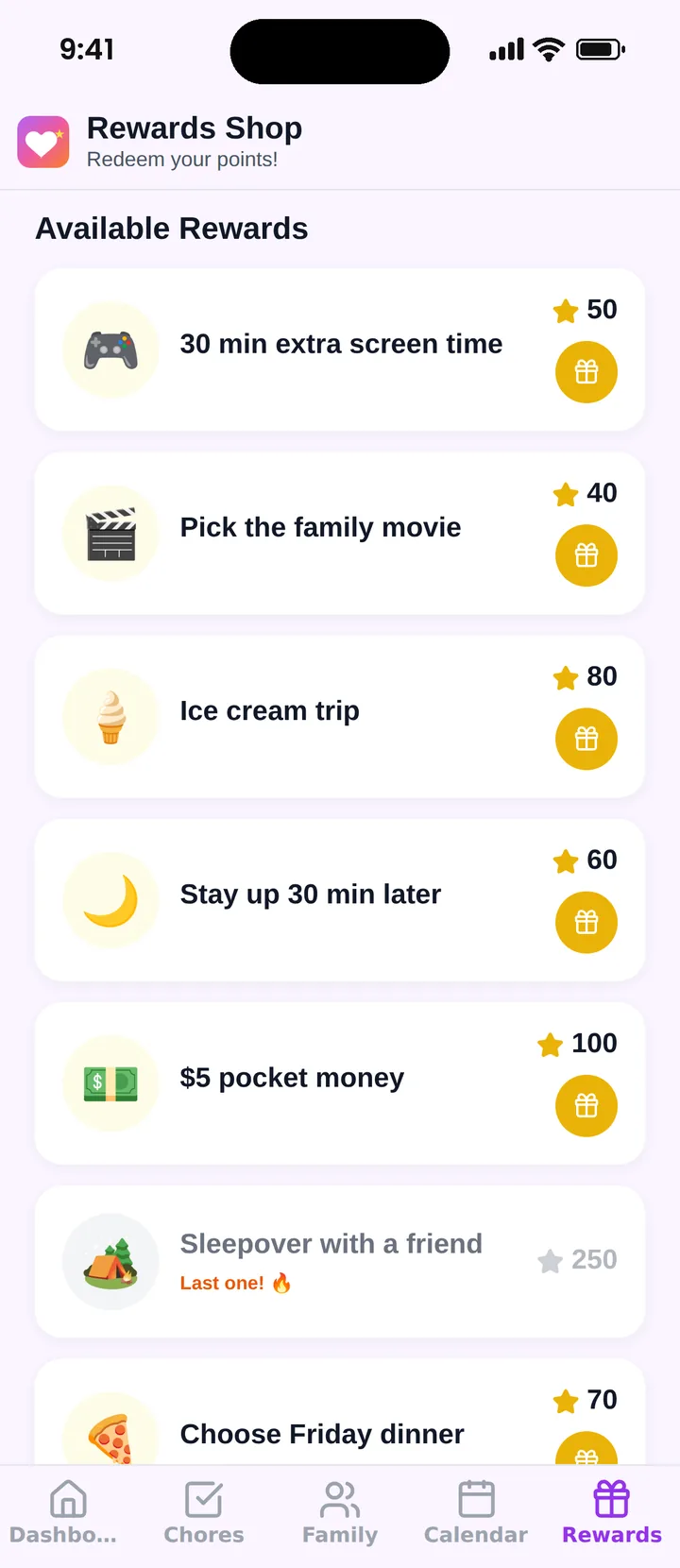
Many parents find a points system is a good compromise, because it keeps the structure of earning without cash in every transaction. A child earns points for jobs and trades them for rewards you set: screen time, a family movie pick, a day out, or pocket money. In a common default, a small task is worth 5 points, a medium one 10 and a big one 20. If you want to convert, 100 points equals $1, which makes a 20-point job worth 20 cents.
Points also solve a modern problem. Plenty of kids never see physical cash. Their money lives in a bank account or a card. Points give them something concrete to count, save and spend, and you control when the "cash out" happens. For the day-to-day money skills that come after, see teaching kids money management.
What paying looks like in practice
Say your 10-year-old wants $20 for a game. You offer three extras on the weekend: wash the car (big job, $4), rake the front yard (big job, $3) and clean out the garage shelf (small job, $1). They choose two, finish them to a standard you agreed on beforehand, and earn $7. The next week they ask for more, and you say yes, as long as the family jobs got done first. That order matters. Family jobs come first, extras second, and extra pay is never a way out of the basics.
A few habits keep it healthy. Agree on the price before the work starts, not after. Inspect the result the same way each time. Pay promptly, because kids lose the link between work and reward quickly. And keep a spending, saving and giving split in mind, for example 50%, 40% and 10% for younger kids, so earnings turn into a lesson and not only a purchase.
How to decide for your family
A few questions usually settle it.
- What do you want the chores to teach? If it's belonging and responsibility, keep basics unpaid. If it's money skills, pay for extras.
- How old is the child? Under about 6, a sticker or a small reward does more than money. From 8 or so, earning small amounts makes sense. Teens often need real money for real needs.
- Will you be consistent? A system you'll forget by Thursday is worse than none.
- How much is enough? If $5 buys out of a chore, the price is too high or the child has too much money.
Whatever you choose, tell your children the rules once and write them down. Kids accept almost any system better than an unpredictable one.
Running paid extras with Famiyo
Famiyo is a free family app for iPhone and Android that combines a shared family calendar, chores with points and a rewards shop; kids join with a code, no email needed. Chores earn points, and kids exchange the points for rewards you choose in the shop. Pocket money can be one of those rewards: you create "$5 pocket money" with a price in points, set how many are available and when, and the money itself changes hands outside the app, since Famiyo doesn't move or hold real money. Each child can earn a different number of points for the same job, so a younger sibling can earn fewer for a smaller version. When a child redeems a reward you get a notification. For a wider comparison, see our list of the best allowance apps for kids.
Start by writing down your two buckets this week. It takes five minutes and settles most of the argument before it starts.
Frequently asked questions
Should kids get paid for chores or get an allowance?
They are two different tools. An allowance is a regular amount to practice managing money, and doesn't depend on chores. Pay for chores is earned per job. Many families give a small allowance for money practice and pay separately for extra jobs beyond the daily basics.
What chores should kids not be paid for?
Everyday jobs that come with living in a family: making the bed, clearing your plate, keeping your room tidy, helping with dishes and laundry. These build responsibility and a sense of belonging. Reserve payment for bigger, occasional jobs like washing the car or raking the whole yard.
How much should I pay a child for a chore?
A common range is $0.25 to $1 for a small extra job and $2 to $5 for a big one. Keep amounts modest and tied to effort. If you use points, 100 points equals $1 is an easy conversion, so a 20-point job is worth 20 cents.
What if my child says no to the paid job?
Let them. That's the difference between a paid extra and a basic chore. If they decline, the job waits or someone else takes it. Learning that earning is a choice and that money comes from work is part of the point of paying.
Try Famiyo With Your Family
Chores with points, a rewards shop for kids and one shared family calendar. Set it up in a couple of minutes.



Free to download • No credit card required • Available on iOS & Android