Paid Chores for 9-Year-Olds: Jobs to Earn Money and What to Pay
Chores for 9-year-olds to earn money: 20 paid jobs with fair rates, what should stay unpaid, and how to track earnings in points or cash without nagging.
By Famiyo Editorial Team6 min read

Nine is a good age to start thinking about money. A 9-year-old can read a price tag, do some math in their head, and has a long list of things they want. They can also do real work: vacuum a house, wash a car, rake a yard. Put those two facts together and you have a natural moment to introduce earning.
This guide lists 20 paid jobs that suit a 9-year-old, what to pay for each, what should stay unpaid, and how to track it all without it becoming a nightly negotiation. A tablet or phone can make the bookkeeping easy, so we cover that too.
First, decide what is free
Before you price anything, sort jobs into two piles. The first pile is the baseline: things a person does because they live in a house with other people. The second is extras: jobs that go beyond that, which you would otherwise do yourself or hire out.
For a 9-year-old, the baseline usually includes making the bed, clearing their own place, putting laundry in the hamper, tidying their room, feeding the pet, and helping load the dishwasher. These match the typical 20 to 30 minutes a day for kids aged 8 to 9. Do not pay for them. A child paid for every task can start to ask "what do I get?" before helping with anything.
If you are still weighing the question, our piece on whether kids should get paid for chores lays out both sides. The plan below assumes you have decided yes, for extras.
20 paid jobs a 9-year-old can do
Pay rates below follow the usual range: $0.25 to $1 for a small extra job, $2 to $5 for a big one. Adjust for your area and your budget.
| Job | Time | Suggested pay | Points (at 100 points = $1) |
|---|---|---|---|
| Wipe down kitchen cabinet fronts | 10 minutes | $0.50 | 50 |
| Sort and bag recycling | 10 minutes | $0.50 | 50 |
| Water outdoor plants and pots | 10 minutes | $0.25 | 25 |
| Wash the inside of car windows | 10 minutes | $0.75 | 75 |
| Take trash cans to the curb and back | 10 minutes | $0.50 | 50 |
| Clean the mirrors and sink in a bathroom | 15 minutes | $1 | 100 |
| Organize a closet or toy shelf | 20 minutes | $1 | 100 |
| Dust all the furniture | 15 minutes | $1 | 100 |
| Sweep the porch or garage | 20 minutes | $1 | 100 |
| Pull weeds in one garden bed | 20 minutes | $1 | 100 |
| Rake leaves in a section of the yard | 30 minutes | $2 | 200 |
| Vacuum the whole house | 30 minutes | $2 | 200 |
| Wash the family car (with a parent checking) | 30 minutes | $3 | 300 |
| Clean the bathroom (sink, toilet, floor) | 30 minutes | $3 | 300 |
| Wash the windows on one floor | 30 minutes | $3 | 300 |
| Deep-clean the fridge shelves | 30 minutes | $3 | 300 |
| Help wash and put away a big pile of laundry | 30 minutes | $2 | 200 |
| Make a simple family meal with a parent nearby | 30 minutes | $3 | 300 |
| Pet duties for a neighbor while they travel, with a parent watching | varies | $2 to $5 | 200 to 500 |
| Organize the garage or shed shelf | 45 minutes | $4 | 400 |
You will not need all of them. Pick six to ten and rotate.
How much is too much?
A weekly total that quietly grows is the real risk. If your child earns a dollar here and three dollars there, the sum can land well past a normal allowance without anyone noticing. A typical weekly range for ages 8 to 10 is $7 to $10 as an allowance. Treat paid jobs as a top-up on that, not a second salary. Many families cap earnings per week, for example at $5 to $10, so a 9-year-old does not sit out the baseline chores to pursue a bigger payday.
Keep an eye on whether your child is choosing jobs on a whim or planning. A kid who says "I want to save up for a $20 toy, so I'll do two big jobs this weekend" is learning something useful. A kid who refuses free jobs because there is no pay is a signal to tighten the baseline.
Points first, cash second
Here is a practical setup for a family comfortable with phones and tablets. Kids earn points for jobs, and the points can be exchanged for rewards you choose, including pocket money. The advantage of points is that the arithmetic is visible. A job worth 100 points is a dollar. A 500-point item takes five of those. Nine-year-olds like seeing their balance climb, and the math is good practice.
The default suggestion most families start with:
| Task size | Example | Points |
|---|---|---|
| Small (2 to 5 minutes) | Make the bed, feed the pet | 5 |
| Medium (10 to 15 minutes) | Empty the dishwasher, tidy the room | 10 |
| Big (30 minutes or more) | Clean the bathroom, mow the lawn | 20 |
| Bonus | Done without a reminder | +2 |
That scale suits daily chores. The paid-extras table above uses a different, bigger scale because those jobs are optional and worth real money. If you want help deciding how to value daily tasks in points, see our guide to the chore point system.
How to keep it from turning into haggling
Nine-year-olds are excellent negotiators. A few rules that hold up:
- Post the price before the job, not after. "Vacuuming the house is $2" is a deal. Arguing afterward is not.
- Agree on what finished means. "Vacuumed" includes under the table and behind the door.
- No payment for redoing. If a job needs a second pass, it is not paid until it is done properly.
- Pay on a fixed day, such as Sunday evening, and not on the spot.
- One "no" is final. If you decline a job offer, move on without a debate.
A sentence that helps: "That's a paid job. Do you want to take it?" It is a choice, and either answer is okay.
A sample earning week
Say your 9-year-old wants a $12 building set. Here is how a week could go with a $7 allowance kept separate and paid extras on top.
- Monday to Friday: the free baseline gets done, bed, plate, room, trash. No pay, no fuss.
- Wednesday: they take the recycling out and wipe the cabinet fronts. $1 total.
- Saturday morning: vacuum the whole house, $2, and wash the car with a parent checking, $3.
- Sunday evening: you add up the week, $6 in extras, and pay it on the spot.
By the end of the second week they have the set, and they have learned how long $12 takes to earn. If they spend the whole $6 at once on a different item, that is fine too. A small mistake with small money is the cheapest way to learn.
Safety and supervision
Nine is still young for some of these jobs. Anything with chemicals, hot water, ladders, power tools or a street needs an adult nearby. Washing the car means using gentle soap and no pressure washer. Window washing stays on the ground floor. A 9-year-old can use a vacuum and a broom but not a lawn mower. Pet care for a neighbor means an adult is close by, and online or door-to-door jobs are off the table at this age.
Money habits to build alongside
Earning is only half the lesson. Once the cash is in hand, a simple split helps: 50% to spend, 40% to save, 10% to give. A jar for each works for a 9-year-old, or three lines in a notebook. Talk about one goal: a specific item and how many jobs it takes. Our guide to teaching kids money management goes deeper on saving and goals.
If you have younger children, the earlier steps in this series might help too: see paid chores for 8-year-olds for the version just below this age.
Running paid jobs in Famiyo
Famiyo is a free family app for iPhone and Android that combines a shared family calendar, chores with points and a rewards shop; kids join with a code, no email needed. For paid chores, the useful part is the rewards shop. Your 9-year-old earns points for jobs, and you create the rewards they can spend them on: screen time, a family movie pick, or pocket money. You set the price in points, how many are available and when.
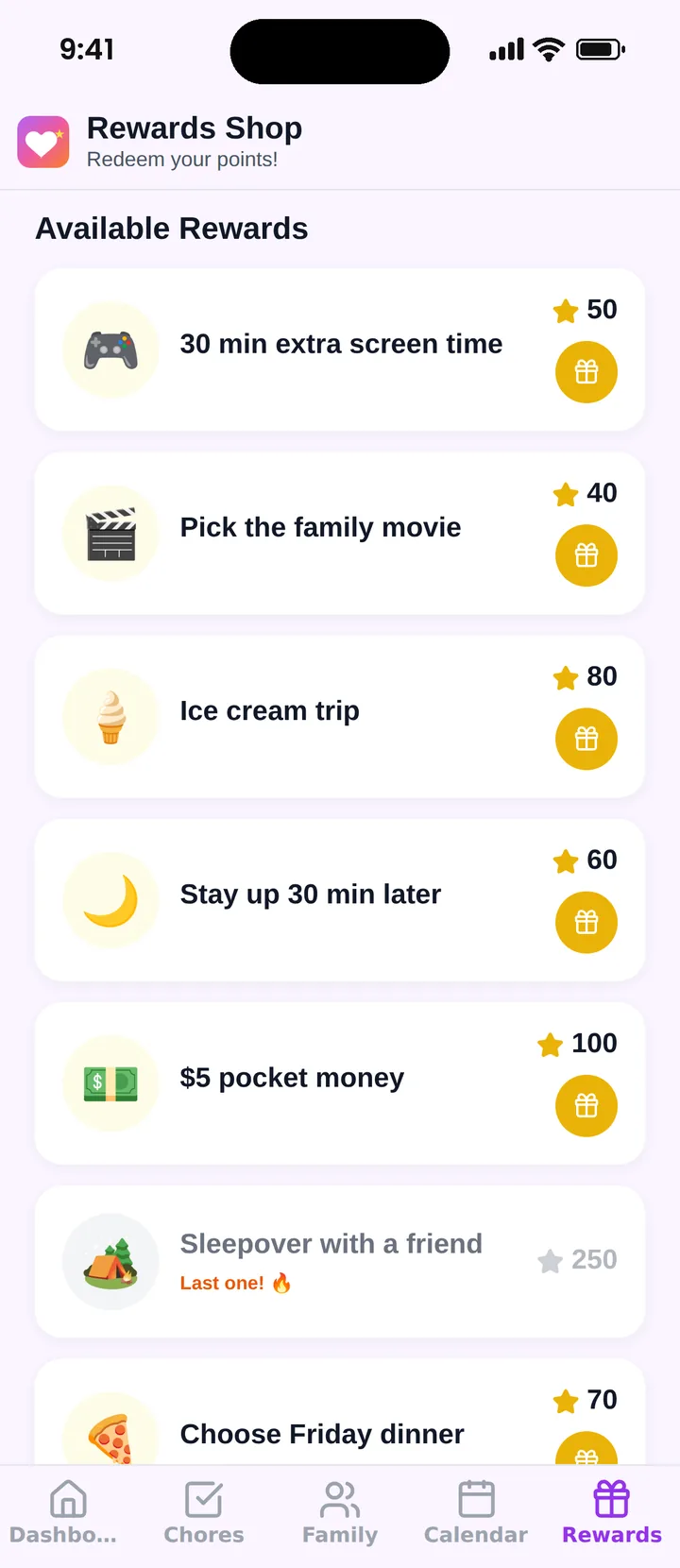
The money itself changes hands outside the app, since Famiyo does not hold or move real money. You hear about it when a reward is redeemed. For options in this category, see our list of the best allowance apps for kids.
Pick three paid jobs this week, write the prices on the fridge, and let your 9-year-old choose.
Frequently asked questions
How much should I pay a 9-year-old for chores?
Roughly $0.25 to $1 for a small extra job and $2 to $5 for a big one. Many families also give a weekly allowance in the $7 to $10 range for this age, kept separate from paid extras.
Which chores should a 9-year-old do for free?
Everyday family jobs: making the bed, putting dirty clothes in the hamper, clearing their own place, tidying their room, helping load the dishwasher. These are part of living in the house. Pay only for extra jobs beyond that baseline.
Can a 9-year-old earn money outside the house?
Yes, with a parent close by. Small neighborhood jobs like watering plants while a neighbor is away, raking leaves or a lemonade stand work well. Keep it local and supervised, and skip anything involving strangers or going online alone.
Should I pay in cash or points?
Points work well at this age because kids see the exchange rate and can choose between spending now and saving. If you convert points to money, 100 points can equal $1. Cash itself changes hands in person, outside any app.
What if my 9-year-old only wants to do chores for money?
Narrow the paid list and make the free baseline firm. Say 'This one's part of the family, this one's a paid extra.' If every chore turns into a negotiation, pause the paid jobs for a week and reset the rules.
Try Famiyo With Your Family
Chores with points, a rewards shop for kids and one shared family calendar. Set it up in a couple of minutes.



Free to download • No credit card required • Available on iOS & Android