Reward System for Kids: How to Build One That Lasts
How to build a reward system for kids that lasts: pick targets, set point values and prices, handle limits, and fade rewards out. Examples and tables included.
By Famiyo Editorial Team6 min read
Most reward systems start well. There is a chart, a trip to buy stickers and about a week of enthusiasm. Then the rules get fuzzy, the rewards get bigger, or somebody forgets to hand out points, and the whole thing is quietly retired. This guide covers how to build one with enough structure to survive month two, and how to end it on purpose.
What a reward system is and what it is not
A reward system is a plan in which a child earns something they like after doing something you want to see more of. In behavioral terms, it is positive reinforcement: the behavior is followed by something pleasant, so it becomes more likely.
Two things it is not. It is not a bribe, which is offered in the middle of a conflict to stop bad behavior. And it is not a replacement for relationship, praise or reasonable expectations. The American Academy of Pediatrics, in its guidance on discipline, consistently puts praise and positive attention at the center and treats rewards as one tool among several.
Some researchers have warned that heavy external rewards can crowd out a child's own interest in an activity, which is often called the overjustification effect. The practical reading is modest: use rewards for building routines and tasks kids don't enjoy, be careful using them for activities a child already loves, and plan to phase them out. How much this matters depends on the child and the reward.
Step 1: Choose two to four targets
Targets are the behaviors you will reward. Fewer is better. A child who has twelve things to remember has none.
A good target is observable, specific and within the child's ability. "Be good" is not a target. "Put dirty clothes in the hamper" is. The table shows the difference.
| Vague | Specific |
|---|---|
| Be responsible | Pack the school bag before bed |
| Be nice to your sister | Ask before taking her toys |
| Help more | Clear your own place after dinner |
| Behave at dinner | Stay seated until everyone finishes |
Start with 2 to 3 daily tasks for preschoolers and 3 to 4 for school-age kids, which matches the usual chores-by-age guidance. If you are mostly rewarding chores, our guide to a reward system for chores goes deeper on that side.
Step 2: Decide how points are earned
Points make it possible to reward different effort fairly and to save up. A simple scale based on time works for most families:
| Task size | Example | Points |
|---|---|---|
| Small (2 to 5 minutes) | Make the bed, feed the pet | 5 |
| Medium (10 to 15 minutes) | Empty the dishwasher, tidy the room | 10 |
| Big (30 minutes or more) | Clean the bathroom, mow the lawn | 20 |
| Bonus | Done without a reminder | +2 |
The bonus is worth keeping. It rewards the thing you actually want in the long run, which is a child who starts on their own.
Whatever the numbers, three rules keep points meaningful. Award them quickly, ideally the same day, since delay weakens the link between action and reward in young children. Award them the same way every time. And never take earned points away as punishment, because that turns a reward system into a threat and children stop trusting it.
Step 3: Build a reward menu with prices
The menu is where most systems fail. Rewards that are boring, too expensive or too cheap kill motivation quickly. Let children help write the menu, since what a 6-year-old finds exciting may surprise you.
| Reward size | Examples | Price |
|---|---|---|
| Small | 15 extra minutes of screen time, choose dessert | 30 to 50 points |
| Medium | Pick the family movie, stay up 30 minutes later | 100 points |
| Big | A day out, a toy around $20 | 300 to 500 points |
Do the arithmetic before you launch. A child who earns about 15 to 25 points a day should be able to afford a small reward every 2 to 3 days and a big one every 3 to 4 weeks. If a goal takes three months, young children will give up. If everything is affordable the first day, nothing feels earned.
Prefer experiences and time with you over things. They cost less, they are less likely to pile up, and they tend to be remembered. If you plan to let points convert to money, 100 points equals $1. See our pay scale for chores before you do, since it changes the rules of the game.
Step 4: Set limits and rules for redeeming
A system with no limits turns into a store that is always open. Decide in advance:
- Which rewards are available this week, and how many of each. Screen time, for example, might have one redemption per day.
- When rewards can be used. Staying up later on a school night is not a good use of 100 points.
- Whether a parent has to approve. Having the child ask rather than just take keeps you in the loop.
- What happens when the answer is "not today". Offer a different day, not a refusal.
Write the rules in a place the child can see them. A short list on the fridge, or inside the app, beats a verbal agreement every time.
Step 5: Adjust by age
The same design does not work across ages. Matching it to development matters more than any individual trick.
- Ages 3 to 5: Immediate and visual. Stickers or a few points, a prize within a day or two, and one or two targets.
- Ages 6 to 9: Points with a short menu, weekly goals and a say in rewards. This is the sweet spot for a classic points system. See our token economy guide for the mechanics.
- Ages 10 to 12: Longer goals, more choice, some link to money or privileges. Fewer reminders.
- Teens: Negotiate the terms with them. Our piece on a reward system for teenagers covers what changes.
For children with ADHD or autism, the same principles often apply with more visual support, shorter delays and smaller steps, and it is worth talking to the child's pediatrician or therapist about what fits. We have separate guides on those.
Why systems fail, and the repairs
| What goes wrong | Why | Repair |
|---|---|---|
| Child loses interest in week 3 | Novelty wore off, menu is stale | Refresh the menu together |
| Fights over points | Rules were vague | Write down exactly what earns what |
| Child only helps when rewards are offered | Rewards cover everything | Narrow the list to routines you're building |
| You forget to award points | System depends on memory | Move it to an app or a fixed daily check |
| Rewards keep getting bigger | Inflation | Hold prices steady, add variety instead |
Notice what is not on the list: a lazy child. A system that stops working is almost always a design problem.
How to fade the system out
The goal is for the behavior to continue without the prize. When a habit has held for several weeks, change gradually. Lower the points for that task, then drop it from the chart, keeping praise and a quick thank-you. Move to occasional surprise rewards, which are good at keeping a behavior going. Add a new target in its place.
If a behavior slips after you remove it, that is information, not failure. Bring the reward back for a few weeks and fade it again, more slowly this time.
Running the system in Famiyo
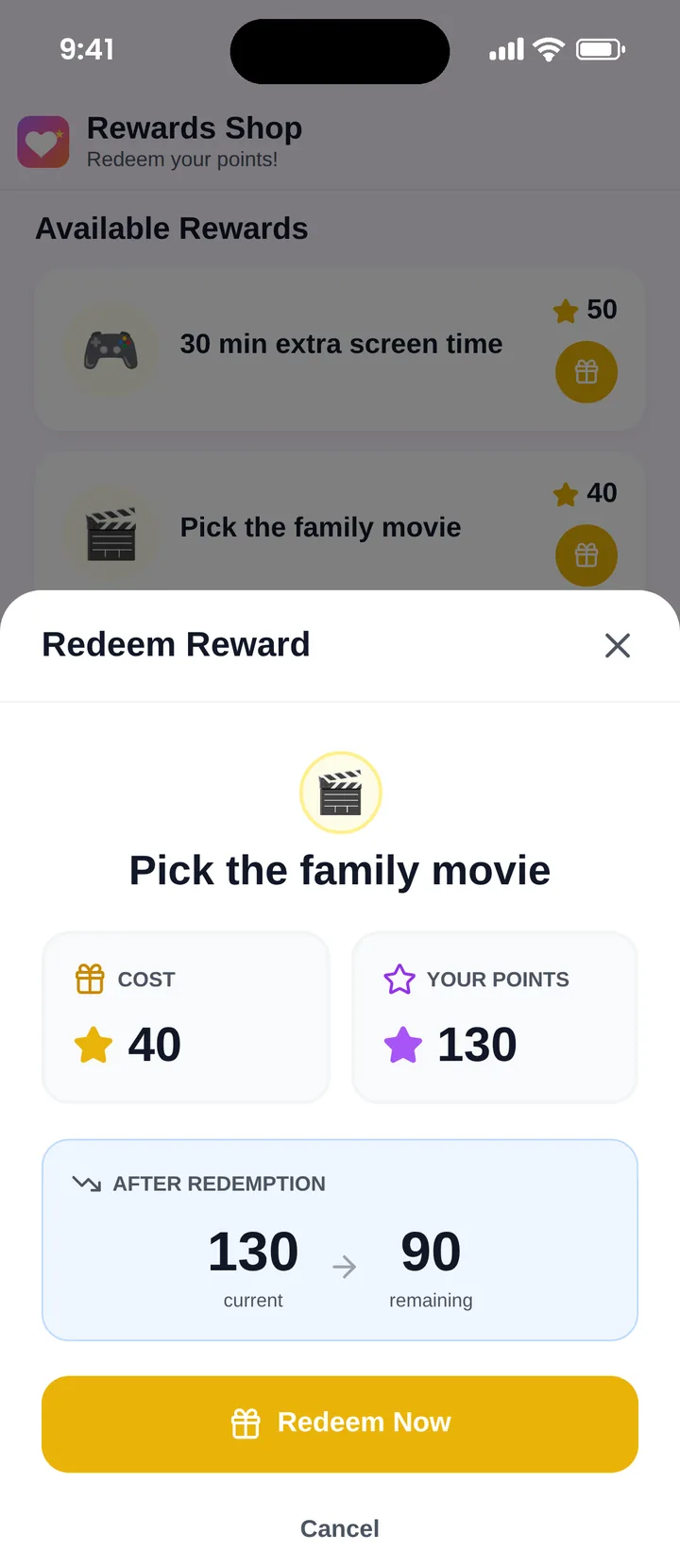
Famiyo is a free family app for iPhone and Android that combines a shared family calendar, chores with points and a rewards shop; kids join with a code, no email needed. The rewards shop is where the menu lives: you create each reward with a price in points, how many are available and when, and your child redeems it from their own phone, where they can see how many points they will have left. You get a notification when something is redeemed. For comparison with other options, see our list of the best reward chart apps for kids.
Pick two targets and write a five-item reward menu this weekend, then run it for three weeks before changing anything.
Frequently asked questions
What is the best reward system for kids?
The best one is the simplest one your family will actually keep running. Points for a few clear behaviors, a short menu of rewards the child chose, and a weekly review. Charts, jars and apps all work if the rules stay the same.
Do reward systems work for kids?
They work for building a new habit when rewards are immediate, specific and small. They work less well when rewards are large, constant or used for things a child already enjoys. Plan to fade them as the habit sets.
What are good rewards for kids that are not food or toys?
Time-based rewards cost nothing and tend to matter more: 15 extra minutes of screen time, picking the family movie, staying up 30 minutes later, choosing dessert, or a day out with one parent.
How many points should a reward cost?
A small reward, like 15 extra minutes of screen time, runs 30 to 50 points. A medium one, like picking the movie, is about 100. Big rewards such as a day out cost 300 to 500. A child should afford a small one every 2 to 3 days.
When should I stop using a reward system?
When the behavior happens most days without a prompt. Reduce points gradually, move to praise and occasional surprises, and keep the routine itself. If the behavior slips, bring the system back for a few weeks.
Try Famiyo With Your Family
Chores with points, a rewards shop for kids and one shared family calendar. Set it up in a couple of minutes.



Free to download • No credit card required • Available on iOS & Android