Teen Budget Planner: A Simple Monthly Plan and Free Printable
A simple monthly budget planner for teens: how to split pocket money into savings, fixed costs and fun, a worked example, and a free printable to fill in.
By Famiyo Editorial Team4 min read
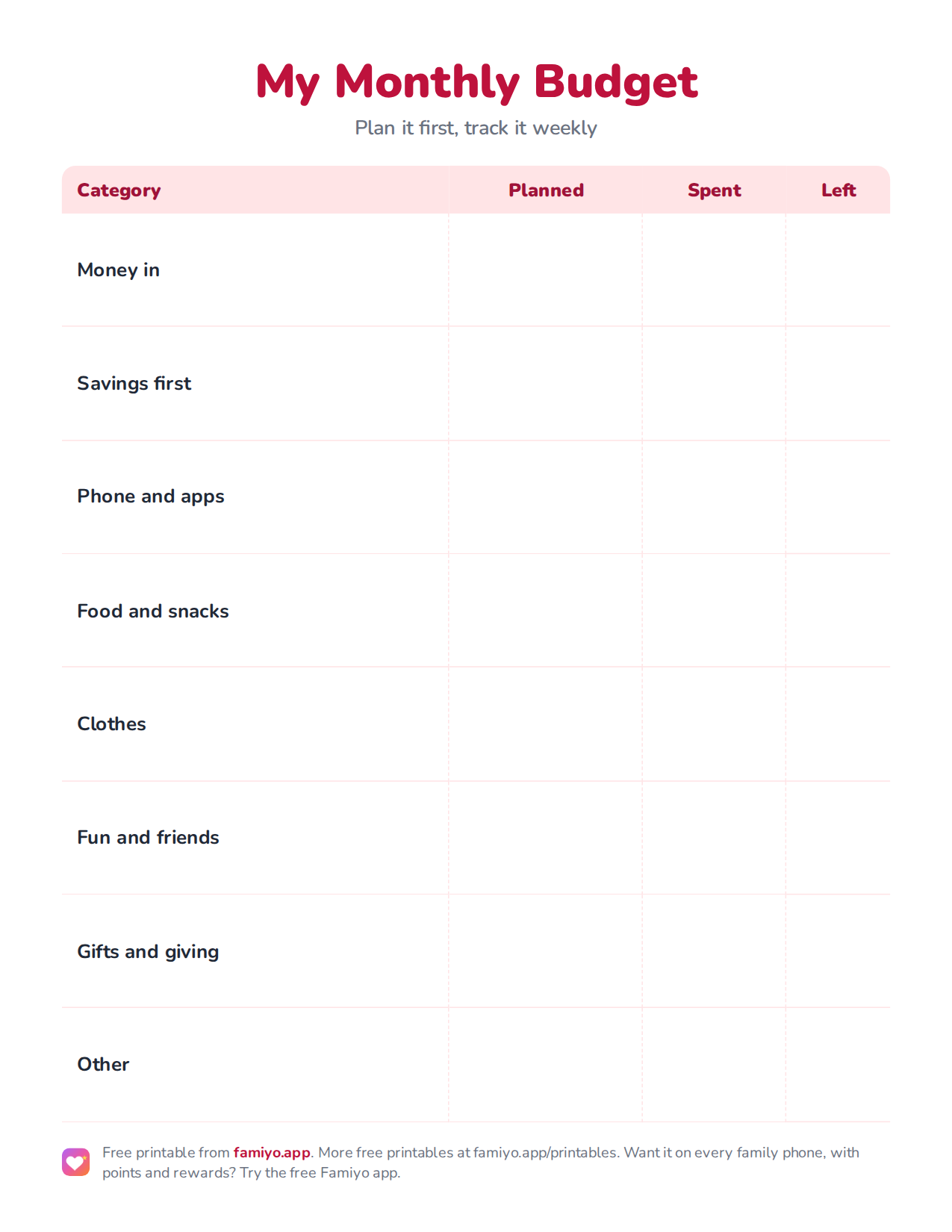
Free printable
My Monthly Budget
A planner on one US Letter page. Download the PDF to print it, or save the image to use it on a tablet or in a document.
Free for home, classroom and nonprofit use, see the license. More free printables.
Give a 15-year-old $80 a month with no plan and it will probably vanish by the second weekend, mostly on food and in-app purchases. That's not a character flaw. Nobody has shown them how to decide where money goes before it leaves. A one-page budget fixes that. Below you'll find the setup in five steps, a worked example with real numbers, ways to track it on a phone, and a printable to fill in.
What a teen budget needs
Keep it to one page and four ideas. Money in, savings, fixed costs, and everything else.
- Money in: allowance, paid jobs, gifts, babysitting.
- Savings: a set amount, moved first.
- Fixed costs: things that recur no matter what, like a music subscription or game pass.
- Flexible spending: food out, clothes, outings, hobbies.
More categories than that and a teen stops filling it in. The printable below uses eight lines, and it suits ages 13 and up. For a younger child, a savings goal chart for kids is a better first step.
How to set up a teen budget in 5 steps
- Add up the money in. Use the real monthly figure. A rule of thumb for ages 14 and up is $15 to $25 a week, and our guide to weekly vs monthly allowance for teenagers helps you pick the rhythm. Only count money that actually arrives, not hopes.
- Decide what the teen now pays for. A budget feels real only when it covers real things. Agree on a short list, such as their phone add-ons, snacks with friends or clothes beyond the basics. Parents keep paying for essentials.
- Pay savings first. Pick a percentage or a dollar amount and set it aside the day money arrives. Twenty to twenty-five percent is a sensible start.
- List the fixed costs, then split the rest across flexible lines. Write the number down before the month starts.
- Track weekly. Five minutes every Sunday is enough: write what was spent, subtract it, see what's left.
A worked example
Say a 15-year-old gets $15 a week in allowance (about $65 a month) and earns $35 from extra jobs like washing the car. That's $100 in for the month. Here's one reasonable split.
| Category | Planned | Notes |
|---|---|---|
| Savings | $25 | Toward a $200 pair of headphones |
| Phone and apps | $15 | One music subscription |
| Food and snacks | $20 | About $5 a week with friends |
| Clothes | $10 | Rolls over if unspent |
| Fun and friends | $25 | Movies, games, outings |
| Gifts and giving | $5 | Birthdays |
| Total | $100 |
At $25 a month, the headphones take eight months. That's a useful moment to talk about it: speed it up with a paid job, or trim the fun line. Both are real tradeoffs, which is exactly what you want a teen to meet while the sums are small.
Real life rarely matches the plan. If the teen overspends on food by $8, they have to take it from somewhere else, or go without. Let them choose.
Common problems and fixes
Teens hit the same snags in the first two months, and they're all fixable.
- Money disappears into small purchases. Add a "snacks and drinks" line with a weekly cap, so small buys stop eating into other lines.
- The savings line gets raided. Move it somewhere harder to reach, such as a separate account or a jar in your room that isn't on their desk.
- The plan is ignored by week two. Shrink it. Four lines beat eight, and one weekly check-in beats a daily one.
- Income is irregular. If most money comes from paid jobs, budget only from the previous month's total, and treat anything extra as a bonus for savings.
- A friend's event blows the budget. Add a small buffer line, about 10 percent, for things nobody could plan.
Spending more than the plan allows is information, not failure. Ask what the plan missed and adjust it.
Tracking it on a phone
Teens won't carry a paper sheet around, so lean on what they already use. A notes app with the eight lines works. So does a simple shared spreadsheet, or the banking app your teen's account already has. Whatever they pick, the rule is the same: write it down within a day of spending, or it's gone.
If you'd rather compare options for tracking, see our allowance tracker for kids for spreadsheet, printable and app versions side by side.
Sit down together once a month for ten minutes. Ask three questions: Where did most of it go? What surprised you? What will you change? Then stay quiet and let them answer.
Teen budgets in Famiyo
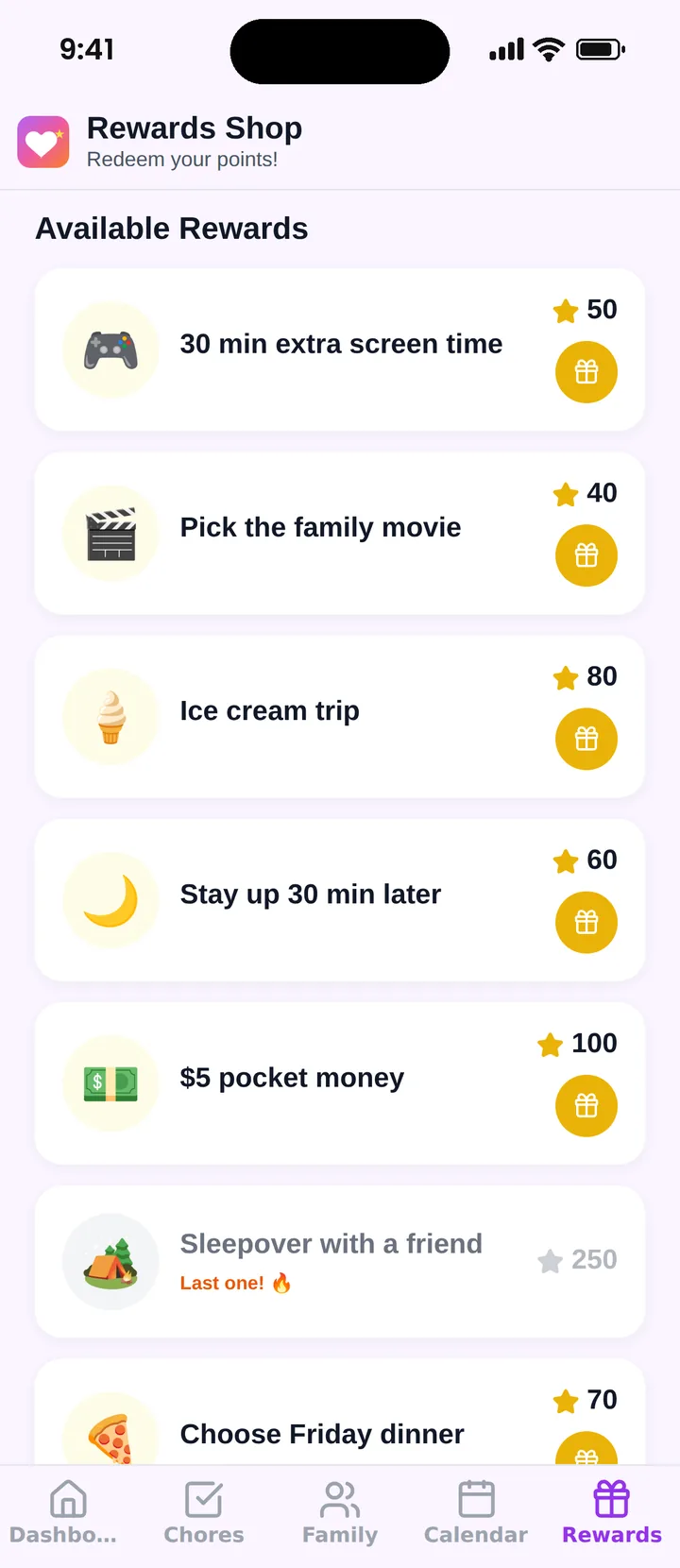
Famiyo is a free family app for iPhone and Android that combines a shared family calendar, chores with points and a rewards shop; kids join with a code, no email needed. For a budget, the useful part is the rewards shop. Your teen earns points for chores, and you create rewards with a price in points. Pocket money can be one of them, for example 500 points for $5, using the 100 points = $1 conversion. The teen redeems it from their own phone and sees how many points are left. Famiyo doesn't hold or move money, so you hand over the cash yourself. See our roundup of the best allowance apps for kids for more on how this compares.
Print the planner, fill in the first column together tonight, and let your teen do the rest.
Frequently asked questions
How much of a teen's money should go to savings?
A common starting point is 20 to 25 percent, taken out first before anything else gets spent. Teens with a specific goal, like a bike or a trip, can go higher for a few months. The exact number matters less than saving automatically each time money arrives.
What should a teenager's budget include?
Income (allowance, paid jobs, gifts), savings, fixed costs such as phone apps and subscriptions, and flexible spending such as snacks, clothes and outings. Add a small giving or gifts line for birthdays. If you've agreed the teen covers certain things, those become the fixed lines.
Should parents check a teen's budget?
Look at it together once a month, but let the teen run it. The point is practice, and a poor choice on $20 teaches more than a lecture. Ask questions ('What would you change?') rather than correcting line by line.
What if my teen runs out of money before the month ends?
Let it happen once, within reason. Don't top up. Sit down at the end of the month and ask what they'd move around next time. Running dry on a small budget is a cheap lesson, and a bailout every month removes it.
Try Famiyo With Your Family
Chores with points, a rewards shop for kids and one shared family calendar. Set it up in a couple of minutes.



Free to download • No credit card required • Available on iOS & Android