Savings Goal Chart for Kids: Free Printable and Examples
A free savings goal chart for kids with a weekly tracker, a table showing how long common goals take, and how to split money between saving and spending.
By Famiyo Editorial Team4 min read
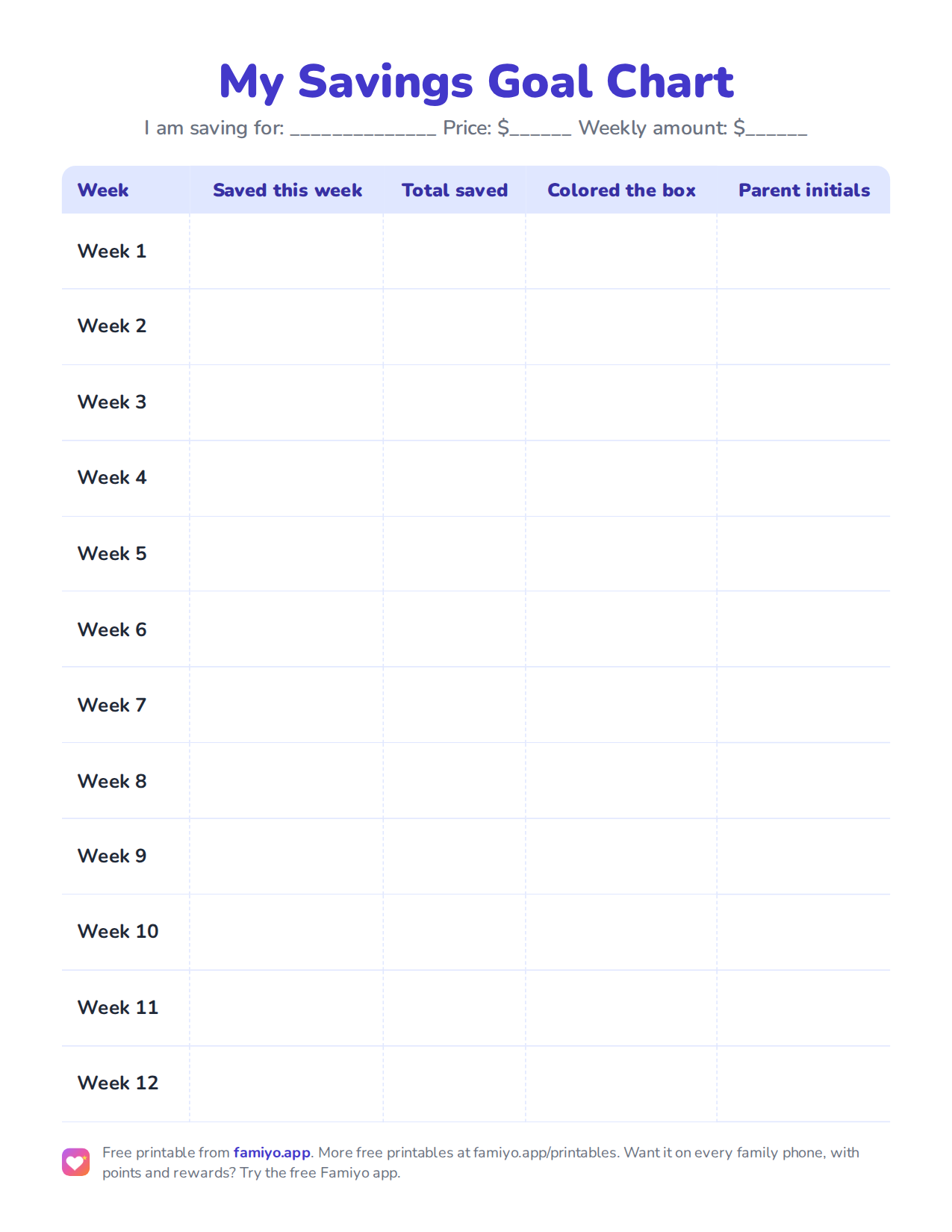
Free printable
My Savings Goal Chart
A planner on one US Letter page. Download the PDF to print it, or save the image to use it on a tablet or in a document.
Free for home, classroom and nonprofit use, see the license. More free printables.
Your 7-year-old wants a $30 LEGO set and has never kept $30 for longer than a trip to the store. A savings goal chart turns that wish into weekly steps. It shows the price, the amount saved so far and the number of weeks left, so waiting feels like progress and not like a delay. Below is a printable tracker, a table of how long common goals take, and the rules that keep kids going.
What a savings goal chart does
Saving is hard for children because the reward is far away and invisible. A chart makes it visible. Each week a box gets colored, the total grows, and the item they want gets a little closer. It also teaches a core money skill: price divided by weekly saving equals time.
Pick one goal at a time. Kids who save for three things at once usually finish none of them.
How to make a savings goal chart in 5 steps
- Choose the goal. Let your child pick something they care about, with a real price. Write it at the top, with a picture if they like.
- Check the timeline. Aim for 4 to 12 weeks. Under 4 weeks isn't really saving, and over 12 weeks is a long wait for a young child.
- Decide the weekly amount. Take a share of their allowance or earnings, such as 40%.
- Divide. Price divided by weekly amount gives the number of weeks. Draw that many boxes or a thermometer with that many marks.
- Add it up weekly. Choose a fixed day. The child puts the money in a jar, colors the box and writes the new total.
How long common goals take
These examples use the common spend, save, give split of 50%, 40% and 10% on an allowance in the typical weekly range for each age. All numbers are examples, so change them to fit your own family.
| Goal | Price | Weekly saving | Weeks |
|---|---|---|---|
| A new book or small toy | $10 | $2 | 5 |
| A LEGO set | $30 | $3 | 10 |
| A board game | $24 | $4 | 6 |
| A skateboard | $60 | $4 | 15 |
| Headphones | $100 | $5 | 20 |
A child who earns $5 a week and saves 40% puts away $2. At $8 a week, 40% is $3.20, which rounds to a handy $3. The pattern is the same: the bigger the goal, the more a parent may need to split it into milestones. For a 20-week goal, mark a small celebration at weeks 5, 10 and 15.
Make saving feel real
Charts work better with a few practical touches.
- Use a clear jar. Seeing coins stack up beats a number in a notebook.
- Use a visual. A thermometer or a staircase fills as the total grows.
- Add a match. Offering $1 for every $4 they save speeds things up. Decide the rule and the cap before you start.
- Celebrate milestones. At halfway, give a high five or a small sticker, not a purchase.
- Let them buy it themselves. The child hands over the money at the store. It is the best part of the whole process.
For a bigger picture, our guide to a chore contract for kids shows how earning, saving and spending fit into one family agreement.
The printable savings goal chart
The printable below is a 12-week tracker. At the top, write the goal, the price and the weekly amount. Each row has a box for what the child saved, the running total, a space to color a box, and a parent's initials. It suits ages 6 to 12. Younger kids can just color a box, older ones can fill in every column.
When the chart stalls
Every child hits a slump around week 4. Some fixes:
- Shorten the goal. Break it into two smaller ones.
- Add a mid-point reward. A small treat that doesn't touch the jar.
- Check the amount. If the weekly saving is too high, the child may feel they never have spending money. Lower it.
- Skip a week without drama. A missed week doesn't mean failure. Move on.
If money is tied to chores, see how to track chores and pocket money together. And if you are using an app, compare options in our guide to the allowance tracker for kids.
Doing this with Famiyo
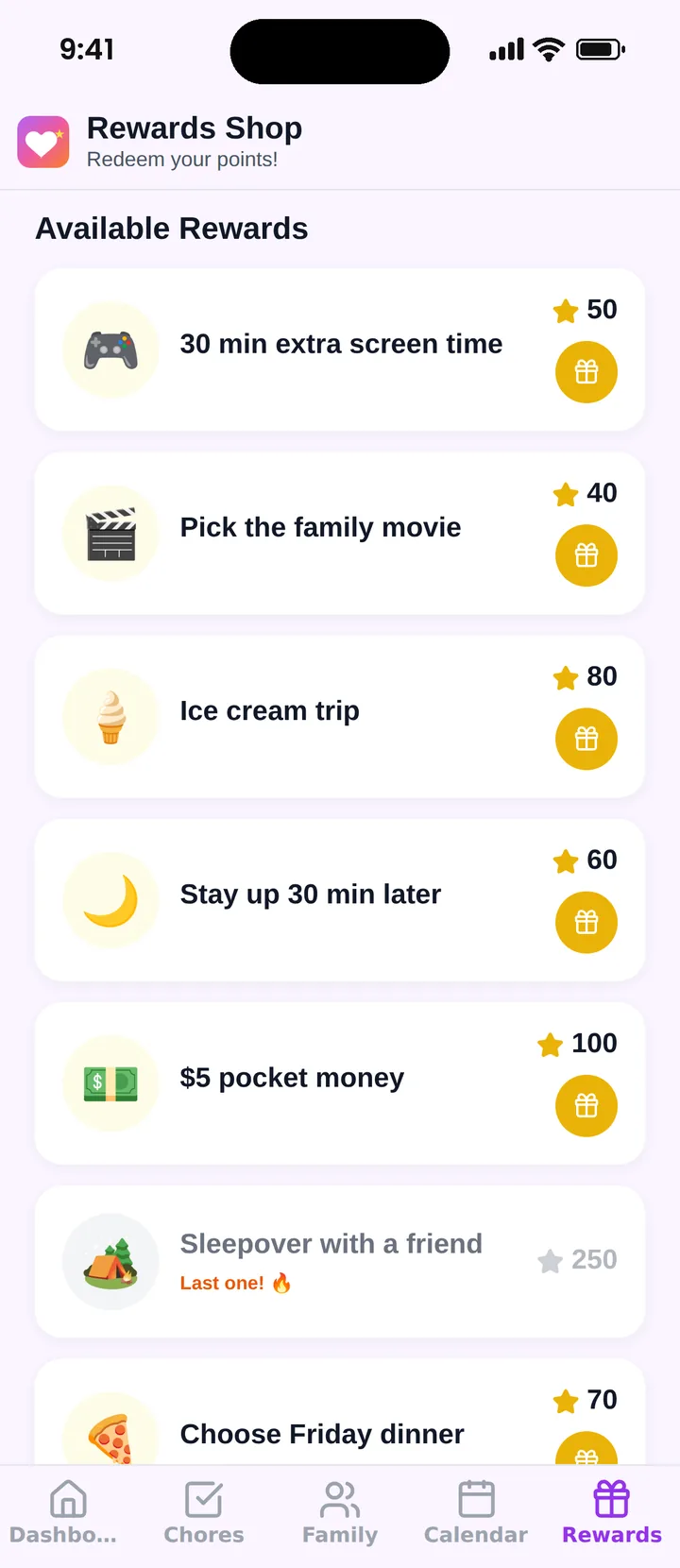
Famiyo is a free family app for iPhone and Android that combines a shared family calendar, chores with points and a rewards shop; kids join with a code, no email needed. For a savings goal, add the big item to the rewards shop as a reward with a price in points, such as 300 to 500 points for a toy around $20. Kids earn points from chores, see on their own phone how many they will have left after redeeming, and you get a notification when they do. Pocket money can be a reward too, though the money itself changes hands outside the app. See our list of the best allowance apps for kids for how the options compare.
Pick one goal with your child this weekend, do the division together, and color in the first box.
Frequently asked questions
How do I set up a savings goal chart for a child?
Choose one item with your child, write its price at the top, decide a weekly saving amount, divide to find the number of weeks, and draw that many boxes. Color a box each week when money goes into the jar. Keep the chart where they see it.
How much should a child save from their allowance?
A simple split for younger kids is 50% spend, 40% save and 10% give. Weekly allowance ranges are $3 to $7 at ages 5 to 7 and $7 to $10 at ages 8 to 10, so saving 40% means roughly $1.20 to $4 a week.
What is a good first savings goal for a young child?
Something small and fun that costs a few weeks of saving, such as a $10 to $20 toy or book. A child under 8 loses interest in goals that take more than about 8 to 10 weeks.
Should parents match what kids save?
Matching can be a strong motivator, for example adding $1 for every $4 saved. Decide the rule in advance and cap it, so the match speeds up the goal without removing the child's effort.
What if my child wants to spend the savings early?
Let them ask, but talk through the trade: the goal moves further away. Letting a child choose is how they learn. If they spend it, start a new chart with a new goal instead of treating it as a failure.
Try Famiyo With Your Family
Chores with points, a rewards shop for kids and one shared family calendar. Set it up in a couple of minutes.



Free to download • No credit card required • Available on iOS & Android