Token System for Kids' Behavior: How to Set One Up and Fade It
A token system for kids' behavior works when tokens come fast, buy rewards the child picks, and fade out over time. Here is the setup and a sample menu.
By Famiyo Editorial Team7 min read
Most parents who search for a token system have a specific problem in mind: shoes thrown, hitting a sibling, ignoring "dinner's ready" for the ninth time. Talking and consequences have not changed it, so they want something more structured.
A token system is a well-known tool from behavior therapy and classroom management, and it can work well at home. It also fails in predictable ways. This guide explains what is behind it, how to set it up step by step, what a good reward menu looks like, and how to phase it out so you are not handing out tokens when your child is 14.
What a token system is and why it works
The idea is simple. When a child does something you want to see more of, they get a token straight away. Tokens add up. When they have enough, they trade them for something they like. That is all.
The reason it works is the same reason praise works, made easier for a young child to feel. Behavior that is followed quickly by something good tends to happen again. Child-development guidance from the American Academy of Pediatrics favors this kind of positive reinforcement over punishment for shaping behavior, and the token is a practical way to deliver it: you can give it in a second, and it does not require a lecture.
The token also solves a timing problem. A promise of a trip on Saturday means little to a 5-year-old on Tuesday. A token in the hand now, with a visible count toward the trip, does.
It does not work for every child in the same way. Some respond strongly, some barely care, and some need the system adjusted. If your child has ADHD or autism, our guides to a token system for kids with ADHD cover changes that often help, and a pediatrician or therapist can tailor it. For a broader overview of the model, see our token economy for kids article.
How to set up a token system in 6 steps
- Pick 2 or 3 target behaviors. Choose things you can see and count: "uses gentle hands," "starts getting ready when asked the first time," "brings the plate to the sink." Avoid vague goals like "be good" or "have a better attitude."
- Describe each one in plain words. Agree on what counts. "Gentle hands means no hitting, pushing or grabbing, for the whole of breakfast."
- Choose the token. For ages 3 to 6, something physical: stickers on a board, pom-poms in a jar, magnets. For ages 7 and up, points on paper or in an app work fine.
- Set values. One token per instance for the easiest behavior, two or three for the hardest. Keep the numbers small and the same each day.
- Build a reward menu with your child. Let them pick from options you approve. Put a token price on each.
- Start on a calm day and explain it once. "We are going to try something new. When you do these things, you earn a token. Tokens buy things from this list."
Then use it for 2 to 3 weeks before judging it. Habits need time.
Sample tokens and a reward menu
These numbers use a simple scale. They are a starting point, not a rule.
| Behavior | Tokens |
|---|---|
| Starts getting dressed when asked the first time | 1 |
| Uses gentle hands and words with a sibling for a whole meal | 2 |
| Puts shoes and bag in the right place after school | 1 |
| Stops a screen activity at the first request | 2 |
| Does a hard thing without a fight (haircut, doctor, a chore they dislike) | 3 |
If you use the Famiyo default scale for chores, 5 points is a small job and 10 is a medium one, with a +2 bonus for doing something without a reminder. You can use the same logic for behavior: small steps earn small amounts.
| Reward | Price |
|---|---|
| 15 extra minutes of screen time, or choose dessert | 30 to 50 |
| Pick the family movie, or stay up 30 minutes later | 100 |
| A day out, or a toy around $20 | 300 to 500 |
Aim for a child to afford a small reward every 2 to 3 days and a big one every 3 to 4 weeks. If a reward is out of reach for weeks, the system loses its pull. If everything is cheap, tokens stop meaning anything.
Not every reward needs to cost money. Time with you is often what children pick when given the choice: a game of cards, a bike ride, ten extra minutes of a bedtime story.
What makes a token system work
- Give the token immediately. Within a few seconds, with a short comment: "That's a token for gentle hands." The longer you wait, the weaker the link.
- Say what they did. "You put your shoes on the shelf without me asking" teaches more than "good job."
- Be consistent. Same behavior, same token, every adult. Both parents and any caregivers need to know the rules.
- Never take away earned tokens as a punishment for something unrelated. A token a child has earned is theirs. If you cancel it when they misbehave later, they learn that effort is not safe.
- Make the menu theirs. Children work harder for rewards they picked.
- Keep praise going. The token adds to your attention. It does not replace it.
Mistakes that break a token system
Too many behaviors. Eight goals on a chart means the child cannot remember any and you cannot notice them all.
Rewards that are too far away. A prize that takes a month to reach will not change what happens at 7:30 on a school morning.
Using it as a threat. "You'll lose your tokens if you don't stop" turns the system into a punishment tool. Children then avoid the system rather than the behavior. Some plans include a small response cost for a clear, pre-agreed rule, but most families do better with earning only, at least at first.
Paying for things children already do. If your child already puts their plate away every day, do not give a token for it. Save tokens for behaviors still in progress.
Inconsistency between adults. One parent hands out tokens and the other forgets. Children notice quickly.
Never stopping. A system with no exit plan can feel like bribery to older children and tie good behavior to a prize. See the next section.
Some parents worry that rewards weaken a child's own motivation. The honest answer is that it depends on how they are used. Rewards for behaviors a child already enjoys can sometimes dampen interest in them. Rewards for behaviors a child finds hard, or has not yet learned, are a common starting point, as long as you fade them. Our article on reward systems for kids' behavior goes deeper into that debate.
How to fade tokens out
The goal is behavior that continues without tokens. Move in small steps, and only when the current step is going well for a couple of weeks.
- Go from a token every time to a token for each part of the day (morning, after school, evening).
- Go from parts of the day to a single check in the evening.
- Go from daily to a few times a week, then to occasional surprise rewards.
- Keep the praise, keep noticing, and keep the family routines.
If the behavior slips after a step, go back one step for a week. That is normal and not a failure.
Older children need a different approach. By the teenage years a token board feels babyish. A negotiated agreement with clear expectations and privileges tends to work better, as in our guide to a reward system for teenagers.
Running the token system in Famiyo
Famiyo is a free family app for iPhone and Android that combines a shared family calendar, chores with points and a rewards shop; kids join with a code, no email needed. The points work as tokens. You set up behaviors or chores worth points, then create rewards in the rewards shop with a price in points, how many are available and when. Your child redeems from their own phone and sees how many points will be left afterward, so the trade-off is clear before they decide. You get a push notification when a reward is redeemed. You can compare apps for this in our list of the best reward chart apps for kids.
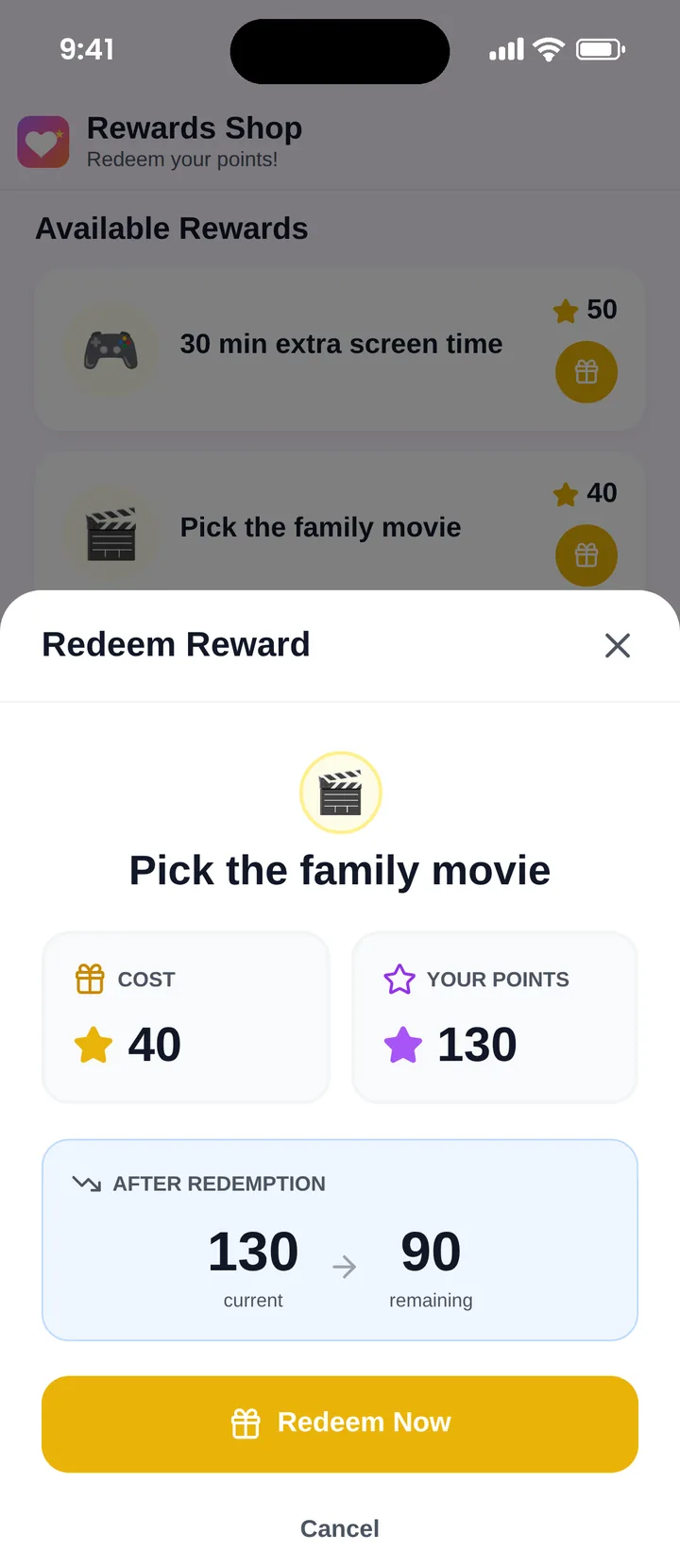
A physical token board is still a fine choice for young children. The app tends to suit kids from about 6 who have their own phone or tablet.
A first-week plan
Choose two behaviors tonight. Write each in one sentence. Pick the token and sit down with your child to choose five rewards for the menu. Start tomorrow morning, give every token within seconds, and review on day seven. If your child earns a small reward in the first two or three days, the setup is about right.
Frequently asked questions
What is a token system for kids?
It is a behavior plan where a child earns tokens (points, stickers, chips) for specific behaviors, then exchanges them for a reward they chose. The token bridges the gap between a good moment now and a prize later.
What ages is a token system good for?
Roughly ages 3 to 12 work best. Younger children need an immediate token and a quick reward. Older children can handle points that build over several days. Teenagers usually do better with a negotiated agreement than a token board.
Should you take tokens away for bad behavior?
Use it sparingly, if at all. Many professionals suggest starting with earning only, because losing tokens often causes anger and makes children stop caring about the system. If you use it, agree on the rule in advance and keep it small.
How many behaviors should a token system track?
Start with two or three. A short list is easy for the child to remember and for you to notice. Add a new behavior only once the first ones happen most days without much effort.
How do you stop using a token system?
Fade it gradually. Move from a token for every instance to a token for a whole morning, then a whole day, then a few times a week, while keeping up the praise. Watch that the behavior holds before each step.
Try Famiyo With Your Family
Chores with points, a rewards shop for kids and one shared family calendar. Set it up in a couple of minutes.



Free to download • No credit card required • Available on iOS & Android