Token Economy for Kids: A Parent's Guide
A token economy for kids explained: how tokens, target behaviors and a reward menu fit together, how to set prices, and when to fade it out as habits form.
By Famiyo Editorial Team6 min read
A token economy sounds like something from a research lab, but the idea is old and simple: a child does something you want to see, gets a token right away, and later trades the tokens for something they chose. It comes from decades of work in applied behavior analysis, and clinics, schools and homes all use versions of it. This guide covers the parts of a token economy, how to price rewards, an example setup and what tends to go wrong.
What a token economy is, and what it isn't
Every token economy has the same four parts. A reward chart with a sticker is a simple version. A full economy adds prices and a menu.
| Part | What it means | Example at home |
|---|---|---|
| Target behaviors | Specific, observable things you want more of | Feed the dog, homework done before dinner, bedroom tidy |
| Tokens | A countable stand-in for the reward | Points, stickers, poker chips, marbles |
| Backup rewards | What tokens can be exchanged for | Screen time, a movie pick, a trip to the park |
| Exchange rules | Prices and when the child can cash in | 50 tokens for 30 minutes of tablet, shop opens Saturday |
The token itself isn't the point. It does one job: it lets you give feedback within seconds of the behavior, even when the real reward (a trip to the park) can't happen yet. That immediacy is the main reason these systems work better than "be good this week and we'll see."
It's also not bribery. A bribe is negotiated in the heat of the moment ("stop screaming and you can have a cookie"). A token economy is set up in advance, with written rules, for behaviors you've chosen on a calm day. The distinction matters, because the second keeps you from rewarding the tantrum.
Why it works, and where it can backfire
Positive reinforcement, meaning that a behavior followed by something the child likes becomes more likely, is among the best-supported ideas in child behavior, and the American Academy of Pediatrics recommends noticing and rewarding behavior you want to see over relying on punishment. Tokens are a way of doing that consistently.
The honest limits are worth knowing. Rewards can crowd out interest in things a child already likes doing. A child who loves to draw may draw less if every picture earns points. And a system that depends on the parent being perfectly consistent will wobble when life gets busy. Neither means tokens are a bad idea. They mean you should use them for habits and chores a child doesn't yet do on their own, and plan from the start to scale them back. We go deeper on this in our overview of a reward system for kids.
How a child responds depends on the child. Some thrive on a clear count. Others feel pressure or start asking "what do I get?" for everything. Watch how your child reacts in the first two weeks and adjust.
Setting up a token economy in six steps
- Choose 3 to 5 target behaviors. Write each as an action you can see: "Put dirty clothes in the hamper," not "be tidy." Younger kids need fewer, around two or three.
- Pick the token. For ages 3 to 6, something physical like stickers or marbles works best. Older kids can use a points count on paper or in an app.
- Decide how many tokens each behavior is worth. Keep it simple: one size for small jobs, double for jobs that take longer.
- Build the reward menu with your child. Ask "What would make this worth your while?" and write down their ideas. Mix small, medium and big rewards.
- Set prices and a cash-in time. Small rewards should be reachable in two or three days, big ones in a few weeks.
- Explain it once, calmly, write it down, and start the next morning. No tokens are removed for misbehavior in the first version, so the system stays friendly.
Pricing: a worked example
The common failure is inflation. If everything is cheap, tokens stop meaning anything. If everything is expensive, the child gives up in a week. Here's one scale that follows the numbers many families start with.
| Task size | Example | Tokens |
|---|---|---|
| Small (2 to 5 minutes) | Make the bed, feed the pet | 5 |
| Medium (10 to 15 minutes) | Empty the dishwasher, tidy the room | 10 |
| Big (30 minutes or more) | Clean the bathroom, mow the lawn | 20 |
| Bonus | Done without a reminder | +2 |
| Reward size | Examples | Price |
|---|---|---|
| Small | 15 extra minutes of screen time, choose dessert | 30 to 50 tokens |
| Medium | Pick the family movie, stay up 30 minutes later | 100 tokens |
| Big | A day out, a toy around $20 | 300 to 500 tokens |
The target is that a child can afford a small reward every two to three days and a big one every three to four weeks. If your 9-year-old earns about 30 tokens a day, a 50-token reward is two days away, which keeps interest up. If it's taking a week, drop the prices or add a behavior.
If you decide to convert tokens to money, the arithmetic is 100 tokens to $1. Whether to pay at all is a separate question, and we weigh it in should kids get paid for chores.
Common problems and fixes
Tokens pile up unspent. The menu is boring. Revisit it with your child every month, and add a new reward when they stop asking for the old ones.
Your child argues over whether a task counts. The behavior isn't specific enough. Rewrite it with a clear end point: "Dishes in the dishwasher, counter wiped" instead of "kitchen clean."
Arguments about taking tokens away. For the first version, don't. Penalties, called response cost, can work for some children, but they add stress and take careful handling. If you do try it, set the rule in advance and keep it small and rare.
A sibling gap. Different ages can earn different amounts for the same task, as long as everyone understands the deal and the effort matches. The same menu can work for all.
Your own consistency slips. It happens. Pick a fixed time, like five minutes after dinner, to hand out tokens and count them, so it doesn't depend on remembering throughout the day.
Teens need a different approach, with more choice and a closer link to privileges. See our guide to a reward system for teenagers. For kids with ADHD, shorter intervals and faster payouts tend to matter, which we cover in token systems for kids with ADHD.
Fading it out
A token economy isn't meant to run forever. When a behavior happens most days without a reminder, there are a few ways to ease off. Raise the bar slightly (two days in a row for a token). Pay tokens less predictably. Pair every token with specific praise so the approval stays after the points go. Move the behavior off the chart and add a new one. If a habit slips after you remove it, bring it back for a week or two. That's normal.
Running a token economy in Famiyo
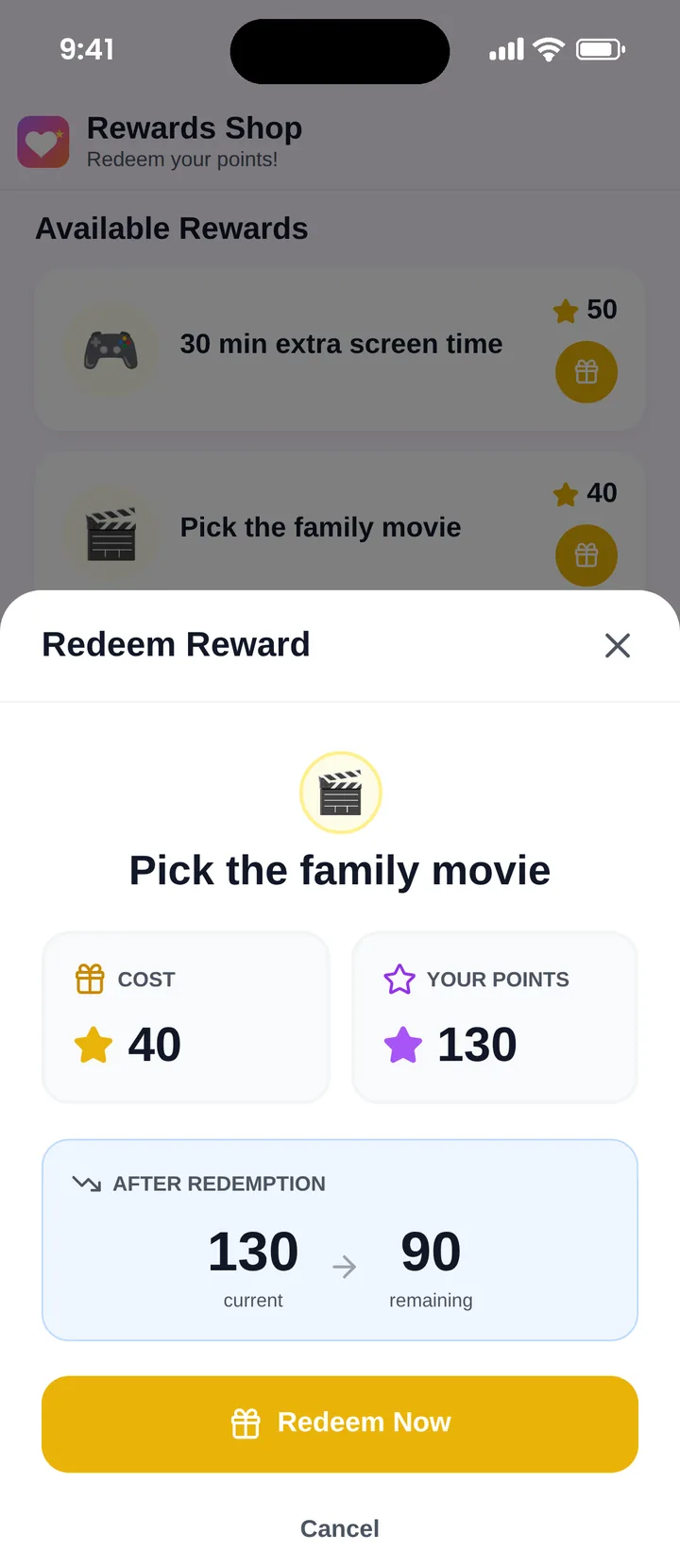
Famiyo is a free family app for iPhone and Android that combines a shared family calendar, chores with points and a rewards shop; kids join with a code, no email needed. The points are the tokens, and the rewards shop is the exchange menu. You create each reward with a price in points, how many are available and when, so a "family movie pick" can have a limit of one a week. Kids redeem from their own phone and see how many points they'll have left, and you get a notification when they do. Each child can earn a different number of points for the same task. If you're comparing tools, see our list of the best reward chart apps for kids.
Start with three behaviors and five rewards this week, and look at how it's going after the first two weeks.
Frequently asked questions
What is a token economy for kids?
It is a reward system that uses a stand-in currency. A child earns tokens such as points, stickers or coins for named behaviors, then exchanges them for a reward they chose from a menu. The token bridges the gap between doing the task and getting the prize.
What can be used as tokens at home?
Anything countable that a child can't easily fake: stickers on a chart, poker chips, marbles in a jar, or points in an app. Tokens need to be handed over right after the behavior, kept safe, and counted together so the child sees the total grow.
Is a token economy bribery?
Bribery is offering a prize in the middle of a meltdown to stop it. A token economy is planned in advance, with clear rules, for behaviors you want to see. Most guidance on positive reinforcement treats that difference as the one that matters.
How long should a token economy last?
Plan on several weeks to a few months. Once a behavior happens reliably, raise the requirement, pay tokens less often, or retire that behavior from the chart. The aim is that praise and routine take over, not that tokens run forever.
Do token economies work for every child?
They help many children, especially those who respond to clear, immediate feedback, but not all. If a child becomes anxious about earning or loses interest in tasks they used to do freely, simplify or pause. For ADHD, autism or behavior concerns, ask the child's pediatrician or therapist.
Try Famiyo With Your Family
Chores with points, a rewards shop for kids and one shared family calendar. Set it up in a couple of minutes.



Free to download • No credit card required • Available on iOS & Android