Reward System for Kids' Behavior: What Works and Why
How to build a reward system for kids' behavior: pick target behaviors, set prices, time the rewards, and fade them out, with examples by age and a sample shop.
By Famiyo Editorial Team6 min read
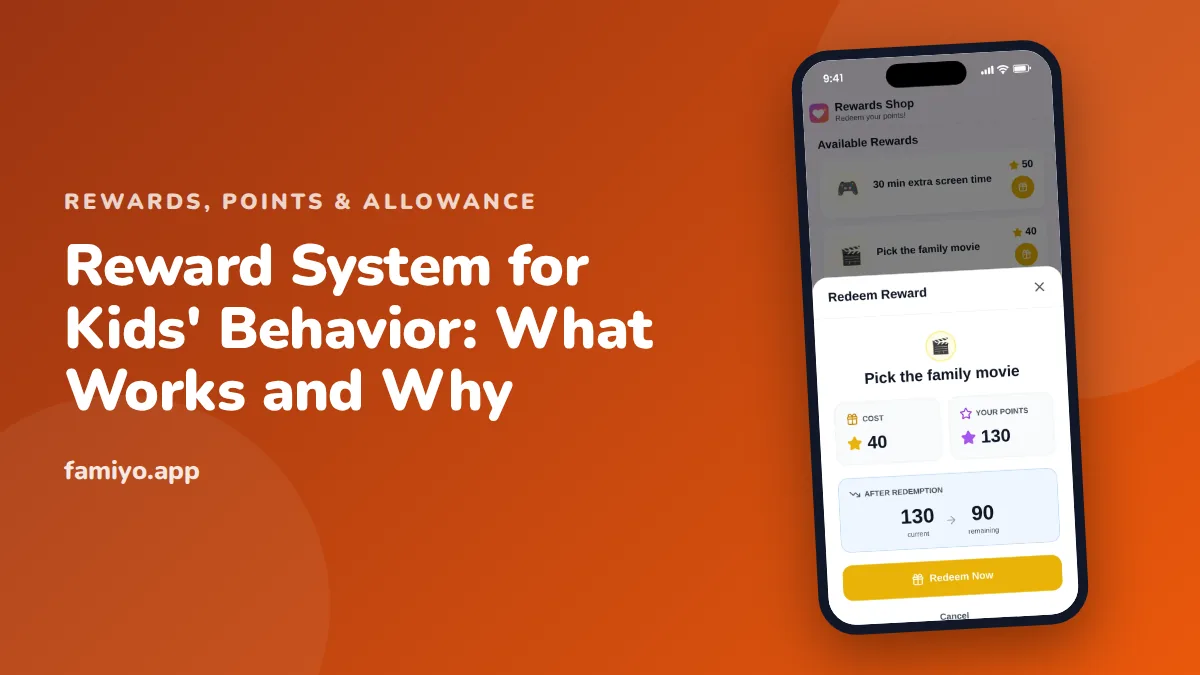
Most parents who search for a behavior reward system are in the same spot: they've asked, reminded and warned, and the same three problems keep returning. A reward system is a tool for exactly that situation, as long as you build it with a few rules in mind. This guide covers what the research-based advice says, how to choose behaviors and prices, what a working week looks like, and how to wind the system down again.
Why reward systems work (and when they don't)
Behavior that gets a good result tends to repeat. That's the plain idea behind positive reinforcement, and it's the basis of the discipline advice from the American Academy of Pediatrics, which leans on praise, attention and clear expectations rather than punishment alone. A reward system just makes that process visible and consistent.
Three conditions make it work. The behavior is specific ("put your plate in the dishwasher," not "be good"). The reward comes soon after. And the system is predictable, so the child can trust it. When any of those slips, the system usually stalls. A reward promised "at the end of the month" means very little to a six-year-old.
It also has limits. Rewards are good at starting and strengthening habits. They are weaker at building motivation from the inside, and if a child is doing something only for the prize, you'll often see the effort vanish when the prize does. That's why the plan below ends with a fade-out, and why praise stays in the mix the whole time. Every child responds differently, so treat the numbers here as a starting point and adjust after a couple of weeks.
Step 1: Choose one to three behaviors
The most common mistake is a system with twelve targets. Start with one to three. Choose behaviors you can see happen, that have a clear finish, and that the child can control.
| Vague goal | Specific behavior |
|---|---|
| Be respectful | Say "please" when asking for something |
| Be responsible | Pack your school bag before bed |
| Behave at dinner | Stay seated until everyone is done |
| Be kind to your sister | Ask before taking her things |
| Listen better | Start the task within one minute of being asked |
Frame each one as something to do, not something to stop. "Use a calm voice" works better than "no yelling," because the child can earn it.
Step 2: Decide what a reward is worth
Points or tokens give you flexibility, because the child can save toward something bigger. A simple scale uses 5 points for a small win, 10 for a medium one and 20 for a big effort, plus 2 bonus points when it's done without a reminder. Then set prices for the rewards on a menu so a child can afford something small every 2 to 3 days and something big every 3 to 4 weeks.
| Reward size | Examples | Price |
|---|---|---|
| Small | 15 extra minutes of screen time, choose dessert | 30 to 50 points |
| Medium | Pick the family movie, stay up 30 minutes later | 100 points |
| Big | A day out, a toy around $20 | 300 to 500 points |
Include a mix of things that cost money and things that cost time. The most motivating rewards are often the cheap ones, like a parent playing a game with them. Let your child help build the menu, because a reward they chose is a reward they want.
Step 3: Time it carefully
The gap between the behavior and the reward matters most with younger children. For ages 3 to 6, aim for points or a sticker right away, and a chance to spend within a few days. For ages 7 to 10, a weekly rhythm works: earn during the week, shop on Saturday. Teens can handle longer stretches and often prefer money or privileges they negotiate. Our guide to a reward system for teenagers covers that stage.
Say the reward out loud when you give it: "You started your homework without being asked, that's 10 points." Praise tied to the exact behavior teaches more than a general "good job."
A sample week
Here's what the system looks like for a 7-year-old with three target behaviors: packing the school bag, using a calm voice when upset, and putting dishes in the dishwasher.
| Day | Behavior | Points earned |
|---|---|---|
| Mon | Bag packed (5), dishes (5) | 10 |
| Tue | Bag packed (5), calm voice after a hard moment (10) | 15 |
| Wed | Dishes (5), bonus for no reminder (+2) | 7 |
| Thu | Bag packed (5), dishes (5), calm voice (10) | 20 |
| Fri | Bag packed (5), no reminder (+2) | 7 |
| Sat | Dishes (5) | 5 |
That's 64 points in a week, enough for a medium reward by the weekend plus a small one early on. If the child can't afford anything for a week, your prices are too high. If they can buy everything by Tuesday, they're too low.
What to do about bad behavior
Keep the reward system for building good habits and handle misbehavior separately. Taking away earned points tends to feel unfair and often ends the child's interest in the whole system. For rule-breaking, use a calm, related consequence that you explained in advance (the toy gets put away, the tablet is off for the evening) and keep it separate from the point balance.
For children with ADHD or autism, the same ideas apply with extra care: shorter targets, faster rewards and visual tracking. Our guides to a token economy for kids and a reward system for kids with ADHD go deeper, and your child's pediatrician or therapist can tailor the approach.
Common mistakes that sink a system
A few patterns show up again and again when reward systems fade after a week or two.
- Changing the rules mid-week. If a child earns 10 points on Monday and 5 for the same thing on Thursday, they stop trusting the system.
- Rewards that are too far away. A prize that costs three months of effort feels impossible, so the child gives up.
- Rewarding only perfect days. Credit effort and partial progress, or a child who has a bad morning will write the whole day off.
- Using the reward as a bribe in the moment. "If you stop screaming I'll give you a point" teaches that screaming gets negotiated. Agree on the deal before the hard moment, not during it.
- Forgetting the praise. The points are the structure, and your attention is the fuel.
If you hit one of these, fix it quietly and tell your child what changed and why. Kids accept an honest adjustment far better than a silent one.
Running the shop in Famiyo
Famiyo is a free family app for iPhone and Android that combines a shared family calendar, chores with points and a rewards shop; kids join with a code, no email needed. You create each reward with a price in points, set how many are available and when, and your child redeems from their own phone.
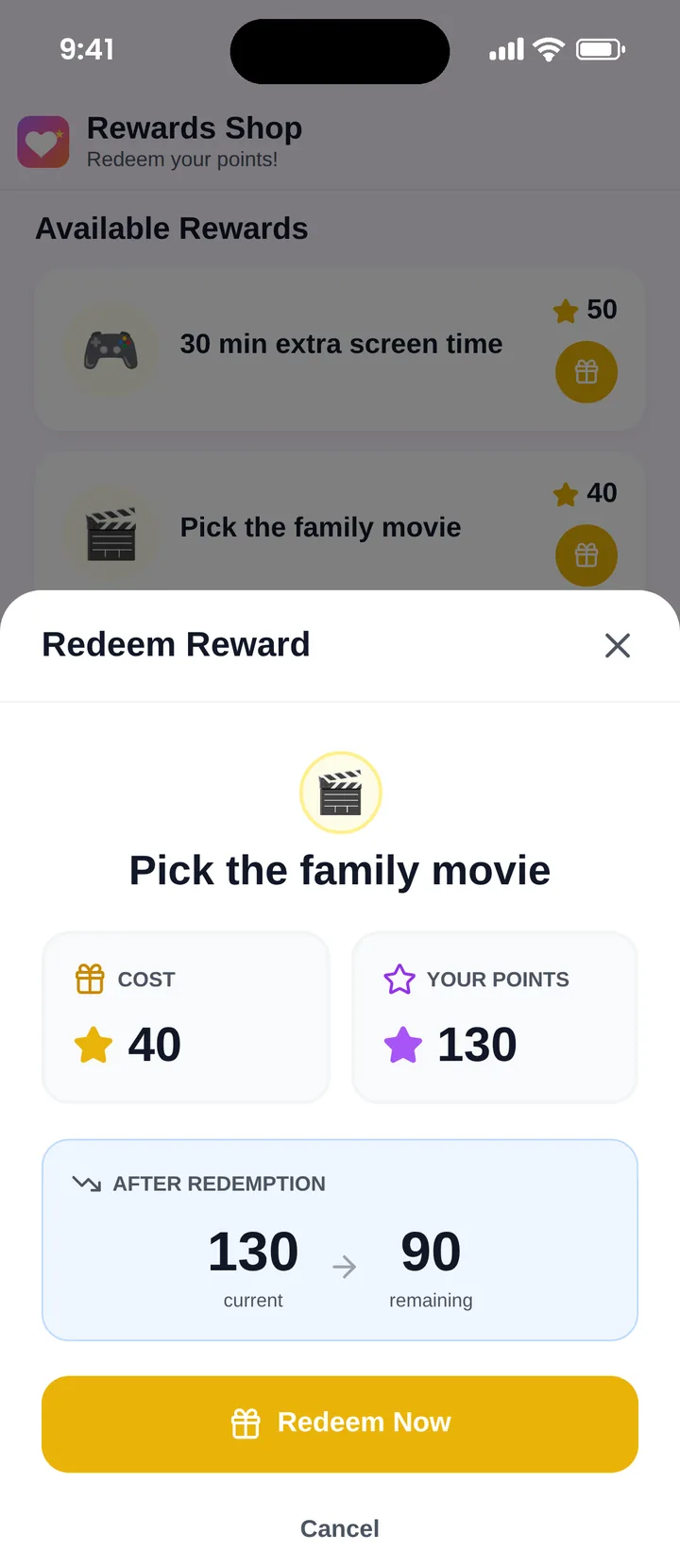
Because the child sees the points left after buying, they learn to choose between a small reward now and a bigger one later. You get a push notification when something is redeemed, and the statistics show points this week per child. For a comparison of tools, see our list of the best reward chart apps for kids.
Fade the system out
A reward system is scaffolding. After a few weeks of steady behavior, stretch the gap: points now come only every other time, or you drop one target and add another. Keep the praise going. Many families find that after a few months the habit holds with only occasional rewards. If it slips, bring the system back for that behavior and try again. That's normal, not a failure of the plan.
For a broader look at building a system from scratch, read our guide on how to build a reward system for kids that lasts.
Frequently asked questions
What is a good reward system for kids' behavior?
One that targets one to three specific behaviors, gives a quick small reward each time, lets the child pick from a menu, and stays predictable. Points, stickers or tokens all work. The structure matters more than the currency.
Do reward systems for behavior actually work?
They work well for building specific habits, especially with younger children, when the target is clear and the reward is immediate. They work poorly when they replace explanation, or when the rules change often. Many families fade them as the habit sticks.
Should you take rewards away for bad behavior?
Mostly no. Taking back points already earned feels unfair and tends to end the child's interest. Use a separate, calm consequence for rule-breaking and keep the reward system for what the child does right. A missed reward is consequence enough.
What are good rewards for kids that aren't candy or toys?
Time and choice work well: picking the family movie, 15 extra minutes of screen time, choosing dessert, a trip to the park, staying up a little later, or one-on-one time with a parent. These cost little and don't create a toy habit.
Try Famiyo With Your Family
Chores with points, a rewards shop for kids and one shared family calendar. Set it up in a couple of minutes.



Free to download • No credit card required • Available on iOS & Android