Reward System for Teenagers: What Works and What Backfires
A reward system for teenagers works when teens help design it, rewards are real and earned, and rules stay predictable. Here is how to build one, with examples.
By Famiyo Editorial Team6 min read
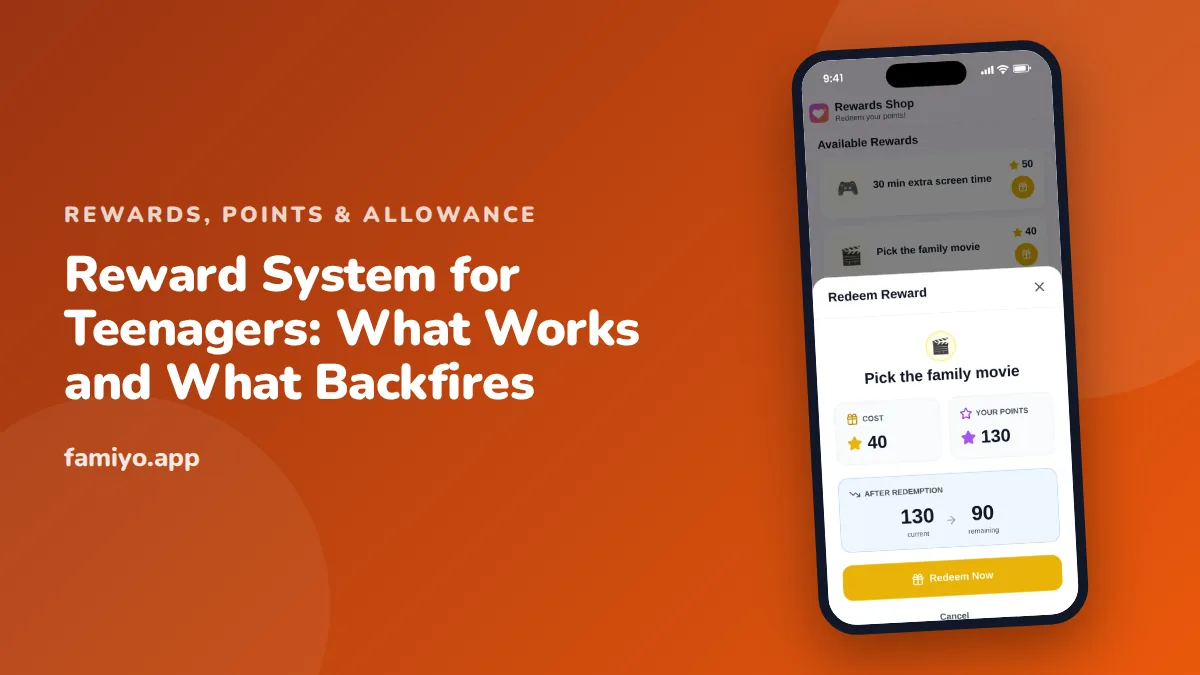
A reward system that worked at 8 usually dies at 14. Stickers feel babyish, a parent holding all the cards feels controlling, and the child on the other side of the table is now very good at spotting a manipulation. Parents often decide that rewards do not work on teenagers.
Mostly, the old version does not work. A version built for a teen's age is a different thing: negotiated, adult in tone, and based on real privileges and real money. This guide covers why teens respond differently, how to design a system, what to reward, and the mistakes that sink it.
Why teenagers need a different kind of system
Teenagers are doing something developmentally normal: pulling toward independence. Guidance from pediatric bodies like the American Academy of Pediatrics consistently points to warmth, clear expectations and involving teens in decisions as the things that keep a relationship working through these years. Reward systems that ignore this feel like a step backward to a teen.
Research on motivation, in general terms, suggests people stay engaged when they feel some choice over what they do and see the link between effort and result. Rewards can still help, especially for dull, repetitive jobs, but they work best when they feel like a fair exchange between near-equals and not a leash.
So the shift is this: with a 7-year-old you design the system. With a 15-year-old you design it together, and you accept that some of the terms are theirs.
Step by step: building a teen reward system
- Pick the one or two problems you want to change. Not twelve. "Chores not getting done" and "homework slipping" is plenty. Starting wide makes teens feel audited.
- Hold a calm talk, away from a conflict. Say what you want to try and why. Ask for their input.
- Let them write the reward menu. You will get answers like "later curfew" and "$20 for a game." Some are fine, some need a counter-offer, and that back and forth is part of the point.
- Set the exchange rate together. Make the points simple (see the table below) and the prices visible.
- Decide what is earned and what is not. Basic expectations, like being respectful or doing their own laundry, are part of living in the house. Rewards go for extra effort or for building a new habit.
- Agree on a review date, four to six weeks out. Anything that is not working changes then.
If you want more on the building blocks, our guide to a reward system for kids covers the basics that apply at any age.
What to reward (and what to leave alone)
| Worth rewarding | Why it fits teens | Typical points |
|---|---|---|
| A bigger weekly job (mowing, cleaning the bathroom) | Real work with a visible result | 20 |
| Medium daily jobs (dishwasher, trash, tidy room) | Builds consistency | 10 |
| Small daily jobs (make the bed, feed the pet) | Easy wins that add up | 5 |
| Doing it without a reminder | Encourages self-direction | +2 |
| Extra help (babysitting a sibling, helping a neighbor) | Initiative, not obligation | Agree case by case |
Be careful with a few things. Grades are a tricky one: rewarding effort and process, like finishing assignments on time, tends to be safer than paying for results the teen cannot fully control. Mood and attitude do not belong on a points chart at all. Neither does anything involving health, such as sleep or food, where a reward system can create an unhealthy relationship with the habit.
What rewards teenagers actually want
Teens often care more about freedom, time and social access than objects. A useful menu mixes all three.
| Reward size | Examples | Price in points |
|---|---|---|
| Small | 15 extra minutes of screen time, choose dessert or dinner | 30 to 50 |
| Medium | Pick the family movie, stay up 30 minutes later on a weekend | 100 |
| Big | A day out with a friend, a gift around $20 | 300 to 500 |
A teen who works steadily should afford a small reward every 2 to 3 days and a big one every 3 to 4 weeks. That pace matters. If big rewards take months, teens quit. If everything comes instantly, it stops meaning anything.
If you want to convert points to cash, 100 points can equal $1. Cash suits extra jobs; the usual range is $0.25 to $1 for small ones and $2 to $5 for a big one. For the money side in more depth, see our guide to chore allowance, and if your teen is thinking about real income, first jobs for teens is worth a read together.
Where reward systems backfire
Most failures come from the same few patterns.
- Rewards offered mid-argument. "If you clean your room, I'll let you go out" is a bribe in a crisis. The same deal agreed in advance is a plan.
- Moving the goalposts. If you promised 100 points for a movie night, a teen who earned it gets the movie night, even if they annoyed you on Thursday.
- Taking points away as punishment. Some families use a loss system on purpose, but for most teens it feels like a penalty on money they already earned. Keep earning and consequences as separate things.
- Letting it run unchanged for a year. Interests, schedules and what a teen wants all shift. Review it.
- Using rewards for everything. If every minor request becomes a deal, you will be negotiating forever and the intrinsic reasons for helping disappear.
Some parents worry that rewards undermine a teen's own motivation. The honest answer is that it depends. Rewards for tedious tasks tend to be fine. Rewards for things a teen already enjoys, like a sport they love, can dilute the enjoyment. Use rewards to get a habit started and let the pride and the privileges take over.
For a similar structure built around tokens, our token economy for kids guide explains the mechanics.
Setting up the rewards shop in Famiyo
Famiyo is a free family app for iPhone and Android that combines a shared family calendar, chores with points and a rewards shop; kids join with a code, no email needed. For a teen, the rewards shop is the part that makes the system feel grown up. You create rewards with a price in points, set how many are available and when, and your teen redeems from their own phone, seeing how many points they will have left afterward.
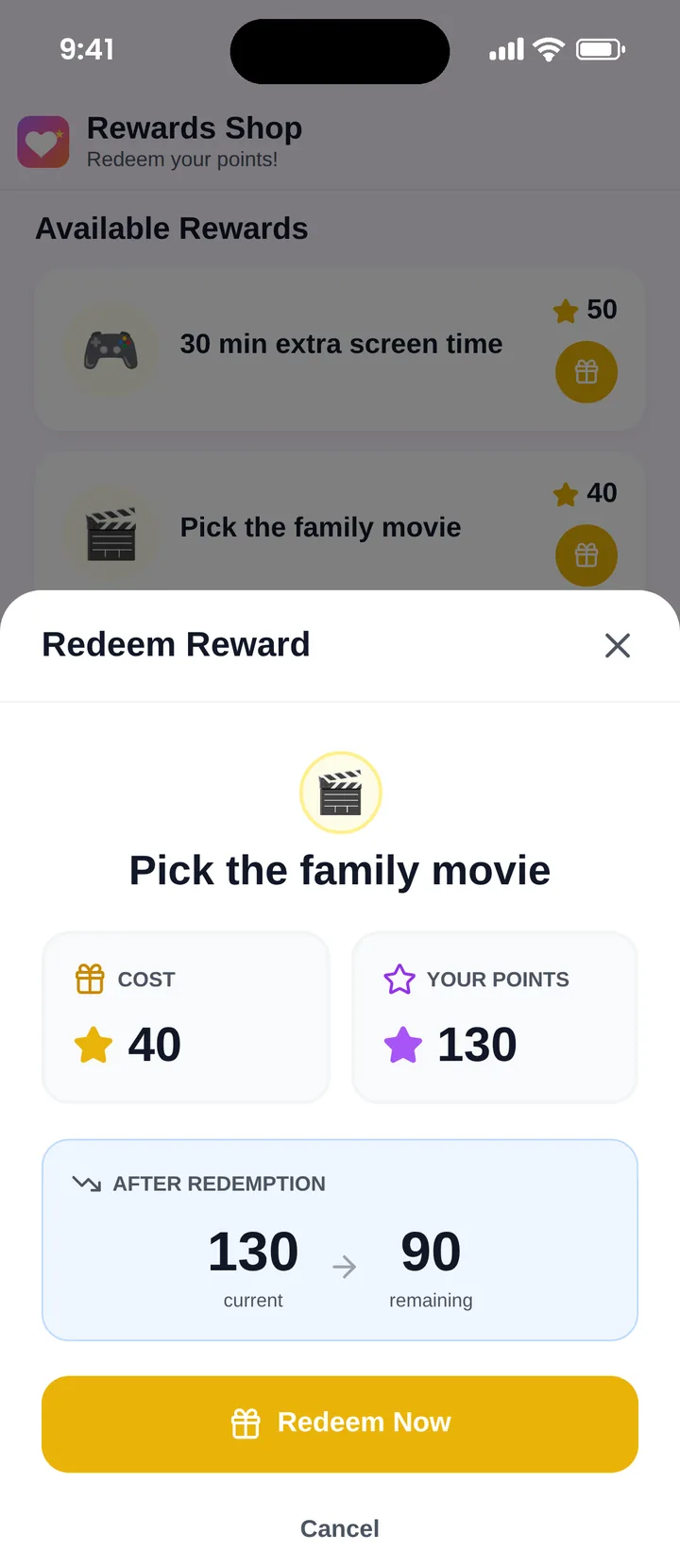
You get a notification when a reward is redeemed, so nothing slips by. Pocket money can be one of the rewards, though the cash itself changes hands outside the app. For a comparison of options, see our list of the best reward chart apps for kids.
What the first month looks like
Expect a rhythm. Week one, the teen tests whether you will really honor the menu. Week two, they notice that the points add up and start planning. By week three, a few will quietly drop the jobs they find dull, and that is your cue to check the exchange rate, not to scold. Week four is the review you scheduled: what felt fair, what felt like a waste, which rewards were never chosen.
Three questions make that review short and useful:
- Which reward did you actually want, and was it affordable?
- Which job felt like too much for the points?
- What should we add, change or drop?
Teens who see their answers lead to changes are far more likely to keep going. If they get nothing changed after being asked, they stop answering honestly.
A few teens will not want a points system at all, and that is a legitimate answer. In that case, fall back on a plain agreement: these jobs, by this time, and this privilege follows. The principle is the same, with the structure stripped down. Families with a child who has ADHD or autism may want more structure and more immediate rewards, and the child's pediatrician or therapist is the right person to shape that.
Sample teen reward menu
A starting point to edit with your teen:
- 30 points: choose dinner, or 15 extra minutes of screen time
- 100 points: pick the family movie, or an extra 30 minutes before curfew on a weekend
- 200 points: friends over for pizza, or a ride and a pick-up from an event
- 300 points: a day out with a friend
- 500 points: a gift around $20
Print it, change it, or let your teen cross out half of it and write their own. A menu they edited is one they will actually use.
When you are ready, start with one problem and one weekend reward. Review it in a month.
Frequently asked questions
Do reward systems work on teenagers?
They can, if the teen has a say. Teens respond to autonomy and fairness more than to being managed. A system they helped design, with rewards they chose, usually works. One handed down from above often gets ignored or gamed.
What are good rewards for teenagers?
Privileges and freedom tend to beat toys: later weekend curfew, a ride to a friend's, extra phone time, choosing dinner, a small amount of money, or a day out. Ask your teen to write their own list first, then agree on what is reasonable.
Should rewards be money or privileges?
A mix works well. Privileges can follow everyday jobs, while money suits bigger extra jobs, such as $2 to $5 for a big one. Keep basic family chores unpaid, and avoid paying cash for things like homework effort.
How do I stop a reward system from feeling like a bribe?
Agree on it ahead of time, in a calm conversation, instead of offering rewards in the middle of an argument. Rewards offered up front as part of a plan feel like a fair deal. Rewards waved around mid-fight feel like a bribe.
When should I stop using a reward system?
When the behavior is steady for a couple of months, loosen the system gradually: fewer tracked items, rewards that arrive less often, more praise and trust. Many teens outgrow formal points on their own, and that is a good sign.
Try Famiyo With Your Family
Chores with points, a rewards shop for kids and one shared family calendar. Set it up in a couple of minutes.



Free to download • No credit card required • Available on iOS & Android