Allowance vs Chore Money: What's the Difference?
Allowance and chore money are not the same thing. Compare the two, see how each works in a real week, and choose a setup that fits your kids.
By Famiyo Editorial Team4 min read
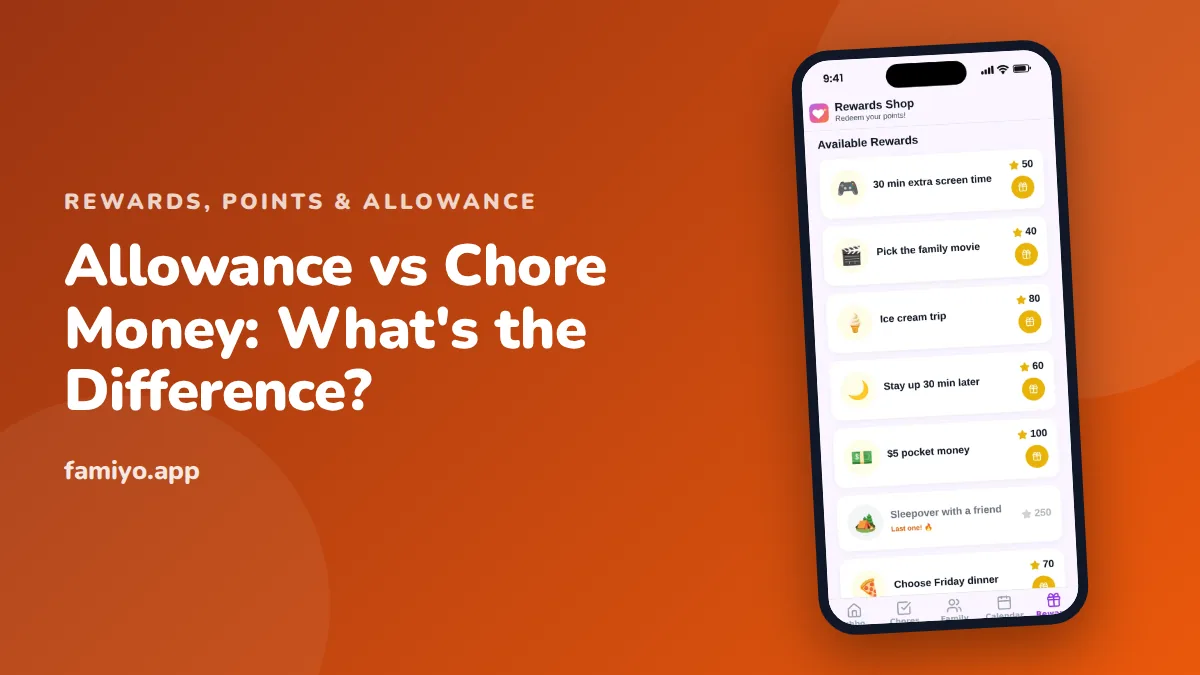
Parents often use the two words as if they were the same, then wonder why the system breaks. "Allowance" and "chore money" are different tools. One teaches a child how to manage money. The other teaches that effort can earn it. You can use either, or both, but you should know which one you're using on any given Saturday.
This page lays out the difference, how they play out in practice, and how to pick.
The difference in one table
| Allowance | Chore money (commission) | |
|---|---|---|
| Purpose | Practice managing money | Reward effort on extra jobs |
| Paid when | Same day every week or month | After a job is done |
| Amount | Fixed | Varies with the job |
| Depends on behavior | No (or only loosely) | Yes, completely |
| Can be missed | Rarely | Yes, if the job is not done |
| Teaches | Budgeting, saving, trade-offs | Work, effort, negotiation |
| Typical amount | About $1 per year of age per week as a starting point | $0.25 to $1 small, $2 to $5 big |
The labels are not perfect. Some families say "allowance" for everything. What matters is whether payment is tied to a specific task.
How allowance works
Allowance is a regular budget. The child receives the same amount on payday and decides what to do with it. Mistakes are the lesson: spend it all on Monday and nothing is left for the weekend.
A common structure is to split money into spend, save and give. For younger children, 50%, 40%, 10% is a typical example. The amount depends on your budget and what you expect the child to cover. Typical weekly ranges are $3 to $7 for ages 5 to 7, $7 to $10 for ages 8 to 10, $10 to $15 for ages 11 to 13, and $15 to $25 from 14 up. The older the child, the more the allowance should cover; see our guide to weekly vs monthly allowance for teenagers.
Strength: it is predictable, so a child can plan. Weakness: if it comes with no link to anything, some kids see it as a payment for existing.
How chore money works
With chore money, each job has a price. Wash the car, $4. Rake the leaves, $3. The child chooses whether to do it. No job, no pay.
It resembles a small job market, which is why it works well for ages 8 and up. It also keeps basic chores separate. Everyday jobs like making your bed and clearing your plate are part of living in a family and are not paid. Extra jobs are the ones with a price tag.
Strength: a child sees that effort produces money. Weakness: some children learn to ask "how much?" before helping with anything, including things they should simply do. Keeping paid and unpaid jobs on separate lists prevents that.
Which one should you choose?
Think about what you want the money to teach.
- If you want to teach budgeting, give a flat allowance that does not depend on chores. The child has real choices and real consequences.
- If you want to teach earning, pay for specific extra jobs and keep a visible price list.
- If you want both, use a small flat allowance plus a menu of paid jobs. This is the most common setup for kids aged 8 to 12.
- If you want one simple system, tie the whole allowance to a defined set of chores and call it what it is: a payment for work.
Neither is wrong. Our article on chore allowance shows a chart format for the combined approach.
A sample week with both
Say your 10-year-old gets a $7 weekly allowance and has a short list of unpaid daily chores. In addition there is a list of paid extras:
| Extra job | Price |
|---|---|
| Wash the family car | $4 |
| Rake the front yard | $3 |
| Clean out the garage shelf | $2 |
| Wipe down kitchen cabinets | $1 |
On Saturday morning the child does the car and the cabinets. Total for the week: $7 allowance plus $5 job money, $12. A parent can hand it over, then the child divides it into jars or lists it in a tracker. If they did none of the extras, they still get the $7 and can do the math on whether it is enough for the thing they want.
Write the rules down once so nobody is surprised. Our chore contract for kids lists what to include.
Common mix-ups to avoid
- Docking allowance for missed chores randomly. If allowance is separate, don't treat it as a penalty tool. If it is tied to chores, say so up front.
- Paying for everything. Kids who are paid to help with dishes tend to stop helping for free.
- Changing the amount constantly. Keep it steady for at least a few months.
- No visible record. If the balance lives only in your head, disagreements are guaranteed.
- Payday drift. Pay on the same day every time, even when it is inconvenient.
Using points instead of cash
If you prefer not to handle money weekly, a point system gives the same lesson with less cash. Famiyo is a free family app for iPhone and Android that combines a shared family calendar, chores with points and a rewards shop; kids join with a code, no email needed. Chores and extra jobs are worth points, and a parent sets what each task is worth for each child. Parents create rewards with a price in points, how many are available and when, and pocket money can be one of those rewards. Kids redeem from their own phone and see what they will have left. The app never holds real money, so the cash or transfer still happens outside it.
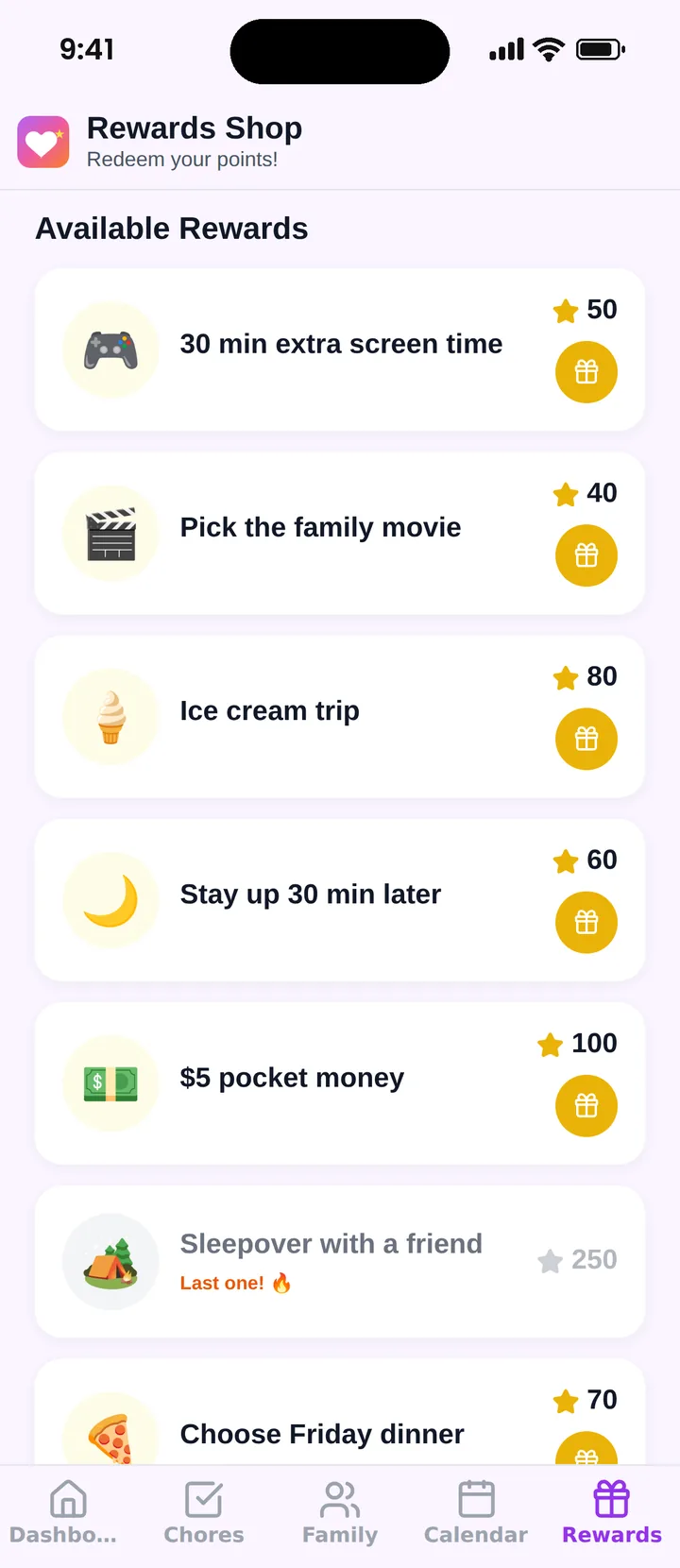
A simple conversion is 100 points to $1. See our list of the best allowance apps for kids to compare options. If you want a record of the balance, the allowance tracker for kids guide compares spreadsheets, printables and apps.
Pick one and say it out loud
Decide whether Saturday money is a budget, a wage or both, and tell your child which it is. Most allowance arguments are really arguments about that single question.
Frequently asked questions
Is allowance the same as being paid for chores?
No. Allowance is a regular amount that helps a child practice spending and saving. Chore pay is earned per job. Many parents keep basic household chores unpaid and pay only for extra jobs.
Should allowance depend on chores?
It can, but there are two clean options. Either tie it fully to chores, like a job, or keep it separate and unconditional as a learning budget. Mixing the two without a rule is what causes arguments.
Can you use both an allowance and paid chores?
Yes, and it is a common setup. A small weekly allowance covers budgeting practice. Extra jobs such as washing the car pay $2 to $5 and teach that more effort earns more.
How much should chore money be compared with allowance?
Paid extra jobs typically run $0.25 to $1 for a small task and $2 to $5 for a big one. A weekly allowance often follows the $1 per year of age rule of thumb, which is a starting point only.
Try Famiyo With Your Family
Chores with points, a rewards shop for kids and one shared family calendar. Set it up in a couple of minutes.



Free to download • No credit card required • Available on iOS & Android