Chore Contract for Kids: What to Include (Free Template)
A free chore contract for kids with the eight parts to include, sample wording, pay rates and a printable PDF you can sign together tonight.
By Famiyo Editorial Team4 min read
Free printable
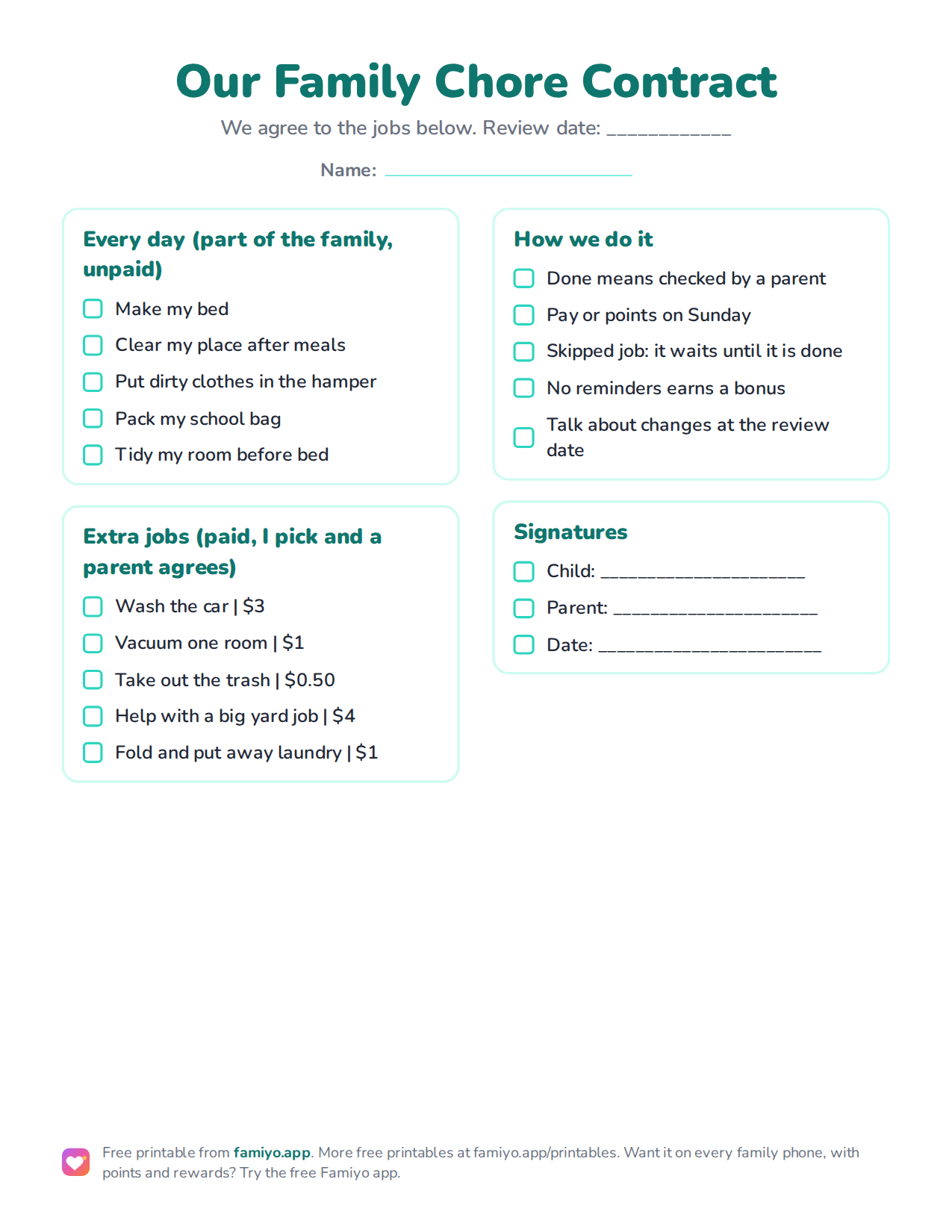
Our Family Chore Contract
A checklist on one US Letter page. Download the PDF to print it, or save the image to use it on a tablet or in a document.
Free for home, classroom and nonprofit use, see the license. More free printables.
Your 8-year-old says he will take out the trash, then he doesn't, then he swears you never said it was every day. A one-page contract ends that argument. It is a written deal that you and your child agree to, with jobs, pay and consequences, so the rules live on paper and not in anyone's memory. Below are the eight parts to include, sample wording, a pay table and a printable version.
What a chore contract is, and what it isn't
A chore contract is a family agreement. It isn't legal, and no one is going to court over a missing bed. What it does is make expectations visible and give a child a stake in the deal, because they helped write it and signed it. That matters most for school-age kids and teens, who respond to fairness more than to orders.
It also forces you to decide things you may have been leaving vague: which jobs are simply part of living here, which earn money, and when the money is paid.
The 8 things to include in a chore contract
- Names and date. The child's name, the parent's name and the start date.
- Daily jobs, unpaid. The basics every family member does. Use the age guide: for 8 to 9 year olds that means jobs like loading the dishwasher or putting away laundry, about 20 to 30 minutes a day in total.
- Extra jobs, paid. A short menu with a price next to each one, so the child chooses.
- What done means. Write it in a sentence: "Bed made with pillow on top, clothes in the hamper, floor clear."
- When pay or points are given. Pick a fixed day, such as Sunday evening. Late pay breaks trust faster than anything else.
- What happens if a job is skipped. Keep it dull and fair, for example "the job stays on the list until it is done, and the pay for it waits."
- How to change the deal. A review date, and a rule that either person can ask for a change at that meeting, not in the middle of an argument.
- Signatures. A signature makes it feel like a real agreement. Let the child sign first.
How much to pay in the contract
Use the ranges in the pay table as a starting point and adjust to your area. These are for extra jobs only. If you want a deeper look at rates, see how much to pay a 9-year-old for chores in our pay guide.
| Job size | Examples | Pay |
|---|---|---|
| Small extra job (2 to 5 minutes) | Take out the trash, wipe the table | $0.25 to $1 |
| Medium extra job (10 to 15 minutes) | Vacuum a room, fold laundry | $1 to $2 |
| Big extra job (30 minutes or more) | Wash the car, rake the yard | $2 to $5 |
Common allowance rules of thumb are $1 a week for each year of age, or weekly ranges such as $7 to $10 for ages 8 to 10. If you pay allowance as well, decide in the contract whether it is tied to the daily jobs or separate. If you would like to compare the two ideas, our chore chart with money guide shows both setups.
Sample contract wording you can copy
Read this aloud to your child before you sign it.
I, [name], agree to do these jobs every day without being paid: make my bed, clear my place, put my clothes in the hamper and pack my school bag. I can also choose extra jobs from the list and be paid the amount shown. A job is done when a parent has checked it. Pay is given every Sunday. If I skip a job, it stays on my list until it is done. We will look at this contract again on [date], and either of us can ask to change it then. Signed: [child], [parent].
For a younger child, cut it to four lines and add pictures. For a teen, add a line they write themselves, such as "I will do my own laundry on Saturdays."
The printable chore contract
The printable below is a one-page checklist version with the daily jobs, five paid extras with prices, the rules and signature lines. It suits kids from about age 6 up. Print it, cross out the jobs that don't fit, and fill in your own numbers. Let your child pick two extra jobs for the first week so they feel ownership from day one.
Mistakes that break a chore contract
- Writing it alone and presenting it. A contract a child helped write gets kept more often.
- Too many jobs. Three to four daily jobs for school-age kids is plenty, per the usual guideline. Add one weekly big job from age 8.
- Vague terms. "Clean room" will be a fight. "Clothes off the floor, bed made, desk cleared" will not.
- Changing the pay mid-week. Wait for the review date.
- Punishing with extra chores. Consequences should be simple and predictable.
If you also want to track the money, our allowance tracker for kids comparison covers spreadsheets, printables and apps.
Doing this with Famiyo
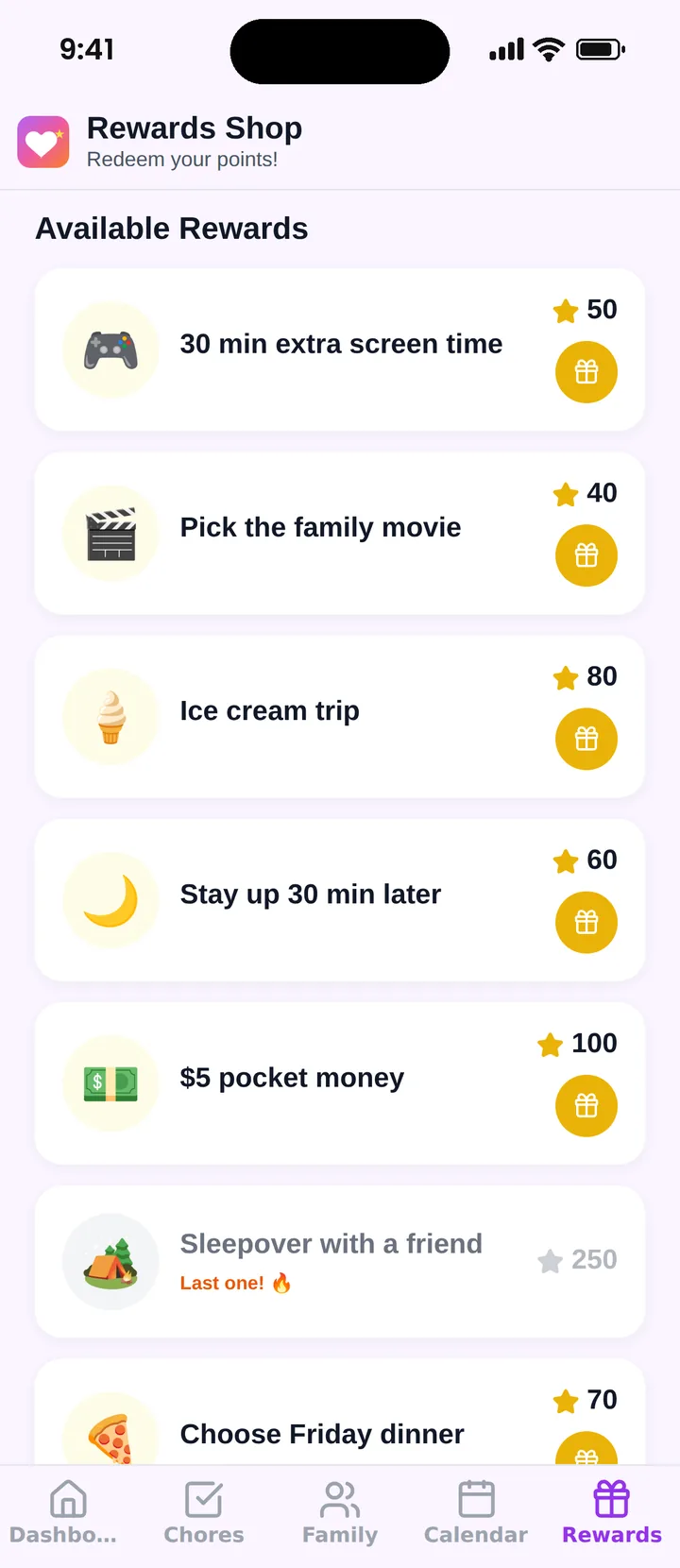
Famiyo is a free family app for iPhone and Android that combines a shared family calendar, chores with points and a rewards shop; kids join with a code, no email needed. To turn a contract into something that tracks itself, add each job as a chore with points, then set up the rewards shop with prices in points, including pocket money as a reward (the money itself changes hands outside the app). Kids check off their jobs on their own phone, or you approve them first. Our roundup of the best allowance apps for kids shows how the options compare.
Print the page, sit down with your child tonight, and sign. Put it on the fridge until the review date.
Frequently asked questions
What should a chore contract for kids include?
Include the daily jobs that are part of family life, any extra paid jobs with the rate, what done looks like, when money or points are given, the consequence for skipped jobs, a review date, and signatures from the child and a parent.
Is a chore contract legally binding?
No. It is a family agreement, not a legal document. Its value is that everyone agreed to the same words in advance, so you can point to the page instead of arguing about what was said last week.
At what age can a child sign a chore contract?
Around age 6 or 7, when a child can read a short list and understand a deal. Younger kids do better with a picture chart. Teens can help write the contract, which makes them far more likely to keep it.
How often should we review the contract?
Every 4 to 6 weeks at first, then every few months, and whenever the child has a birthday. Kids grow into bigger jobs and higher pay, and a contract that never changes starts to feel unfair.
Should basic chores be paid in a contract?
Many families keep everyday jobs like making the bed and clearing plates unpaid, because they are part of living in the home, and pay only for extra jobs. A common range is $0.25 to $1 for a small extra job and $2 to $5 for a big one.
Try Famiyo With Your Family
Chores with points, a rewards shop for kids and one shared family calendar. Set it up in a couple of minutes.



Free to download • No credit card required • Available on iOS & Android