Chore Allowance Chart: Track Chores and Pocket Money
A chore allowance chart shows what your child did, what it earned and what you owe on payday. Sample week, payday routine and a free printable.
By Famiyo Editorial Team4 min read
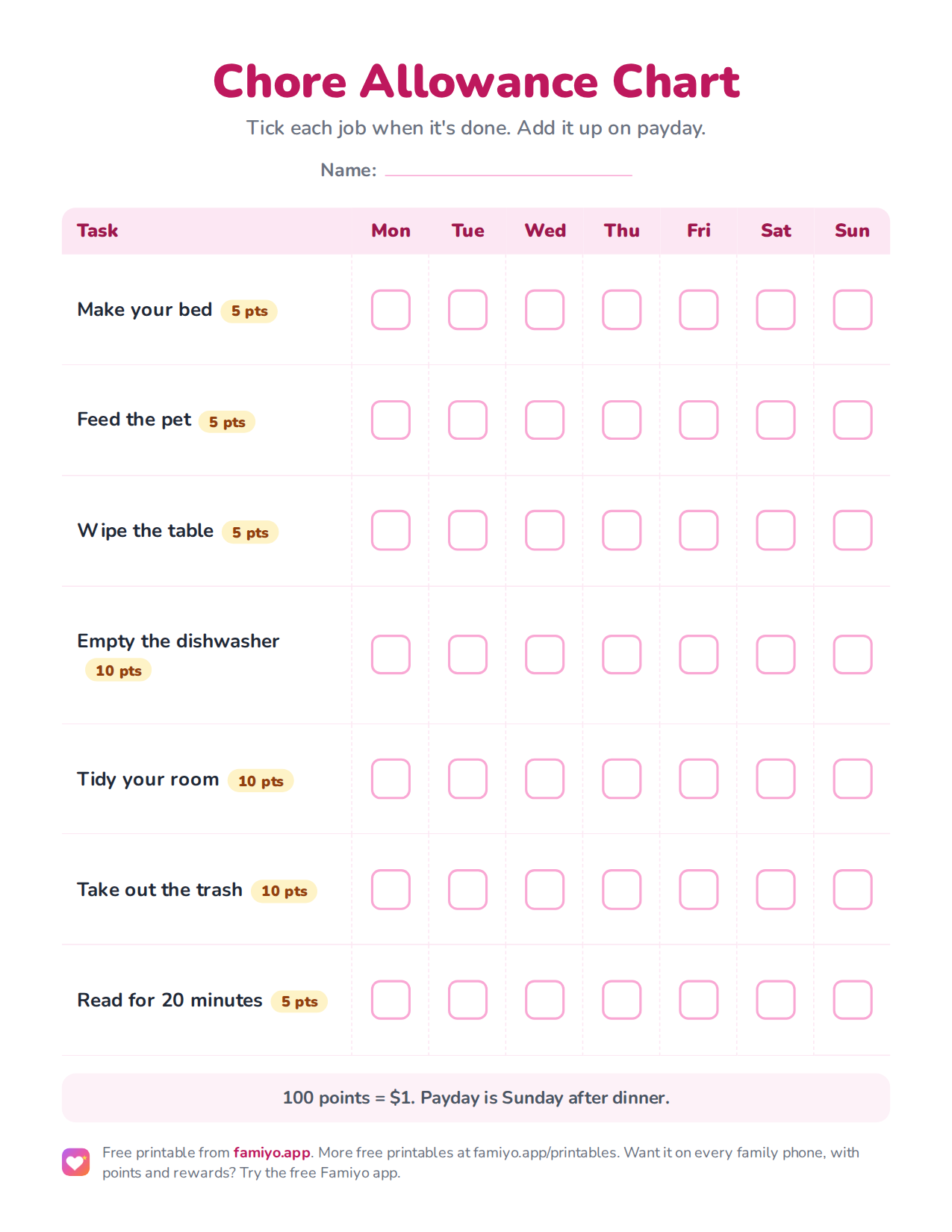
Free printable
Chore Allowance Chart
A weekly chart on one US Letter page. Download the PDF to print it, or save the image to use it on a tablet or in a document.
Free for home, classroom and nonprofit use, see the license. More free printables.
Most allowance charts fail at the same spot: the chores get tracked, but nobody tracks the money. By Sunday there's an argument about whether Tuesday counted and nobody remembers what was owed last week. This page shows a chart that records both sides, a worked example with real numbers, and a short payday routine that takes about ten minutes.
What goes on a chore allowance chart
A useful chart has five parts. Skip one and you'll feel the gap within a week or two.
| Part | What it does | Example |
|---|---|---|
| Chore list | The jobs on offer this week | Empty the dishwasher |
| Value | What each job earns | 10 points |
| Day boxes | Where your child ticks the job | Mon to Sun |
| Weekly total | The sum of all ticked jobs | 240 points |
| Payday line | The converted amount and the date it was paid | $2.40, paid Sunday |
Notice that the value column uses points, not dollars. Points are easier to adjust (a chore that turns out to be harder can go from 10 to 15) and they make the same chart work for rewards that aren't cash. If you want money at the end, the conversion in this guide is 100 points to $1.
Decide what the chart pays for
Before you print anything, split your child's jobs into two groups.
The first group is family-member chores: making the bed, putting dirty clothes in the hamper, clearing their own plate. Everybody in the house does these, and they don't earn cash. You can still list them on the chart so your child sees the full week, but give them no value, or a small one if you pay a base allowance.
The second group is extras. Washing the car, raking leaves, sorting the recycling, vacuuming the stairs. These earn the money. The typical range is $0.25 to $1 for a small extra job and $2 to $5 for a big one.
If you want help choosing an amount, our guides on how much to pay a 9-year-old for chores and how much allowance for a 7-year-old go through typical ranges and how to decide.
A sample week with the math
Say your 7-year-old has seven jobs on the chart. Small jobs (a few minutes) are worth 5 points, medium jobs (10 to 15 minutes) are worth 10.
| Chore | Points | Days done | Points earned |
|---|---|---|---|
| Make your bed | 5 | 6 | 30 |
| Feed the pet | 5 | 7 | 35 |
| Wipe the table | 5 | 5 | 25 |
| Empty the dishwasher | 10 | 4 | 40 |
| Tidy your room | 10 | 5 | 50 |
| Take out the trash | 10 | 3 | 30 |
| Read for 20 minutes | 5 | 6 | 30 |
| Week total | 240 |
At 100 points to $1, that's $2.40. A perfect week would be 350 points, or $3.50. That sits comfortably inside the usual $3 to $7 weekly range for ages 5 to 7, and your child can see exactly where the missing $1.10 went.
Want a second set of numbers for an older child? Add a weekly big job at 20 points, such as vacuuming a room, and the ceiling moves up without changing the chart's shape.
The Sunday payday routine
The chart only works if payday is boring and predictable. Here's a routine that takes ten minutes.
- Sit down together with the chart, a pen and the cash or the note you'll write.
- Let your child add up each row. Check the math with them, don't do it for them.
- Write the total at the bottom: "240 points = $2.40".
- Hand over the money, or write it on a small ledger card with the date.
- Ask one question: "What do you want to do with it?" Spend, save or give are all fine answers. If you use the 50, 40, 10 split for younger kids, this is the moment to divide it.
- Start a fresh chart for next week.
A ledger card is nothing fancy: date, amount earned, amount spent, balance. If you'd rather keep it in a spreadsheet, our allowance tracker template has one ready.
What to say when the chart gets messy
It will. A few lines that work.
- When a chore is half done: "That job counts when it's finished. You've got until Saturday night to fix it."
- When your child asks for more: "That's a new job. Let's work out what it's worth and add it to next week's chart."
- When a week is empty: "Looks like a $0 week. It happens. Fresh chart tomorrow."
Resist the urge to deduct points as punishment for bad behavior. The chart tracks work done. Mixing in penalties turns payday into a courtroom.
Running the chart in Famiyo
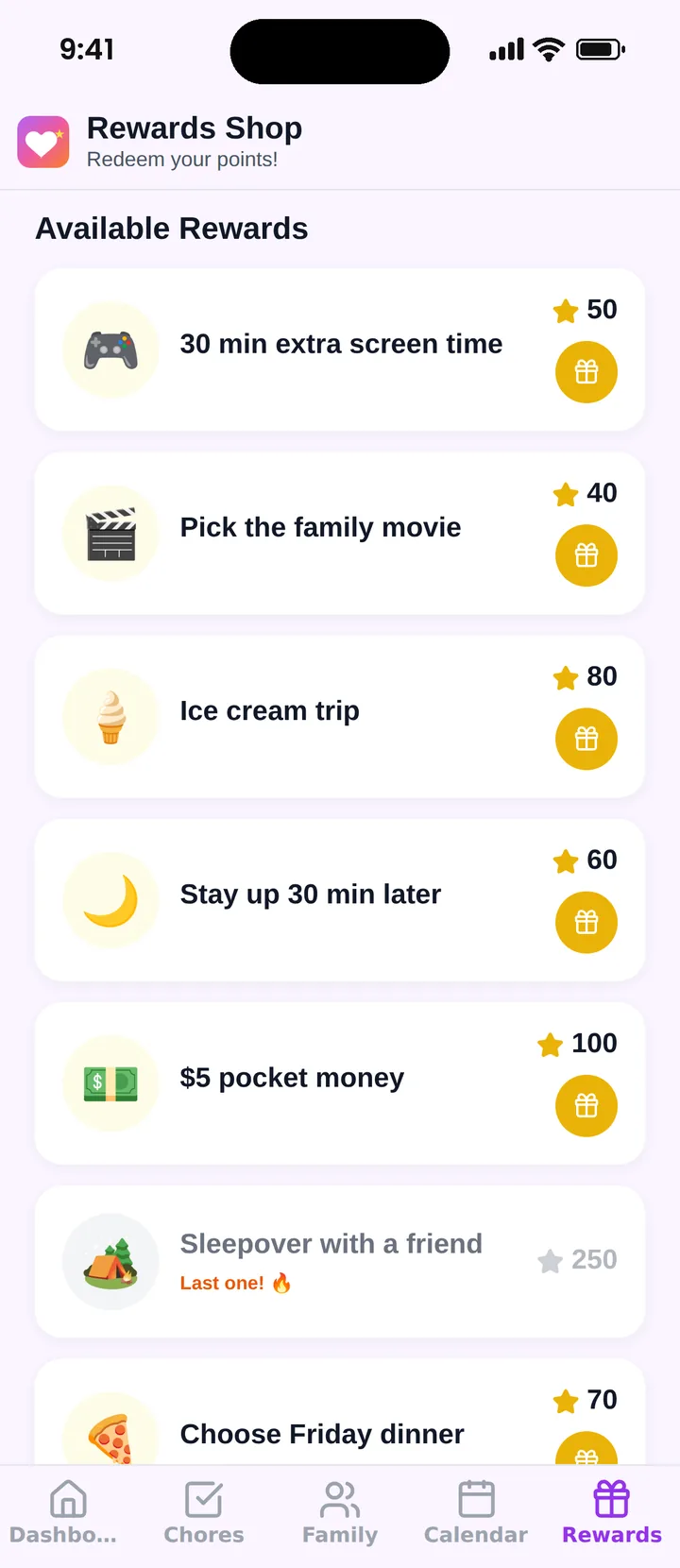
Famiyo is a free family app for iPhone and Android that combines a shared family calendar, chores with points and a rewards shop; kids join with a code, no email needed. You can keep this exact chart in it. Add each chore with its points, set it to repeat, and your child checks it off on their own phone (or you approve it, your choice). Points add up automatically, so there's no Sunday arithmetic. Then create a "pocket money" reward in the rewards shop, priced at 100 points for $1, and your child redeems it when they want cash. The money itself still changes hands outside the app. See our list of the best allowance apps for kids if you want to compare options.
Where to start this week
Print the chart above, write the three extras you'd actually pay for at the top, and agree on the payday day with your child tonight. Run it for three weeks before you change anything.
Frequently asked questions
What is a chore allowance chart?
It is a weekly chart that lists chores, the days of the week and what each chore is worth. Your child ticks off finished jobs, and on payday you add up the values to see how much pocket money they earned.
Should the chart pay for every chore?
No. Keep everyday family chores, like making the bed or clearing the table, unpaid or covered by a small base allowance. Use the chart's money column for extra jobs, which typically pay $0.25 to $1 for a small task and $2 to $5 for a big one.
How do I handle chores that were only half done?
Decide the rule before the week starts. A simple option is that a chore either counts or it doesn't, and your child can redo it before payday to earn the value. That avoids arguing over partial credit every Sunday.
How often should I pay out from the chart?
Weekly works best for most kids under 12, because a month is too far away to connect effort and reward. Pick one fixed day, such as Sunday evening, and do it the same way every time.
Try Famiyo With Your Family
Chores with points, a rewards shop for kids and one shared family calendar. Set it up in a couple of minutes.



Free to download • No credit card required • Available on iOS & Android