Kids Responsibility List: What to Include and How to Use It
A kids responsibility list by area of life: self-care, room, kitchen, pets, school and money, with ideas for a responsibility chart that kids actually follow.
By Famiyo Editorial Team5 min read
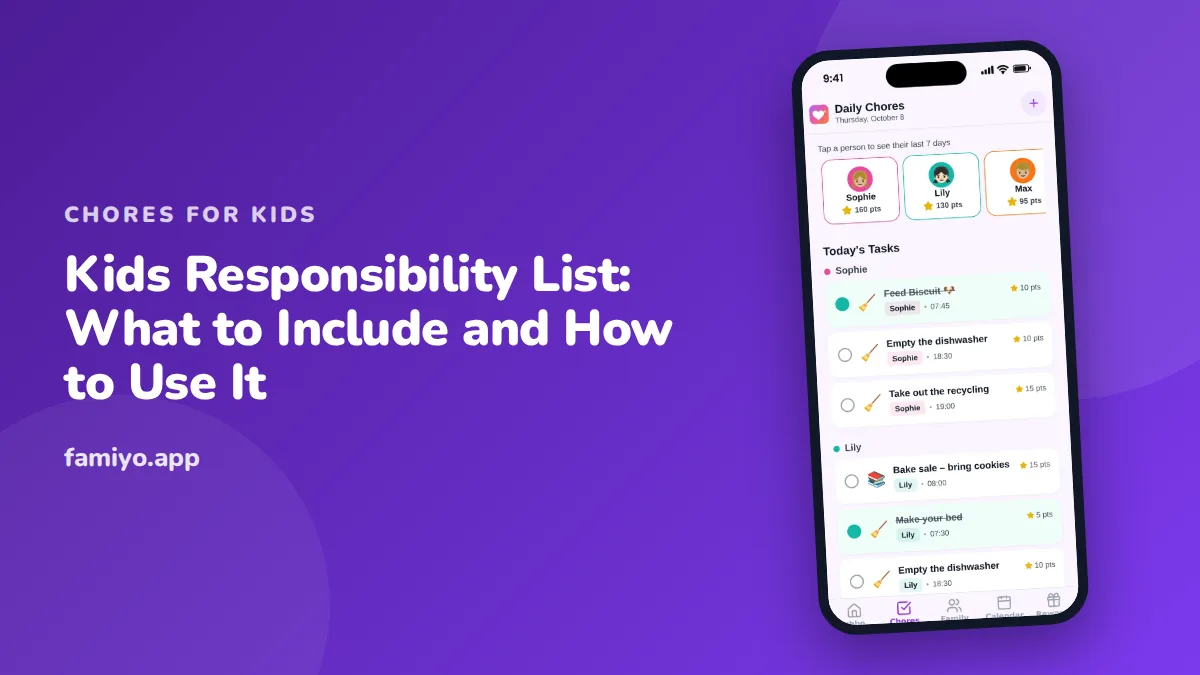
Chore charts tend to answer one question: what needs cleaning? A responsibility list asks something bigger: what is this child in charge of? That includes taking care of their body, their stuff, their space, their school work and the people and animals around them. Below is a list organized by area, with ideas for each age, plus a way to turn it into a chart that holds up on a regular Tuesday.
How to build the list in four steps
- Pick the areas. Self-care, room and belongings, household, pets, school, money. You do not need all of them at once.
- Choose two or three items per area for your child's age. Fewer is better. Write each as an action you could photograph: "Hang up the towel," not "Be tidy."
- Mark each item as daily, weekly or occasional.
- Decide which items earn something and which are simply expected. Brushing teeth is not a points job. Washing the car might be.
A quick guide to how much fits on a list: 2 to 3 daily tasks for preschoolers, 3 to 4 for school-age kids, and one weekly "big" job from about age 8.
Responsibilities by area
Looking after themselves
| Age | Examples |
|---|---|
| 3 to 5 | Brush teeth with help, put on shoes, choose clothes from two options, wash hands before meals |
| 6 to 8 | Get dressed without help, pack the school bag, brush and floss, put dirty clothes in the hamper |
| 9 to 12 | Run their own morning routine, shower and hair care, lay out clothes the night before, set an alarm |
| 13 and up | Manage sleep and bedtime, handle laundry start to finish, keep track of appointments |
Their room and belongings
- Put toys and books back where they live (ages 2 to 5)
- Make the bed, roughly (ages 4 and up)
- Tidy the room before the weekend (ages 6 and up)
- Take care of electronics, charge them and keep them in a set spot (ages 8 and up)
- Change bed sheets (ages 10 and up)
Helping the household
- Set and clear their own place at the table (ages 4 and up)
- Empty unbreakable dishes from the dishwasher (ages 6 and up)
- Sweep a floor, wipe the table (ages 6 and up)
- Load the dishwasher, take out the trash, fold laundry (ages 8 and up)
- Clean the bathroom sink and toilet, cook a simple meal with an adult nearby (ages 10 to 12)
- Cook a family meal, shop from a list, mow the lawn (ages 13 and up)
Caring for pets and plants
- Help feed a pet or water plants (ages 4 and up)
- Fresh water and food every day, on their own (ages 7 and up)
- Walk the dog, clean the cage or litter box (ages 9 and up)
School and learning
- Put the school bag by the door (ages 5 and up)
- Start homework at the agreed time (ages 6 and up)
- Check the planner or calendar for tomorrow (ages 9 and up)
- Talk to the teacher about a problem first (ages 11 and up)
Money and giving
- Put coins in a spend, save and give jar (ages 5 to 8)
- Track a savings goal (ages 8 and up)
- Plan a small purchase, compare prices (ages 10 and up)
- Manage a monthly budget for something, such as clothes (ages 13 and up)
Being kind to others
- Greet people, say please and thank you (all ages)
- Help a younger sibling with a small job (ages 7 and up)
- Write a thank-you note or message (ages 7 and up)
- Look after a grandparent or neighbor with a task (ages 10 and up)
Daily, weekly and occasional
A list is easier to use when each item has a rhythm. Here is one way to split things for an 8-year-old:
| Rhythm | Responsibilities |
|---|---|
| Every day | Get dressed and pack the bag, make the bed, feed the cat, clear their plate |
| Twice a week | Take out the trash, put away laundry |
| Once a week | Tidy the room, help with one bigger job, such as vacuuming the living room |
| As needed | Charge the tablet, update the homework planner |
This is about 20 to 30 minutes a day for an 8-year-old, which fits the usual range for that age.
Turning the list into a responsibility chart
A list on a notepad is a good start. A chart makes it visible. Three formats work for most families:
- A weekly grid with tasks down the side and days across the top.
- A picture strip for young children, one image per step.
- A checklist with morning, after-school and evening sections.
For layout ideas you have not tried, see our page of chore chart ideas for kids. If you want rewards built in, how to make a kids reward chart walks through it, and the master chore list for kids has more jobs to draw from. If you have more than one child, a chore list for multiple kids shows how to split the load.
Print it and put it where the action happens: the fridge, the child's door, the mudroom. Review it with your child once a week for five minutes. Ask what is working and what is annoying. Their answer will usually point to the one thing to change.
Letting an app replace the chart
Paper charts fail in predictable ways: someone forgets to tick, a parent is away, siblings argue about what counts. If that sounds familiar, a phone can hold the whole list.
Famiyo is a free family app for iPhone and Android that combines a shared family calendar, chores with points and a rewards shop; kids join with a code, no email needed. You enter each responsibility once and set it to repeat daily, weekly or every few days. Each task can carry points, and each child can have a different number of points for the same task. Kids get push notifications about new tasks and check them off on their own phone, or you approve them. Every phone updates live, so the today view always shows who has done what.
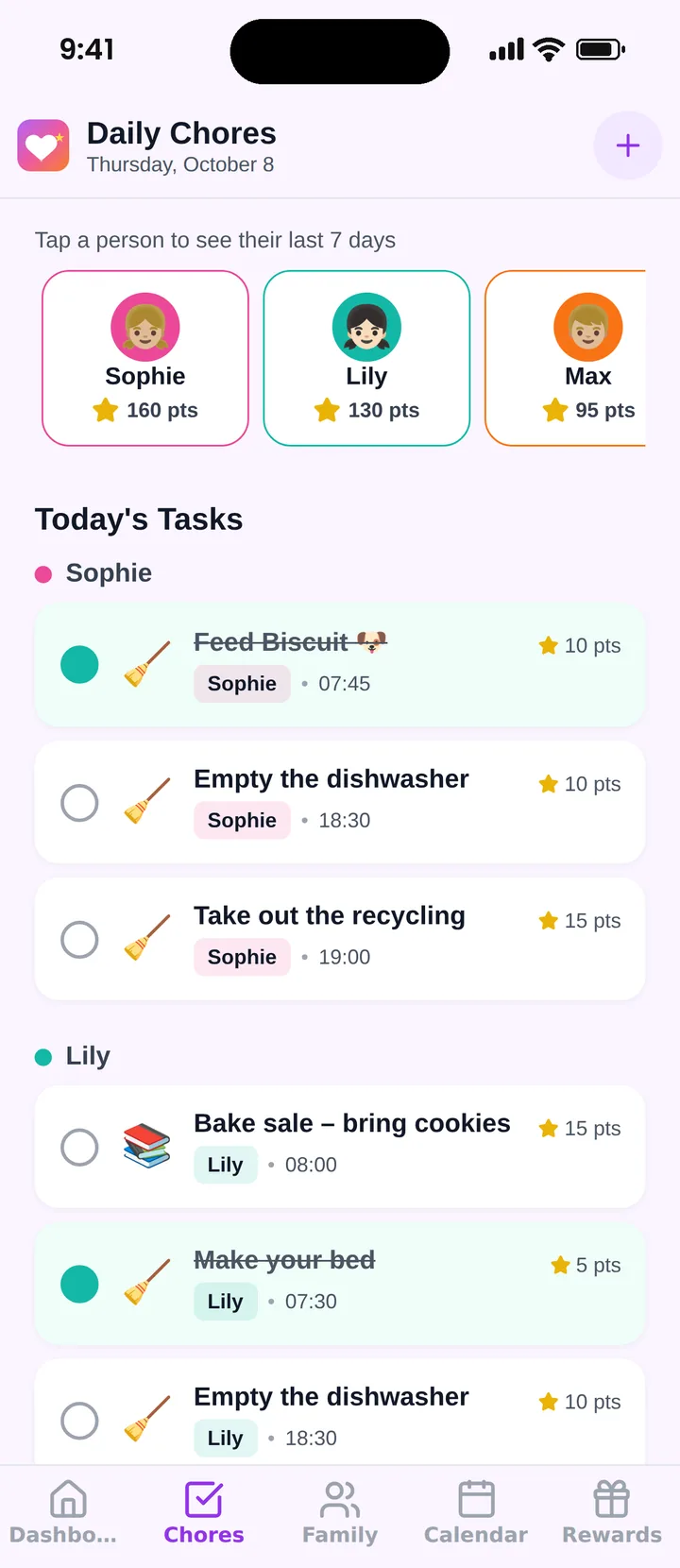
If you are comparing options, see our list of the best chore chart apps. The free plan covers up to 3 family members and 1 repeating task.
This week, pick one area from the list above and write down just two items. Run them for two or three weeks before you add anything else.
Frequently asked questions
What is the difference between a chore list and a responsibility list?
A chore list covers household jobs. A responsibility list is wider and includes self-care, schoolwork, looking after belongings and caring for others. Chores are one part of it, and the whole list shows a child what they own.
How many responsibilities should a child have?
Start with 2 to 3 daily tasks for preschoolers and 3 to 4 for school-age kids, then add a weekly bigger job from about age 8. More than that tends to overwhelm kids and parents, and the list quietly stops being used.
Should a responsibility chart include rewards?
It can. Many families attach small points to tasks and let kids trade them for rewards, while keeping basic self-care and family chores as expected. Decide which items are just part of life and which earn something.
How often should I update the responsibility list?
Every few months, and at natural change points like a birthday, a new school year or a new pet. Retire what is now automatic, add one new item, and keep the total manageable.
At what age should a child have a responsibility list?
As soon as they can follow a simple routine, around age 3. At that age it is two or three picture-based tasks. The list then grows with the child, adding self-care, schoolwork and money responsibilities as they get older.
Try Famiyo With Your Family
Chores with points, a rewards shop for kids and one shared family calendar. Set it up in a couple of minutes.



Free to download • No credit card required • Available on iOS & Android