How to Teach Kids About Money: A Parent's Guide by Age
What to teach kids about money at each age, how to make tap-to-pay and in-app spending visible, and the words to use when they ask to buy something.
By Famiyo Editorial Team6 min read
Your kid sees you tap a phone at the checkout and walk out with groceries. From where they stand, money is a beep. Teaching kids about money now means making something invisible visible again, then handing them real decisions with small amounts while the stakes are low. This guide covers what to teach at each age, how to handle cards, apps and in-app purchases, and what to say when the "can I have it?" questions start.
Why money is harder for kids to understand now
When parents paid with cash, kids watched bills leave a wallet and change come back. The wallet got thinner. That was a lesson on its own.
Tap-to-pay, saved cards in online stores and subscriptions that renew in the background remove all of that. A child can easily grow up thinking the phone is the money, or that the card "has money in it" forever. Add games that sell coins and gems for real dollars, and kids meet spending decisions much earlier than they meet the idea of a limit.
None of this means you need to go back to cash. It means you have to say out loud what used to be obvious, and give kids a balance they can watch go up and down.
What to teach kids about money at each age
Kids pick up money ideas in roughly this order: money buys things, you have to choose, you can wait for something better, you can plan, and money can grow or shrink over time. The table matches each stage to an activity and to words you can actually use.
| Age | Main idea | Try this | What to say |
|---|---|---|---|
| 3 to 5 | Money is swapped for things, and sometimes we wait | Play shop with real coins, let them pay the cashier, use a clear jar for savings | "We have enough for one treat today. Which one do you want?" |
| 6 to 8 | You get a set amount and you choose | Weekly allowance split into spend, save and give jars or columns | "This is your money for the week. When it's gone, it's gone until Saturday." |
| 9 to 12 | Plan ahead and compare | Save for a $30 to $60 goal, compare prices online, track spending for a month | "That costs 6 weeks of allowance. Is it worth 6 weeks?" |
| 13 to 15 | Money in apps and accounts | Look at a bank statement together, discuss subscriptions and in-game purchases, give a monthly budget for one category | "This renews every month. Over a year, what does it cost?" |
| 16 to 17 | Earning, taxes and bigger choices | First paycheck, a savings account, a clothing or phone budget they manage | "Your pay was $120 but $109 landed in your account. Let's find out why." |
The ages are a guide, not a test. A careful 7-year-old may be ready for a savings goal, and a 12-year-old who has never handled money might need to start with the jars.
Make digital money visible
This is the part most money advice skips, and it's where kids today get confused. A few habits help a lot.
- Narrate card payments. At the store, say it: "I'm paying $64 for groceries with my card. That comes out of our bank account right now." It feels silly the first few times. Kids remember it.
- Show them the other side. After an online order, open your banking app and show the line where the money left. For a child, that screen is the empty wallet.
- Keep a balance they can see. A written ledger on the fridge, a spreadsheet for older kids or a points balance in an app. What matters is that the number goes down when they spend.
- Translate prices into something they know. "That game skin costs $10. That's more than one week of your allowance."
- Lock in-app purchases. On every phone and tablet, turn on the setting that requires a parent password for purchases. Then explain why: "Games are designed to make buying easy. We decide together."
- Do a subscription check with a teen. Pull up the family's streaming and app subscriptions once a year. Teens are often surprised how small monthly charges add up, and some will happily help you cancel one.
For kids under 8, real coins still help. Some families keep a small amount of cash for allowance just so younger kids can hold it, count it and feel the jar get heavier.
Let them earn, spend and get it wrong
Kids don't learn money from talks. They learn it from having some and running out.
A regular allowance is the simplest tool. A common rule of thumb is $1 per week for each year of age, so a 6-year-old gets about $6. It's a starting point, not a standard, and the exact number matters less than paying it on the same day every week. For younger kids, a simple split works: 50% to spend, 40% to save and 10% to give.
Many families keep everyday chores unpaid, since everyone who lives in the house helps, and pay a little extra for bigger jobs: $0.25 to $1 for a small extra task, $2 to $5 for a big one. Older kids who want more can take on real paid work, and our guide to chores for teenagers to earn money has fair rates for bigger jobs.
Then comes the hard part for parents: letting them spend it badly. Say your 8-year-old spends all $8 on a toy that's broken by Tuesday. Don't top them up. Don't say "I told you so." Later, ask one question: "Would you buy that again?" That conversation is worth more than any savings chart.
Waiting is the other half. Saving for something that costs three or four weeks of allowance teaches patience in a way kids feel in their stomach. If you want to know why this matters so much, our article on delayed gratification for kids explains it.
What to say when kids ask money questions
Kids ask blunt questions. Short, honest answers work better than big speeches or dodging.
"Are we rich?" Try: "We have enough for what we need and some things we want. We still have to choose." You don't have to share your salary to be honest.
"Why can't I have it? You have a card." Try: "The card uses money from our bank account. When it's spent, it's spent, just like your jar."
"Everyone else has one." Try: "Maybe. Our family spends money on other things. If you really want it, let's figure out how long you'd need to save."
"Can I buy gems in my game?" Try: "You can use your own money if you want. Tell me how much, and let's check how many weeks of allowance that is first."
"How much do you make?" Many parents prefer a range or a comparison to an exact figure for younger kids. With teens, being more open about real numbers, like rent, groceries and the electric bill, tends to make budgets feel real.
Common mistakes that slow kids down
A few patterns make money lessons harder than they need to be:
- Rescuing them. If you always cover the shortfall, the allowance stops being a limit.
- Paying for every task. When making the bed earns money, some kids start asking "what do I get?" for everything. Our piece on intrinsic motivation in kids covers how to keep helping from turning into a transaction.
- Keeping money secret. Kids who never hear money discussed at home tend to learn about it later and from worse sources.
- Starting with investing. Compound interest is a great topic for a 12-year-old who already saves. For a 6-year-old, the jar comes first.
- Inconsistent pay. An allowance that arrives "when we remember" teaches that money is random.
Practicing with points in Famiyo
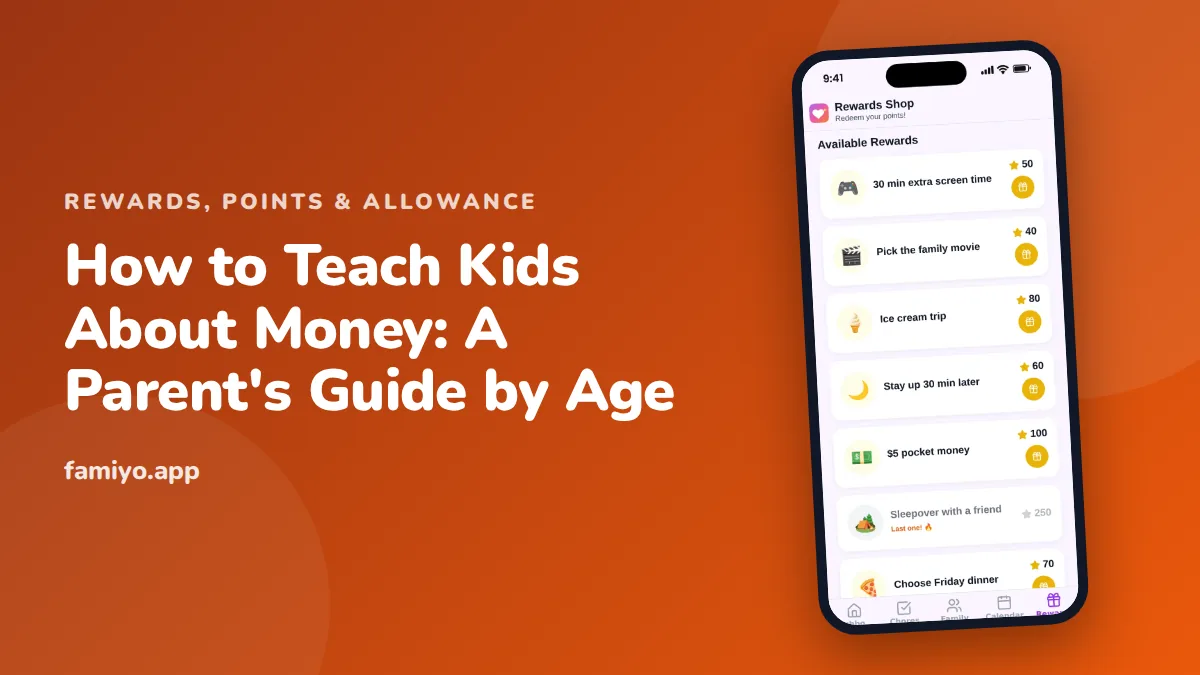
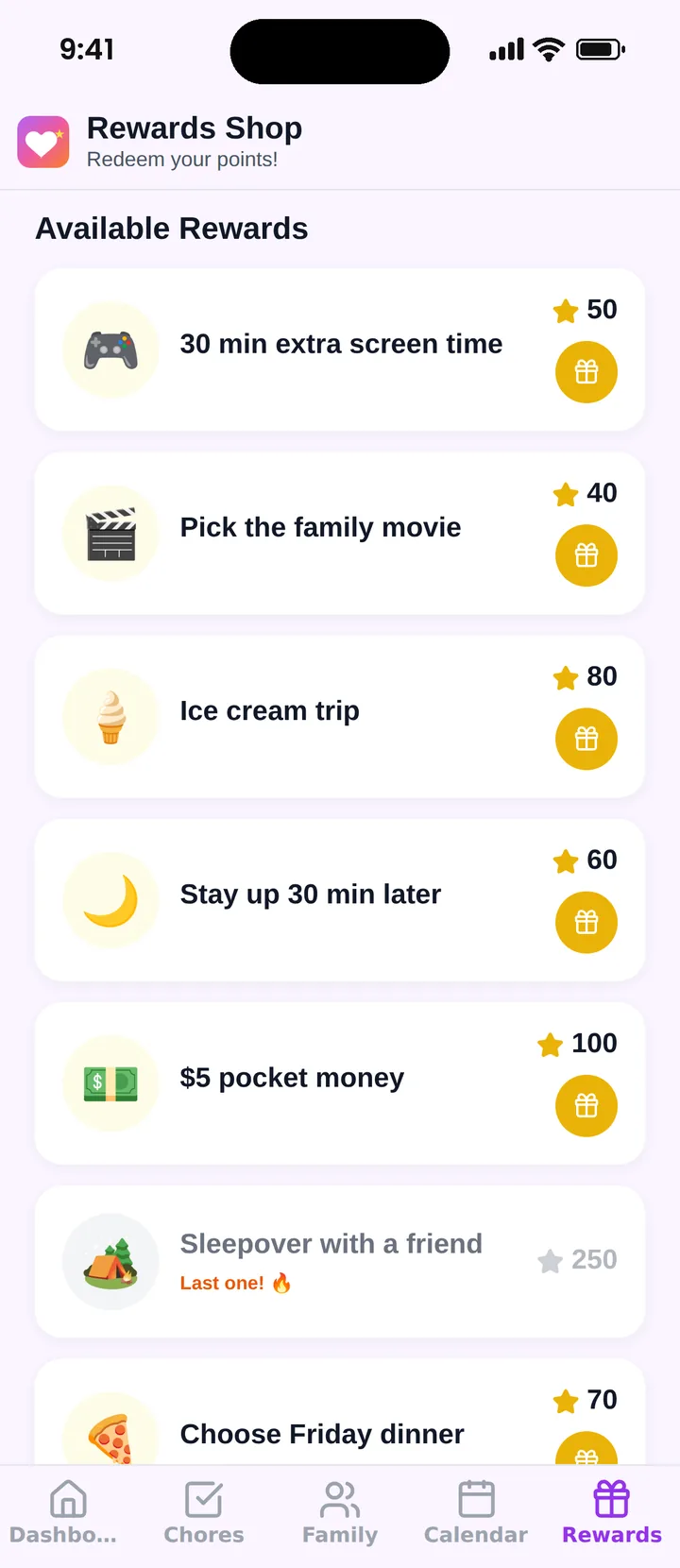
Famiyo is a free family app for iPhone and Android that combines a shared family calendar, chores with points and a rewards shop; kids join with a code, no email needed. For money lessons, the points work as a practice currency. Kids earn points for chores, and you fill the rewards shop with things that have a price in points, from 15 extra minutes of screen time to pocket money. If you want a fixed exchange rate, 100 points for $1 is simple to explain. When a child redeems a reward on their own phone, the app shows how many points they will have left, which is the "wallet getting thinner" moment kids rarely see with cards. The money itself changes hands outside the app. For tools that do hold real money, see our list of the best allowance apps for kids.
Start this week with one habit: the next time you tap your card, say the amount out loud and tell your kid where the money came from.
Frequently asked questions
What age should you start teaching kids about money?
You can start around age 3 with simple ideas: money is swapped for things, and sometimes we wait. Counting coins, playing shop and letting a preschooler hand over cash at the store all count. Regular money of their own, like a small allowance, usually makes sense from around 5 or 6.
How do I teach kids about money when we hardly use cash?
Narrate your card and phone payments out loud, show your child the purchase in your banking app afterward and give them a way to track their own money, such as a written ledger or a points balance. Some families also keep a small amount of cash for kids so they can feel the difference.
Should kids learn about money by making mistakes?
Yes, small ones. A 7-year-old who spends a week's allowance on a toy that breaks the next day learns more than any lecture could give them. Keep the amounts small, don't rescue them with extra money and talk about it calmly later: what would you do differently next time?
How much allowance should I give to teach money skills?
A common starting point is $1 per week for each year of age, so a 7-year-old would get about $7. Typical ranges are $3 to $7 a week for ages 5 to 7 and $7 to $10 for ages 8 to 10. The amount matters less than paying it on time every week.
Try Famiyo With Your Family
Chores with points, a rewards shop for kids and one shared family calendar. Set it up in a couple of minutes.



Free to download • No credit card required • Available on iOS & Android