How Much to Pay a 9-Year-Old for Chores
Pay a 9-year-old $0.50 to $1 for small extra jobs and $2 to $5 for big ones, and keep basic chores unpaid. Sample rates, a sample week and how to track it.
By Famiyo Editorial Team3 min read
Nine is when many kids start to want real money, and when they can do jobs that are actually worth paying for. The tricky part is deciding which jobs get paid and which are just part of living in the house. Here are the rates, a sample week and the rules that keep it from getting out of hand.
What is a fair rate for a 9-year-old?
There is no standard rate, but typical amounts for kids this age are $0.25 to $1 for a small extra job and $2 to $5 for a big one. Typical weekly allowance for ages 8 to 10 is $7 to $10, so a few paid extras on top of a base allowance is plenty.
| Job | Time | Typical pay |
|---|---|---|
| Wipe the kitchen counters and table after dinner, extra | 5 minutes | $0.25 to $0.50 |
| Sort and fold a basket of laundry | 15 minutes | $1 |
| Vacuum one room | 15 minutes | $1 |
| Wash the family car (outside) | 30 minutes | $3 to $5 |
| Clean the bathroom sink and toilet | 30 minutes | $2 to $4 |
| Rake the yard or pull weeds | 30 to 45 minutes | $3 to $5 |
| Help a neighbor carry in groceries | 10 minutes | $1 |
If you are unsure, pay slightly less than you think. You can always raise a rate, and it is much harder to lower one.
Which chores should stay unpaid?
Most 9-year-olds can handle 20 to 30 minutes of household work a day without pay. This is the "family member" tier, and it covers things such as:
- Making the bed and keeping their room tidy
- Loading the dishwasher after dinner
- Taking out the trash on trash day
- Putting their own laundry away
- Feeding the pet
Paying for those teaches that helping at home is optional, unless money is on offer. A simple line to say: "We all help because we all live here. Extra jobs are how you earn money."
What does a sample week look like?
Say your 9-year-old does the unpaid basics every day, plus a few extras. A realistic week might look like this.
- Monday: fold a basket of laundry, $1
- Wednesday: vacuum the living room, $1
- Friday: wipe counters and table after dinner, $0.50
- Saturday: wash the car, $4
- Sunday: rake the front yard, $3
Total: $9.50. If you also give a base allowance of $5, the weekly total reaches $14.50. That may be more than you want to hand over. Many parents either skip the base allowance or cap the extras at one or two jobs a week.
Pay by the job or by the hour?
For this age, pay by the job. An hourly rate rewards slow work, and a 9-year-old has no sense of what an hour of work is worth. A flat price per job, agreed before it starts, keeps things simple and gives them a reason to do it well.
Write down what done means. "Wash the car" is vague. "Wash the outside, rinse it off and dry the windows" is a clear job with a clear price.
What if they spend it all right away?
Let them, at least some of the time. A 9-year-old who spends $8 on cards and has nothing left for a $20 game is learning how money works. A split helps: spend 50%, save 40%, give 10%. On a $10 week that is $5, $4 and $1. If you want a younger-age comparison, our guide to how much allowance a 7-year-old gets shows how the amounts grow.
For tracking, a chore allowance chart can show what has been earned and what has been paid.
Tracking pay with points in Famiyo
Famiyo is a free family app for iPhone and Android that combines a shared family calendar, chores with points and a rewards shop; kids join with a code, no email needed. For a 9-year-old you can give each extra job a point value, using the conversion of 100 points to $1, so a $4 car wash is worth 400 points.
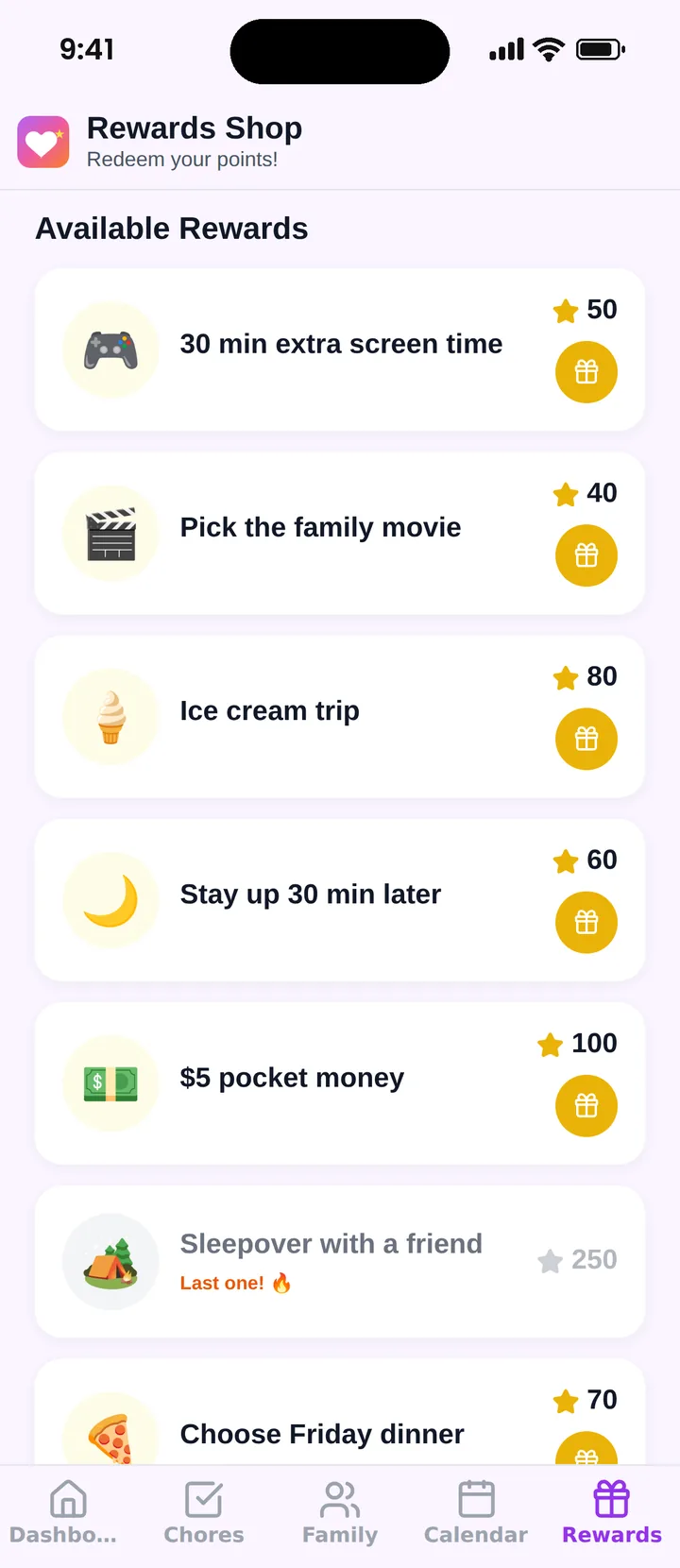
Add "pocket money" as a reward in the rewards shop with a price in points, and your child redeems it from their own phone when they have enough. The app does not hold or send money, so you pay the cash yourself. See our list of the best allowance apps for kids to compare tools.
Start with three jobs
Pick three extra jobs and a price for each, write them on a page and show your child on the weekend. Run it for a month. If your child never does the extras, the prices may be too low or the jobs too dull, so ask what they would rather do.
Frequently asked questions
How much should a 9-year-old get paid per chore?
Usually $0.25 to $1 for a small extra job and $2 to $5 for a big one. Pick rates that match the time and effort, and keep them the same from week to week so your child can plan.
What chores can a 9-year-old do for money?
Washing the car, raking leaves, vacuuming a whole floor, cleaning a bathroom, weeding a garden bed or helping a neighbor. Everyday jobs like making the bed or clearing their plate should stay unpaid.
Should a 9-year-old get an allowance and be paid for chores?
You can do both. Many families give a small steady allowance for money practice and pay extra for bigger jobs. Others pay only for extra jobs. The key is explaining the rule so your child knows what is expected.
What if my 9-year-old does the job badly?
Teach it first, then agree on what done looks like before the job starts. If the work falls short, ask them to fix it before you pay. Do not pay for half a job.
Try Famiyo With Your Family
Chores with points, a rewards shop for kids and one shared family calendar. Set it up in a couple of minutes.



Free to download • No credit card required • Available on iOS & Android